Area: Counting Squares
Two friends in Nairobi each have a bedroom floor to cover with a rug. Wanjiru's room is long and thin; Otieno's is short and wide. Who needs the bigger rug? Walking round the edge won't tell you. The question is not about the edge at all. It is about how much floor there is inside.
How much surface
The amount of flat surface a shape covers is called its area. A table top, a page, a football pitch and a country all have an area.
To measure a length, we lay a ruler along it and count centimetres. To measure an area, we need a unit that covers surface: a small square. We cover the shape with equal squares, with no gaps between them and no overlaps, and count how many we used.
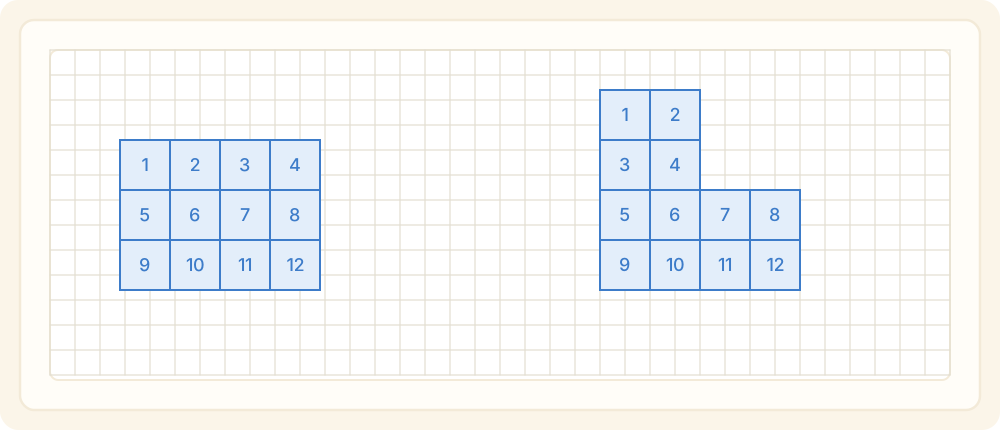
Both shapes in the picture are covered by 12 squares, so they have the same area, even though they look quite different. Area is about how much surface there is, not about the shape.
So for the two bedrooms, looking is not enough. Cover each floor with equal squares and count: whoever's floor takes more squares needs the bigger rug.
Square centimetres and square metres
People all over the world need to agree on how big the square is, just as they agree on the metre. So the units of area are built from the units of length:
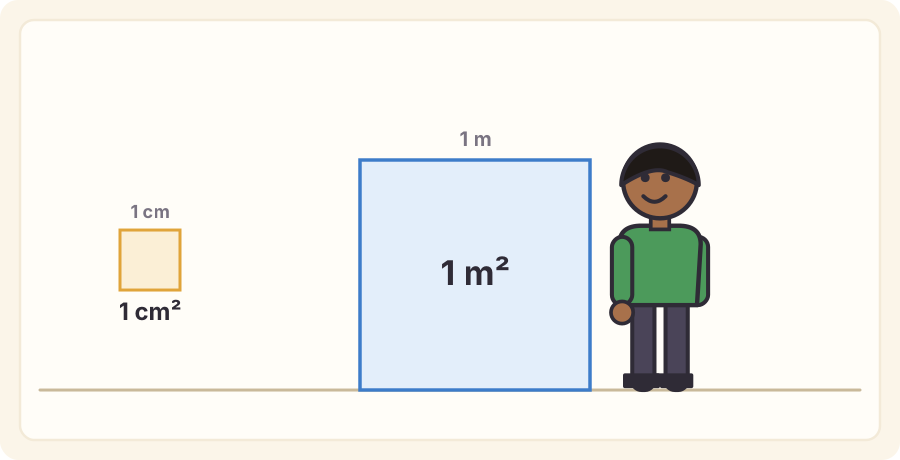
- A square centimetre is a square with sides 1 cm long. It is about the size of a fingernail. We write it cm².
- A square metre is a square with sides 1 m long, about as tall as a young child. A child can sit inside one with room to spare. We write it m².
The small ² is read "square": 12 cm² is "twelve square centimetres". Small things, like a stamp or a phone screen, are measured in cm². Rooms, gardens and flats are measured in m².
Area is not perimeter
The perimeter is the way round; the area is what is inside. They are measured in different units: perimeter in cm, area in cm². A long thin ribbon of squares has a big perimeter but a small area. Keep the two apart by asking: "Am I walking round it, or covering it?"
Try it at home
- Draw a shape on squared paper (or a page of a maths exercise book) by following the lines. Count the squares inside it.
- Cover a book with sticky notes or playing cards, edge to edge. How many does it take? That number is its area, measured in notes.
- Two shapes on squared paper: one covers 9 squares, the other is 2 squares wide and 5 squares long. Which has the bigger area?
Answers: 3. The second: 2 rows of 5 is 10 squares, more than 9.
Words to know
- area - how much flat surface a shape covers
- square centimetre (cm²) - the area of a square with sides 1 cm long
- square metre (m²) - the area of a square with sides 1 m long
Big idea
Area measures the surface inside a shape. Cover it with equal squares, no gaps and no overlaps, and count them. Shapes that look different can have the same area.