Circles
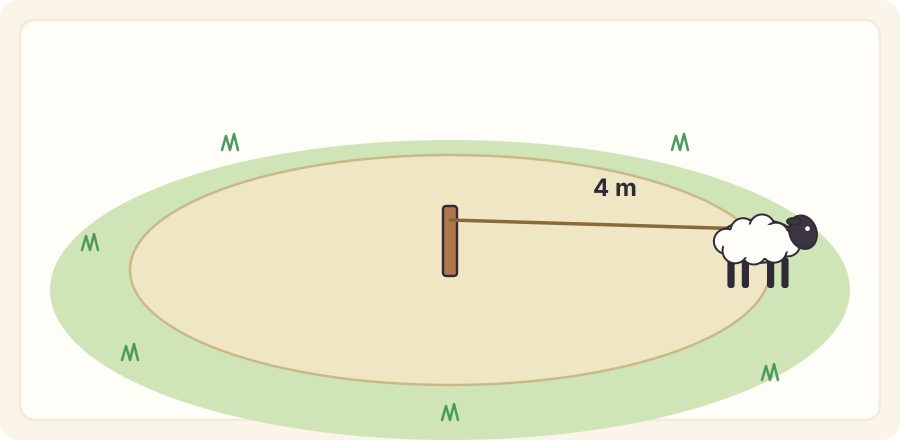
A farmer ties a sheep to a post with a rope 4 metres long. By evening the sheep has eaten a patch of grass around the post, and the rope has stopped it at 4 metres in every direction. What shape is the edge of the eaten patch?
The same distance, all the way round
Stand at the post and look out along the stretched rope. Wherever the sheep goes, the farthest it can reach is 4 metres away. Mark all those farthest places and you get a circle: a round curve made of every point that is the same distance from one point in the middle. That middle point is the centre.
You can draw one the same way: pin a string to a card, tie a pencil to the other end, keep the string tight and go once round. A compass (a drawing tool with two legs, one with a point, one with a pencil) does the same job.
A circle is not a polygon: it has no straight sides and no corners. It is one smooth curve.
Radius and diameter
A circle has a few parts with names:
- The radius is a line segment from the centre to the circle. The sheep's rope is a radius 4 metres long. Every radius of a circle has the same length.
- The diameter is a line segment from one side of the circle to the other, through the centre. It is made of two radii (the plural of radius) end to end, so it is twice as long: the sheep's patch is 4 + 4 = 8 metres across.
- The circumference is the length of the circle itself, the whole way round. It is the circle's perimeter.
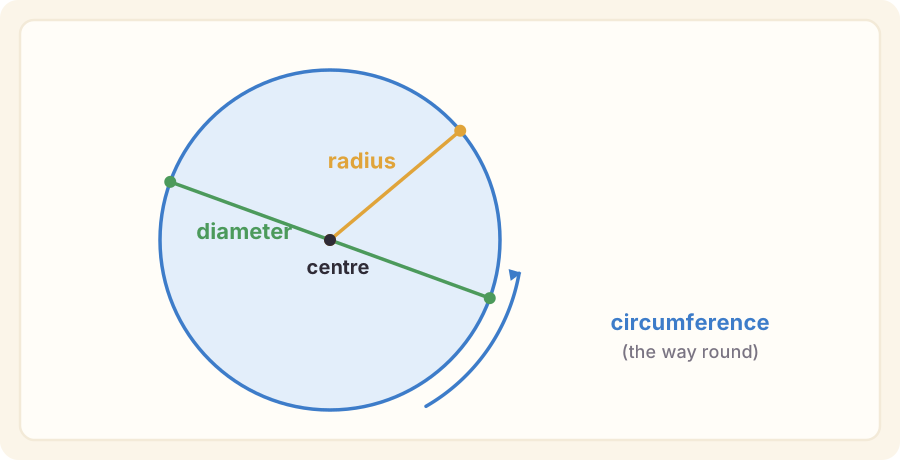
So if you know the radius, double it to get the diameter. If you know the diameter, halve it to get the radius. A plate 24 cm across has a radius of 24 ÷ 2 = 12 cm.
Why wheels are round
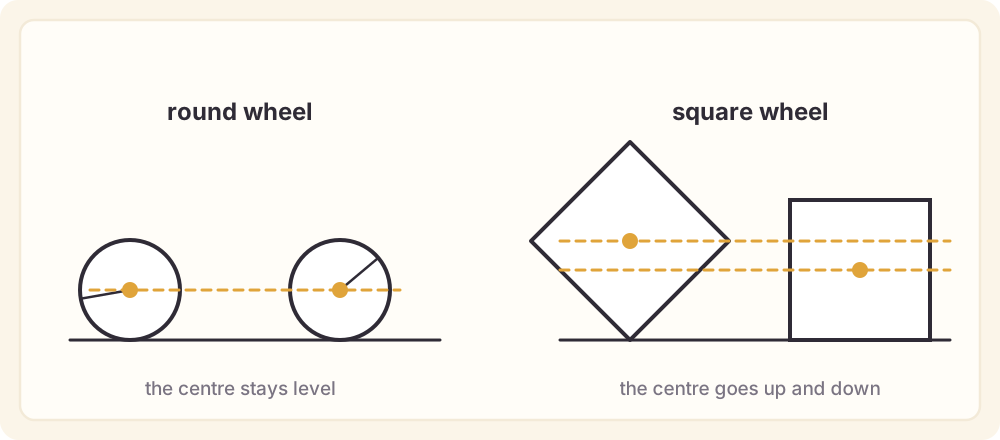
A wheel turns about its centre, where the axle (the rod the wheel turns on) goes through. As a round wheel rolls, the point touching the ground is always one radius below the centre. So the axle stays at the same height, and the cart rolls smoothly.
A square wheel's corners are further from its centre than the middles of its sides. So its axle goes up on a corner and down on a side, and the cart bumps at every quarter turn.
Try it at home
- Pin a string to a piece of cardboard and draw a circle with a pencil, as the farmer's sheep would. Measure the string: that is the radius.
- Draw a straight line across your circle through the pin hole. Measure it. Is it twice the string?
- A round table is 1 metre across. How far is its centre from its edge?
Answers: 2. Yes, the diameter is two radii. 3. Half a metre, 50 cm: that is the radius.
Words to know
- circle - a round curve made of every point at the same distance from one point, its centre
- centre - the point in the middle of a circle
- radius - a line segment from the centre to the circle (plural: radii)
- diameter - a line segment across the circle through the centre; two radii long
- circumference - the length all the way round a circle; its perimeter
- compass - a tool for drawing circles: one leg stays at the centre
Big idea
A circle is every point at the same distance from its centre. That distance is the radius, the diameter is twice it, and the way round is the circumference. Because every radius is equal, a round wheel keeps its axle level.