Four-Sided Shapes
A door, a page of this book, a floor tile, a kite flying on a windy beach, a slice of cake cut from a long tray. All of them have four sides. But they don't look the same. How do you tell these four-sided shapes apart, and how are they related?
The family of quadrilaterals
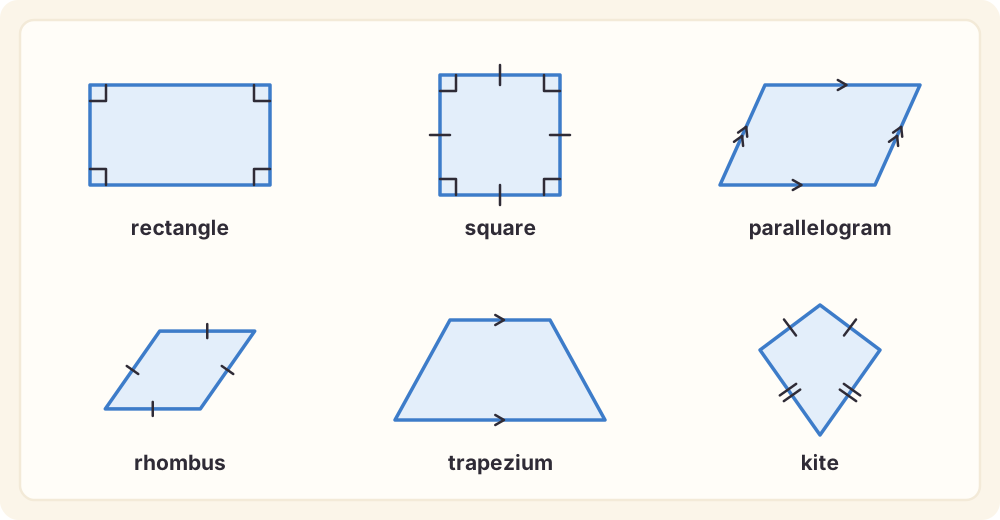
A polygon with four sides is a quadrilateral. Some quadrilaterals are special enough to have their own names. Each name says what is special about the sides or the angles:
- a rectangle has four right angles;
- a square has four right angles and four equal sides;
- a parallelogram has two pairs of parallel sides: the top and bottom are parallel, and so are the left and right;
- a rhombus has four equal sides (it looks like a pushed-over square);
- a trapezium has just one pair of parallel sides (in the United States it is called a trapezoid);
- a kite has two pairs of equal sides that sit next to each other, like the toy.
A square is a rectangle too
Is a square a rectangle? Read what a rectangle needs: four right angles. A square has four right angles, so yes, a square is a rectangle: a special one whose sides are all equal. In the same way, a square is a rhombus (four equal sides), and every rectangle and every rhombus is a parallelogram (both pairs of opposite sides are parallel).
So the shapes form a family tree. The higher a name is, the more shapes it covers; the lower, the more it demands.
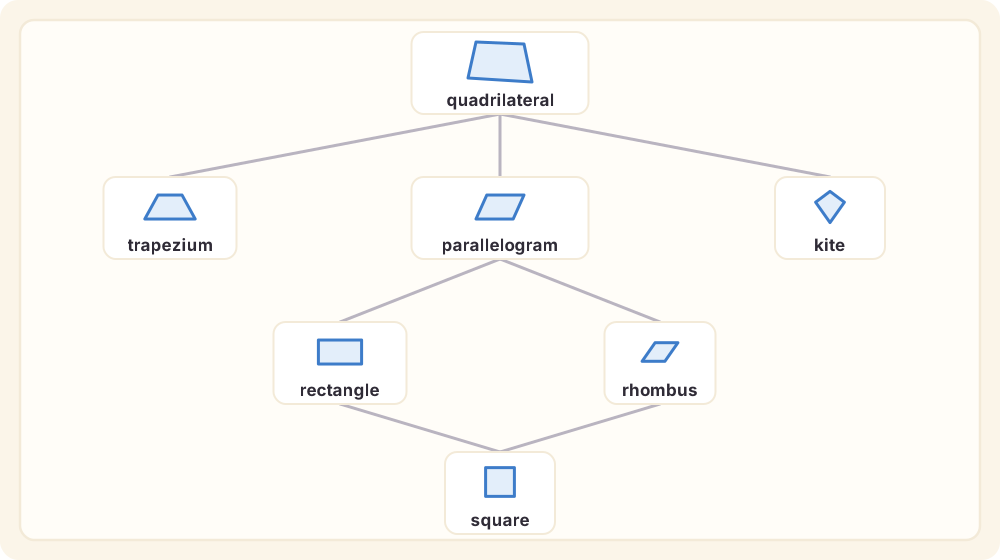
It works like the names of animals: every cat is an animal, but not every animal is a cat. Every square is a rectangle, but not every rectangle is a square.
Diagonals
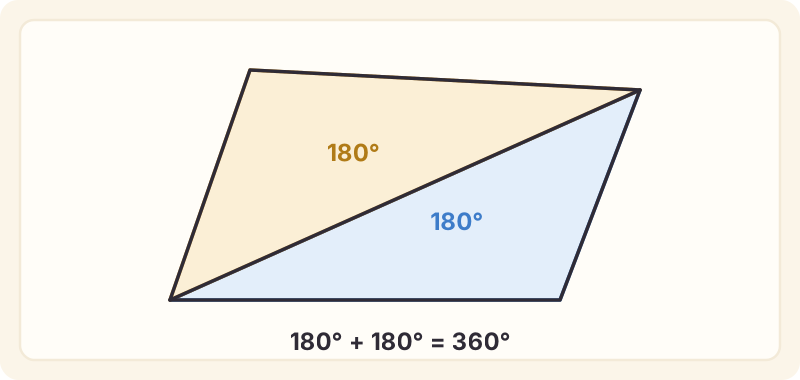
A line segment from one vertex to the opposite vertex is called a diagonal. Every quadrilateral has two of them. A diagonal cuts a quadrilateral into two triangles. In the last lesson we saw that the angles of each triangle add up to 180°. Together, the two triangles have exactly the angles of the quadrilateral, so the angles of every quadrilateral add up to 180° + 180° = 360°. A rectangle checks it: 4 × 90° = 360°.
Try it at home
- Find a rectangle, a square and, if you can, a trapezium in your home.
- Is every rectangle a square?
- Three angles of a quadrilateral are 90°, 90° and 100°. How big is the fourth?
Answers: 2. No: a rectangle's sides don't have to be equal. A square is a special rectangle. 3. 90° + 90° + 100° = 280°, and 360° - 280° = 80°.
Words to know
- quadrilateral - a polygon with four sides
- rectangle - four right angles; square - four right angles and four equal sides
- parallelogram - two pairs of parallel sides; rhombus - four equal sides
- trapezium - one pair of parallel sides; kite - two pairs of equal sides next to each other
- diagonal - a line segment joining two opposite vertices
Big idea
Quadrilaterals form a family, each name saying what is special about the sides or angles. A square is a rectangle and a rhombus at the same time. A diagonal cuts any quadrilateral into two triangles, so its angles add up to 360°.