How Much a Box Holds
A shop sells sugar in small cubes, each 1 centimetre long, wide and tall. They come packed tightly in a cardboard box, with no gaps. How many sugar cubes fit in the box, without opening it and counting one by one?
Measuring space with cubes
Volume is how much space a thing takes up, or how much a container can hold. For milk and water we measure it in litres and millilitres (see volume). For a box, there is another way: fill it with small cubes and count them.
A cube 1 centimetre long, 1 centimetre wide and 1 centimetre high is one cubic centimetre, written 1 cm³. It is about the size of a sugar cube. Just as area counts squares (in the Area: Counting Squares lesson), volume counts cubes.
Count one layer, then the layers
Take a box 4 cm long, 3 cm wide and 2 cm high. Start with the bottom layer of cubes. It has 3 rows of 4 cubes: 4 × 3 = 12 cubes. That is the same as the area of the bottom, 12 cm², from the Area of a Rectangle lesson.
The box is 2 cm high, so 2 of these layers fit, one on top of the other:
- 12 cubes in each layer × 2 layers = 24 cubes.
So the box holds 24 sugar cubes, and its volume is 24 cm³.
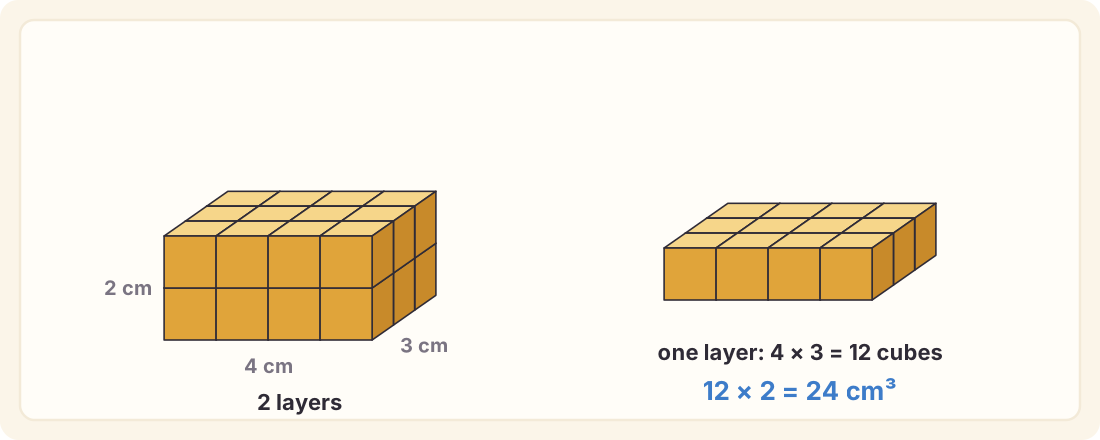
The same steps work for every box. Multiply the length by the width to count the cubes in one layer, then multiply by the height to count the layers:
- volume of a box = length × width × height
A box 5 cm long, 4 cm wide and 3 cm high holds 5 × 4 × 3 = 60 cm³. The lengths must all be in the same unit: centimetres give cubic centimetres, metres give cubic metres (m³).
A cube of 1,000 cubes
For a cube, all three lengths are the same. A cube 3 cm along each edge holds 3 × 3 × 3 = 27 small cubes. This is why 3³ is called "3 cubed" (see powers): 3 × 3 × 3 cubes make a cube.
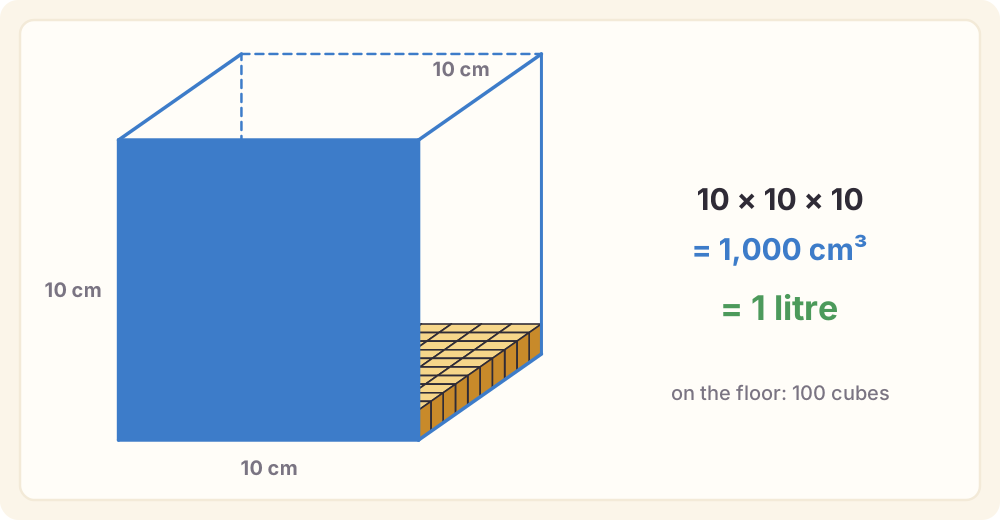
Now take a cube 10 cm along each edge. It holds 10 × 10 × 10 = 1,000 cm³. Fill it with water and you have exactly 1 litre. So:
- 1 litre = 1,000 cm³, and 1 millilitre = 1 cm³.
A sugar cube takes up the same space as a millilitre of water: about 20 drops.
Try it at home
- Measure a small box with a ruler, in whole centimetres. Work out its volume.
- A box is 6 cm long, 5 cm wide and 2 cm high. How many 1 cm cubes fit in it?
- A fish tank is 50 cm long, 20 cm wide and 30 cm high. How many litres of water does it hold when full?
Answers: 2. 6 × 5 = 30 cubes in a layer, × 2 layers = 60. 3. 50 × 20 × 30 = 30,000 cm³, which is 30 litres.
Words to know
- volume - how much space something takes up or a container holds
- cubic centimetre (cm³) - the space inside a cube 1 cm long, 1 cm wide and 1 cm high; the same as 1 millilitre
- volume of a box - length × width × height
Big idea
Volume counts cubes. One layer of a box holds length × width cubes, and there are as many layers as the box is high, so its volume is length × width × height. A cube 10 cm across holds 1,000 cm³, exactly one litre.