A Length No Fraction Can Name
Fold a square napkin from one corner to the opposite corner. The fold is the square's diagonal. If each side of the napkin is 1 m long, how long is the fold? It is longer than 1 m and shorter than 2 m. But what is it exactly? The answer turned out to be one of the great surprises in the history of mathematics.
Pythagoras gives the square
The diagonal cuts the square into two right-angled triangles. In each one, the two shorter sides are 1 m and the diagonal is the hypotenuse. By Pythagoras' theorem:
- 1 × 1 + 1 × 1 = 2
So the square on the diagonal has an area of exactly 2 m². You can see this without any sums: the square on the diagonal is made of four halves of the small square, which is two whole small squares.
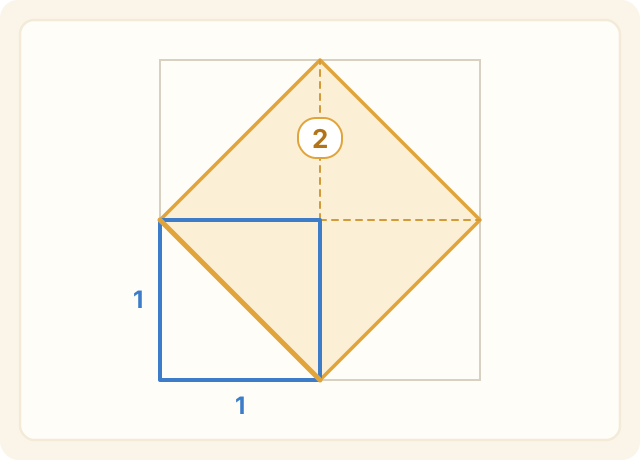
The diagonal is the side of a square of area 2. So its length is the number that, times itself, makes 2. That is √2, the square root of 2.
Hunting for √2
Let us look for √2 by trying numbers, as with any square root:
- 1.4 × 1.4 = 1.96. A little too small.
- 1.5 × 1.5 = 2.25. Too big. So √2 is between 1.4 and 1.5.
- 1.41 × 1.41 = 1.9881. Too small.
- 1.42 × 1.42 = 2.0164. Too big. So √2 is between 1.41 and 1.42.
- 1.414 × 1.414 = 1.999396. Still a little too small.
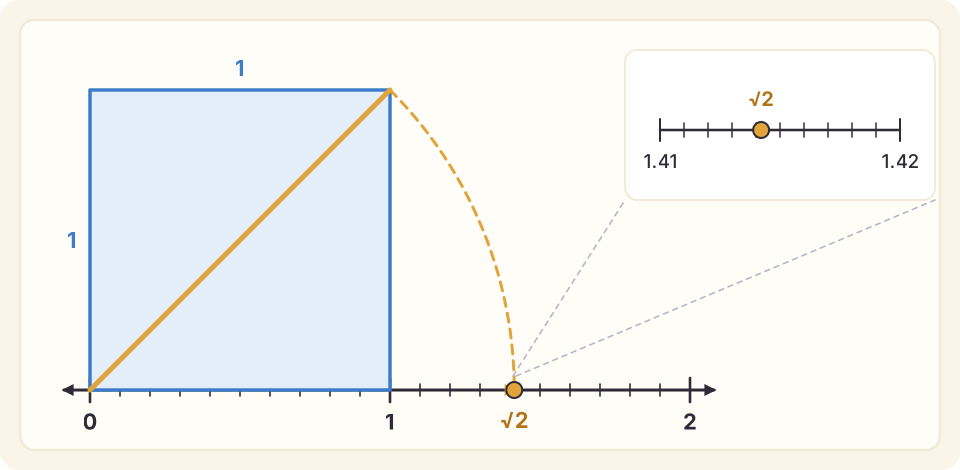
Every new digit brings us closer, but we never land exactly on 2. The decimals of √2 begin 1.41421356 ... and go on for ever, never settling into a pattern that repeats.
No fraction is exactly right
Maybe a fraction could do better than a decimal? 7/5 times 7/5 is 49/25, a bit less than 2. 17/12 times 17/12 is 289/144, a bit more than 2. You can find fractions closer and closer to √2, but never one that is exactly right. Greek mathematicians proved this more than 2,000 years ago: no fraction, however big its top and bottom numbers, times itself, makes exactly 2.
Yet √2 is a real length. The fold in the napkin has it, and the swung diagonal marks its exact place on the number line. It is a number, just not one a fraction can name.
Numbers like this are called irrational numbers: numbers that are not a fraction. Their decimals never end and never repeat. Compare 1/4 = 0.25, which ends, and 1/3 = 0.333 ..., which repeats the same digit for ever: every fraction does one or the other. √3 and √5 are irrational too. So is the number that tells how far it is round a circle, which we meet in Pi: Once Round the Circle.
Try it at home
- Cut out a paper square with sides of 10 cm. Measure its diagonal. Is it close to 14.1 cm?
- Is √2 closer to 1.41 or to 1.42? Use the sums above.
- Which of these is irrational: √9, √5, 0.5?
Answers: 1. Yes: 10 × √2 is about 14.14 cm. 2. To 1.41, because 1.9881 is closer to 2 than 2.0164 is. 3. √5. √9 = 3, and 0.5 = 1/2.
Words to know
- irrational number - a number that cannot be written as a fraction, like √2; its decimals never end and never repeat
Big idea
The diagonal of a square with sides of 1 is √2. No fraction is exactly equal to it, and its decimals go on for ever without repeating. Numbers like this are irrational, and they have their own places on the number line.