The Area of a Parallelogram
In some old towns two streets cross at a slant, and the flower bed between them is not a rectangle. Its sides lean. The gardener wants to cover it with grass squares, and needs to know how many to buy. Counting squares is hard when the edges cut across them. Is there a quicker way to find the area of a shape that leans?
A rectangle that leans
A shape like this flower bed is a parallelogram: four sides, and each side is parallel to the side across from it. We met it in Four-Sided Shapes. In The Area of a Rectangle we saw that a rectangle's area is length × width. A parallelogram looks like a rectangle that has been pushed over. Can we push it back?
Cut and slide
Take a parallelogram made of paper. From one top corner, cut straight down to the bottom side, at a right angle. A triangle comes off one end. Slide that triangle to the other end, and it fits exactly into the gap. Now the shape is a rectangle.
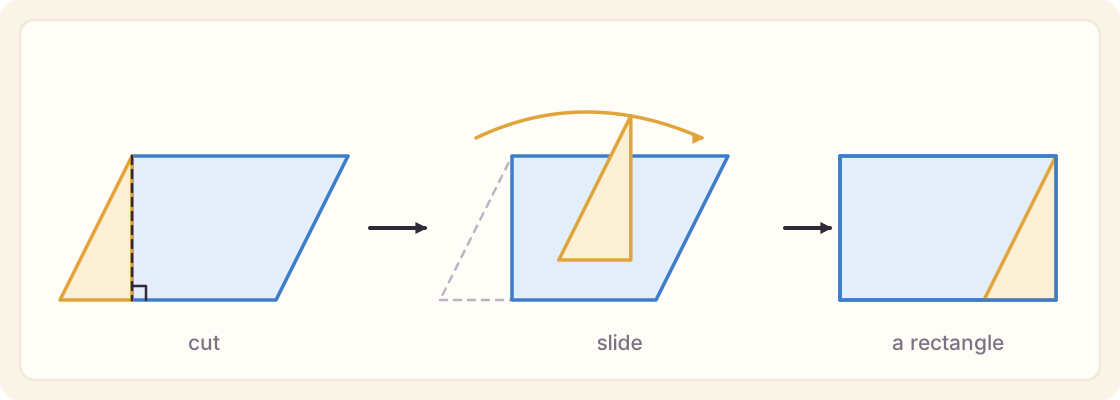
Nothing was added and nothing was thrown away. Every piece of paper is still there, so the rectangle has the same area as the parallelogram.
The rectangle is as long as the parallelogram's bottom side. We call that side the base. The rectangle is as tall as the straight-down cut. We call that distance the height. So:
- area of a parallelogram = base × height
Height goes straight up
Here is the mistake to watch for. The height is not the slanted side. It is the distance straight up from the base to the top side, at a right angle to the base, like the cut we made.
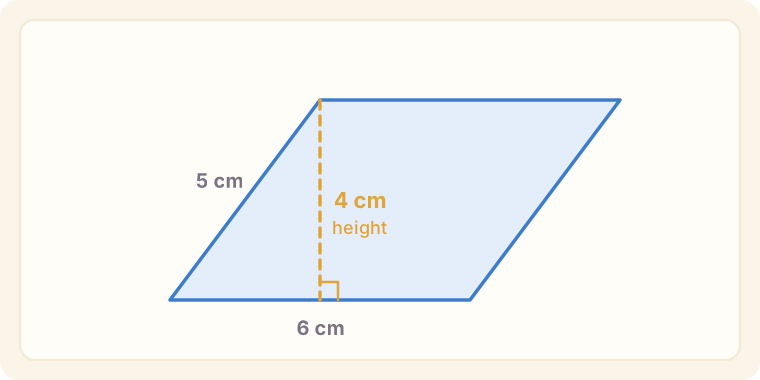
This parallelogram has a base of 6 cm and a slanted side of 5 cm. Its height is 4 cm. Its area is 6 × 4 = 24 cm². Multiplying the base by the slanted side gives 6 × 5 = 30 cm², which is too much: the slanted side is longer than the height.
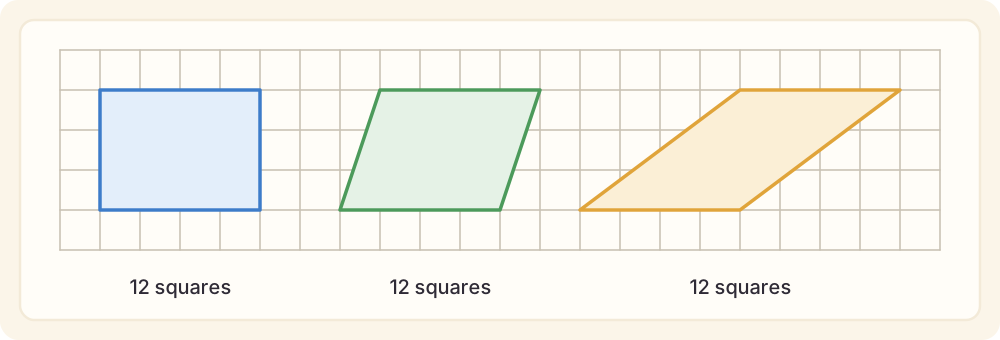
The lean does not matter, only the base and the height. Push a parallelogram over more and more, keeping its base and height the same, and its area stays the same. On the grid below, each of the three shapes covers 12 squares.
Try it at home
- Draw a parallelogram on paper and cut it out. Cut straight down from a top corner and slide the triangle across. Do you get a rectangle?
- A parallelogram has a base of 8 cm and a height of 3 cm. What is its area?
- A parallelogram has a base of 10 m, a slanted side of 6 m and a height of 5 m. What is its area?
Answers: 1. Yes, always. 2. 8 × 3 = 24 cm². 3. 10 × 5 = 50 m² (the slanted side, 6 m, is not used).
Words to know
- base - the side a shape stands on, which we measure from
- height - the distance straight up from the base to the top, at a right angle to the base (also called the perpendicular height)
Big idea
Cut a triangle off a parallelogram and slide it across, and it becomes a rectangle with the same area. So the area of a parallelogram is base × height, where the height is measured straight up, not along the slant.