Triangles
Look at a bicycle frame, a crane on a building site or the steel of an old railway bridge. Triangles everywhere. Builders could use squares or hexagons, but they choose triangles again and again. Why? And are all triangles the same?
Sorted by their sides
A triangle is a polygon with 3 sides and 3 vertices. Measure its sides, and it is one of three kinds:
- equilateral: all three sides are the same length;
- isosceles: two sides are the same length;
- scalene: all three sides are different lengths.
In pictures, sides of the same length are marked with the same small lines across them. One mark on two sides means those two are equal; a side with two marks is a different length.
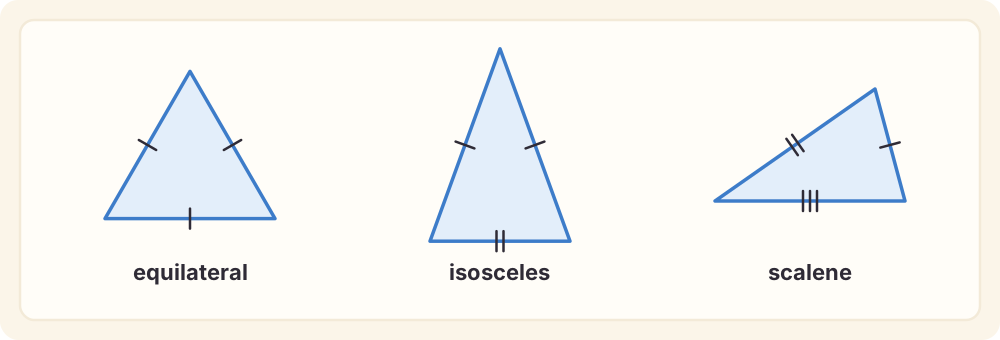
An equilateral triangle is the regular triangle from the last lesson: its sides are equal, and so are its angles.
Sorted by their angles
Now look at the angles instead. In the Measuring Angles in Degrees lesson we met right angles (90°), acute angles (less than 90°) and obtuse angles (more than 90° but less than 180°). A triangle can be:
- a right-angled triangle: one of its angles is a right angle, like the corner of a page;
- a triangle with one obtuse angle, which looks stretched out and flat;
- a triangle whose angles are all acute.
A triangle never has more than one right angle or more than one obtuse angle. The next lesson shows why.
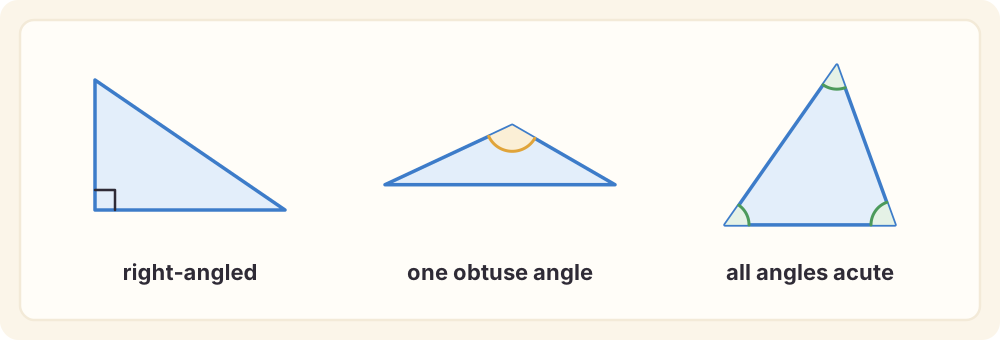
The two ways of sorting work together. A triangle can be right-angled and isosceles at the same time: fold a square piece of paper corner to corner and you get one.
A triangle cannot wobble
Make a square from four sticks, joined at the corners with a pin that lets them turn. Push one corner and the square leans over into a flatter shape. The sides are the same length as before, but the angles have changed.
Now make a triangle from three sticks. Push it as hard as you like: it does not change shape. Three sides of fixed lengths fit together in only one way, so the angles cannot change either. To squash a triangle you would have to bend or break a side.
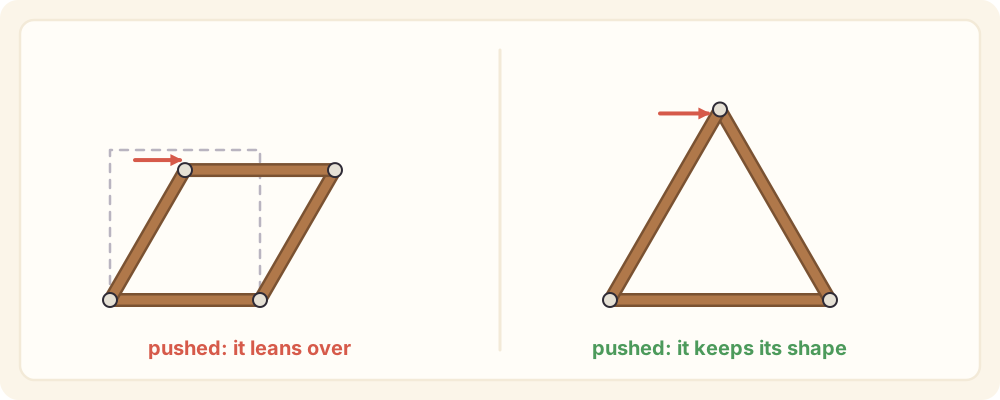
That is why builders use triangles: a frame made of triangles stays stiff. A wooden gate gets a board nailed across it from one corner to the opposite corner for the same reason: the board cuts the rectangle into two triangles.
Try it at home
- Cut three straws to 10 cm, 10 cm and 6 cm and thread them on a string. What kind of triangle do they make?
- Make a square from four straws on a string and push it. Then tie one more string from a corner to the opposite corner. What happens?
- Can a triangle be equilateral and right-angled?
Answers: 1. Isosceles. 2. The square leans over; with the extra string it is two triangles and stays stiff. 3. No: an equilateral triangle's three angles are equal, and three right angles would be far too much (the next lesson shows the angles always add up to 180°).
Words to know
- equilateral triangle - all three sides equal
- isosceles triangle - two sides equal
- scalene triangle - all three sides different
- right-angled triangle - one angle is a right angle
Big idea
Triangles are sorted by their sides (equilateral, isosceles, scalene) and by their angles (right-angled, with an obtuse angle, or all acute). Three sides fit together in only one way, so a triangle cannot wobble.