Finding a Place on a Grid
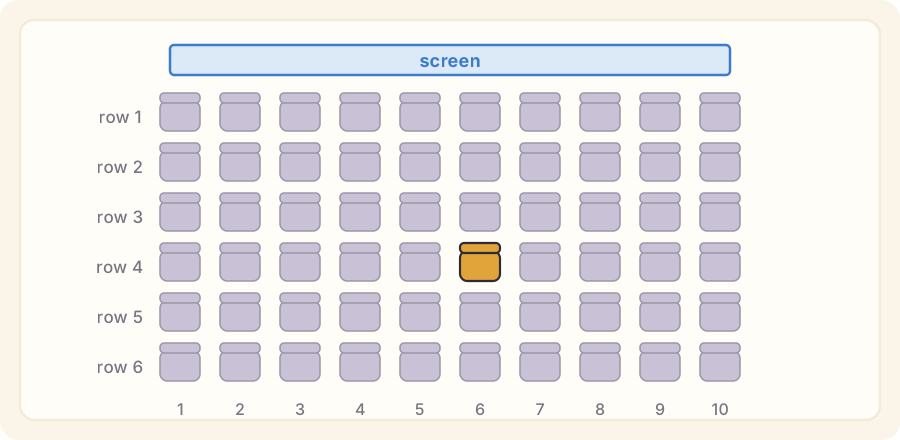
A cinema ticket says "row 4, seat 6". With just two numbers, you can walk straight to your seat, even in a dark room with hundreds of seats. Can two numbers name any place on a flat page in the same way?
Two numbers name a place
Picture the seats as a grid. Count the rows from the front and the seats from the side: row 4, seat 6 is exactly one seat. Each number alone is not enough: "seat 6" is in every row.
Across, then up
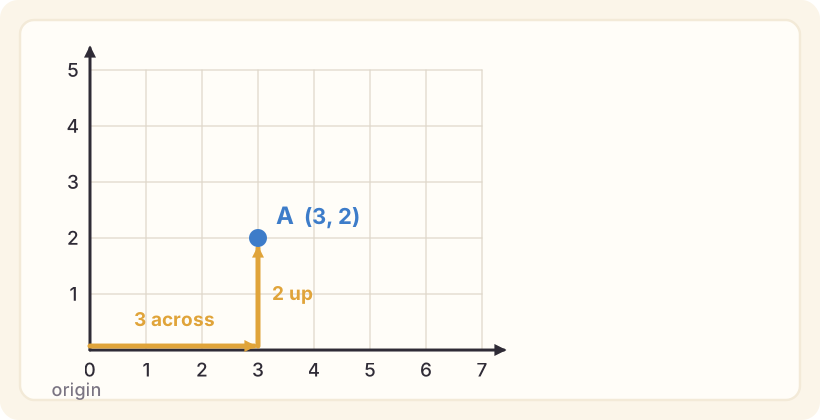
Mathematicians do the same on squared paper. Draw two lines that are perpendicular: one going across, one going up. Each is called an axis (two of them are axes). They are marked 0, 1, 2, 3 ... like two number lines, and they meet at 0 on both, a point called the origin.
To name a point, start at the origin, count how far across you go, then how far up. Write the two numbers in brackets, across first: (3, 2) means 3 across and 2 up. These two numbers are the point's coordinates.
The order matters
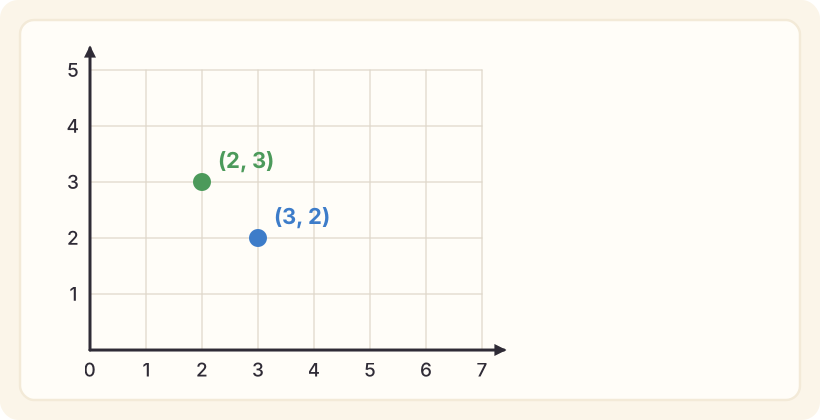
(3, 2) and (2, 3) use the same two numbers, but they are different points. (2, 3) is 2 across and 3 up. That is why everyone agrees on one rule: across first, then up.
Shapes on a grid
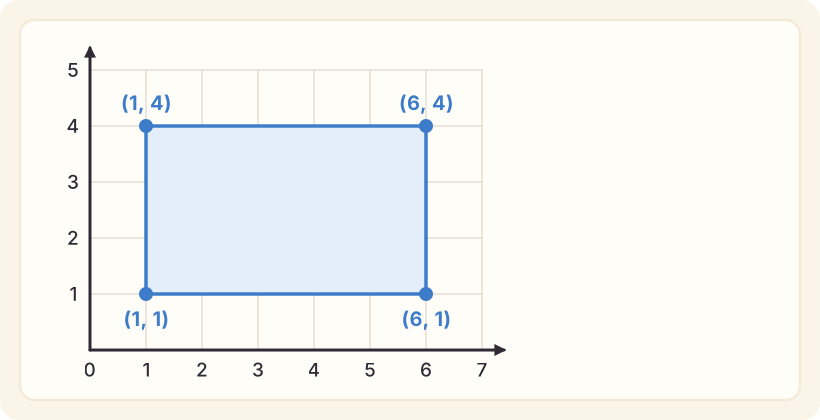
With coordinates, you can describe a shape with numbers. Join the points (1, 1), (6, 1), (6, 4) and (1, 4) in order, and back to (1, 1). You get a rectangle 5 squares long and 3 squares tall. Anyone, anywhere, can draw exactly the same rectangle from those four pairs of numbers. Maps, computer screens and games all name their places this way.
Try it at home
- Draw axes on squared paper, from 0 to 8 across and 0 to 6 up.
- Mark the points (2, 1), (6, 1) and (4, 5) and join them. What shape is it?
- A friend secretly marks a point. Find it by asking for its coordinates.
Answers: 2. A triangle, with two equal sides.
Words to know
- axis (axes) - one of the two number lines on a grid, across and up
- origin - the point where the axes meet, (0, 0)
- coordinates - two numbers that name a point: how far across, then how far up
Big idea
Two numbers, across then up, can name any point on a flat page. With them, a shape becomes a list of numbers. From points and lines to grids, the whole of geometry is about where things are and how big they are.