The Area of a Rectangle
A tiler in Istanbul is covering a kitchen floor with square tiles. The floor is a rectangle 5 metres long and 3 metres wide, and each tile is 1 metre by 1 metre. How many tiles does she need? She could lay them all down and count them. But there is a quicker way, and it works before a single tile is laid.
Rows and columns
Cover a rectangle 5 cm long and 3 cm wide with 1 cm squares. The squares don't lie about in a muddle: they make neat rows.
- Along the 5 cm side, 5 squares fit in each row.
- Along the 3 cm side, 3 rows fit.
3 rows of 5 squares is 3 × 5 = 15 squares. So the area is 15 cm².
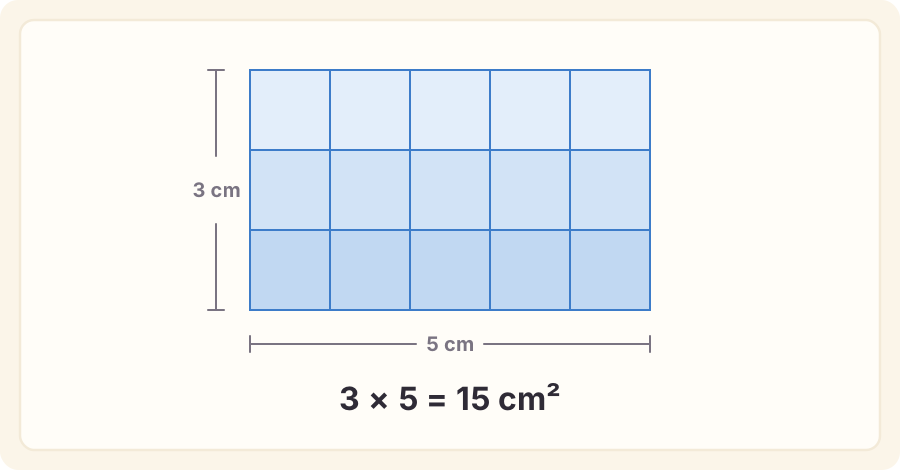
The length tells you how many squares are in a row. The width tells you how many rows there are. Multiplying them counts all the squares at once. In words:
the area of a rectangle = length × width
The tiler's floor is 5 × 3 = 15 m², so she needs 15 tiles.
Why it always works
This is the same picture as multiplying with rows of dots: 3 × 5 is 3 rows of 5. It doesn't matter which way you turn the rectangle. 5 rows of 3 is the same 15 squares, because the rectangle is the same rectangle.
Watch the units. Length times width is centimetres times centimetres, and the answer is in square centimetres. A rectangle 8 m long and 2 m wide has an area of 8 × 2 = 16 m². If you write "16 m", you have written a length, not an area.
A square, squared
A square is a rectangle whose length and width are the same. So the area of a square is one side times itself. A square with sides of 5 cm has an area of 5 × 5 = 25 cm².
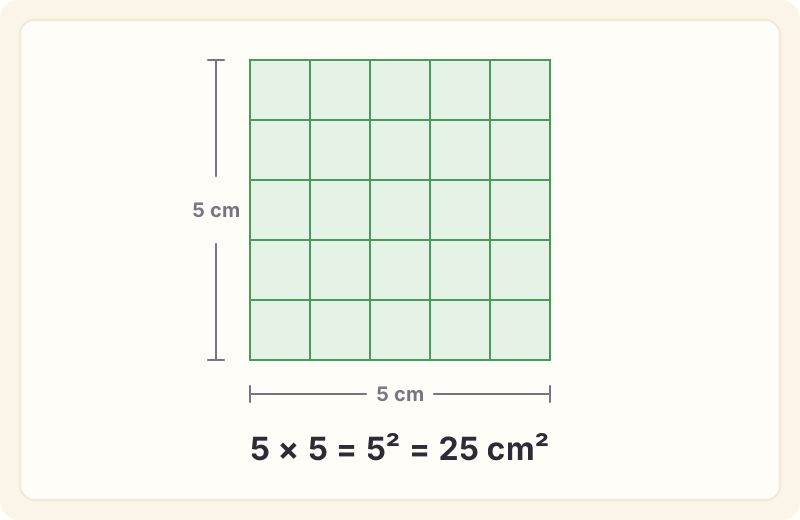
That is where a famous word comes from. A number times itself, like 5 × 5, is written 5² and read "5 squared", because it is the area of a square with that side. The square numbers 1, 4, 9, 16, 25 ... are exactly the areas of squares with sides 1, 2, 3, 4, 5 ...
Try it at home
- Measure the length and width of a sheet of paper (or a tablet) in centimetres, rounded to whole centimetres. Multiply them to find its area.
- A garden is 7 m long and 4 m wide. What is its area?
- A square table top has sides of 80 cm. What is its area?
Answers: 2. 7 × 4 = 28 m². 3. 80 × 80 = 6,400 cm².
Words to know
- area of a rectangle - its length times its width, in square units
- squared - a number times itself, written with a small ²: 5² = 25, the area of a square with sides 5
Big idea
The squares covering a rectangle make rows and columns, so the area is length × width. A square's area is its side times itself, which is why 5 × 5 is called "5 squared".