The Angles of a Triangle
Draw a triangle on a piece of paper, any triangle you like: tall and thin, short and wide, with a right angle or without. Measure its three angles with a protractor and add them up. Your neighbour draws a completely different triangle and does the same. You both get the same answer. What is it, and why?
Tear off the corners
Here is a way to see it without measuring at all.
- Cut out a paper triangle and colour its three corners in three colours.
- Tear off the three corners.
- Lay them side by side so that their points meet at one place, with no gap and no overlap between them.
The three corners always fit together into a straight line. In the Measuring Angles in Degrees lesson we saw that a straight line is half a turn, a straight angle of 180°. So the three angles of the triangle add up to 180°.
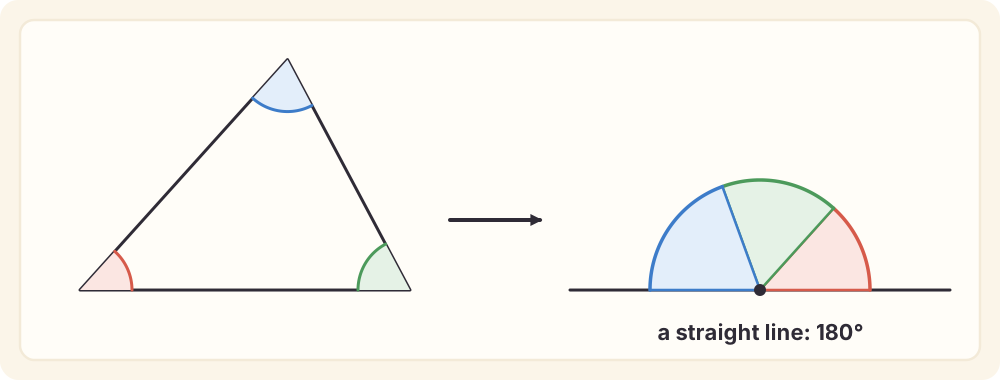
Try it with a different triangle. The three angles change, but they still make a straight line. This is true for every triangle: its angles add up to 180°.
Checking with numbers
- An equilateral triangle has three equal angles. 180° ÷ 3 = 60°, so each is 60°.
- Fold a square piece of paper corner to corner. The triangle has a right angle and two angles of 45°: 90° + 45° + 45° = 180°.
- A set square, the triangle ruler in a school pencil case, often has angles of 90°, 60° and 30°: 90° + 60° + 30° = 180°.
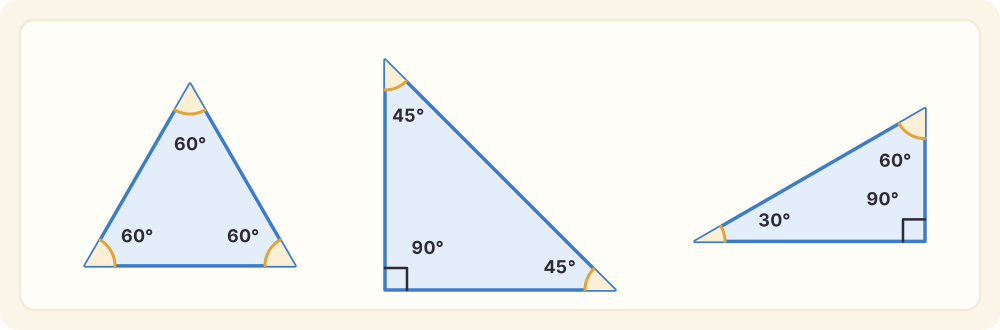
This also lets you find a missing angle without a protractor. If two angles of a triangle are 50° and 70°, they make 120° together, and 180° - 120° = 60°. The third angle is 60°.
Why not two right angles?
Could a triangle have two right angles? Try to draw one. Start with a side along the bottom of the page and draw a line straight up from each end, at a right angle. The two lines are parallel: they go up side by side and never meet. There is no third corner, so there is no triangle.
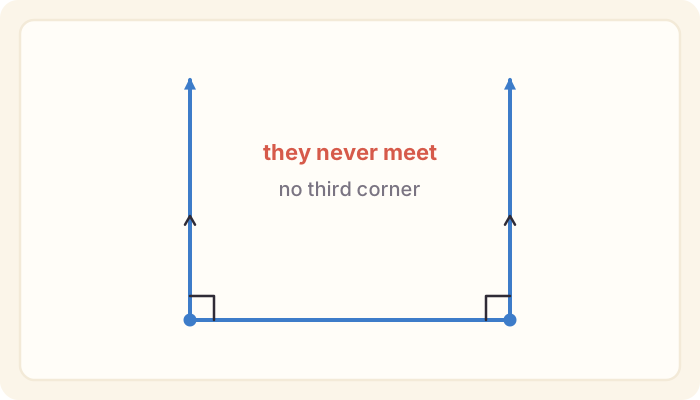
The numbers say the same: two right angles already make 90° + 90° = 180°, leaving nothing for the third angle. For the same reason, a triangle can't have two obtuse angles, or even one right angle and one obtuse angle.
Try it at home
- Do the tearing experiment with two very different paper triangles.
- Two angles of a triangle are 40° and 100°. How big is the third?
- A right-angled triangle has one angle of 35°. How big is the other one that isn't the right angle?
Answers: 2. 40° + 100° = 140°, and 180° - 140° = 40°. 3. 90° + 35° = 125°, and 180° - 125° = 55°.
Words to know
- angle sum - all the angles of a shape added together; for every triangle it is 180°
Big idea
The three corners of any triangle fit together into a straight line, so the angles of every triangle add up to 180°. That is why a triangle has at most one right angle or one obtuse angle.