The Area of a Circle
Leila wants to paint a round table top. The tin says one tin covers 1 square metre. Will one tin be enough? She needs the area of the circle. But a circle has no straight sides, so the squares we counted in Area: Counting Squares never fit it exactly. How can we find it?
Cut it into slices
Cut the circle into 8 equal slices, like a pizza. Lay them in a row, one pointing up, the next pointing down, and so on. Nothing is added and nothing is taken away, so the row has the same area as the circle.
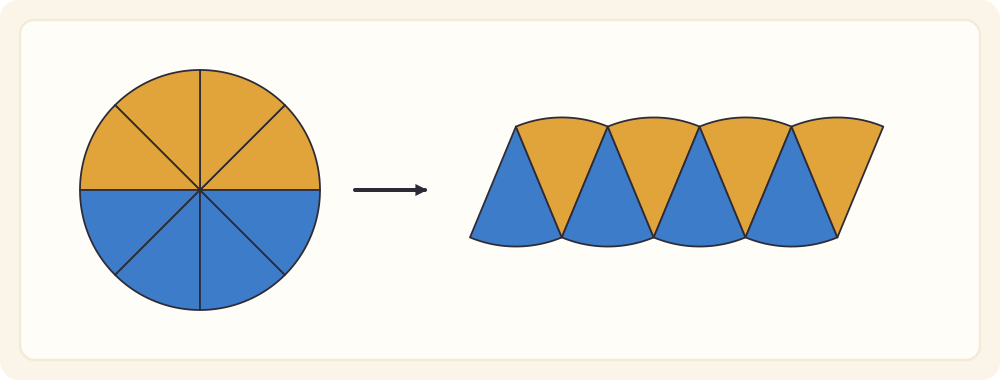
The row looks like a parallelogram with bumpy top and bottom edges. Now cut 16 slices, then 32. The thinner the slices, the flatter the bumps, and the more the row looks like a rectangle.
Measure the rectangle
Look at the nearly-rectangle made of many thin slices:
- Its height is the length of one slice: the radius of the circle.
- Its length is made of the curved edges of half the slices: the other half are along the bottom. So it is half the circumference. In the last lesson we saw that the circumference is 2 × π × radius, so half of it is π × radius.
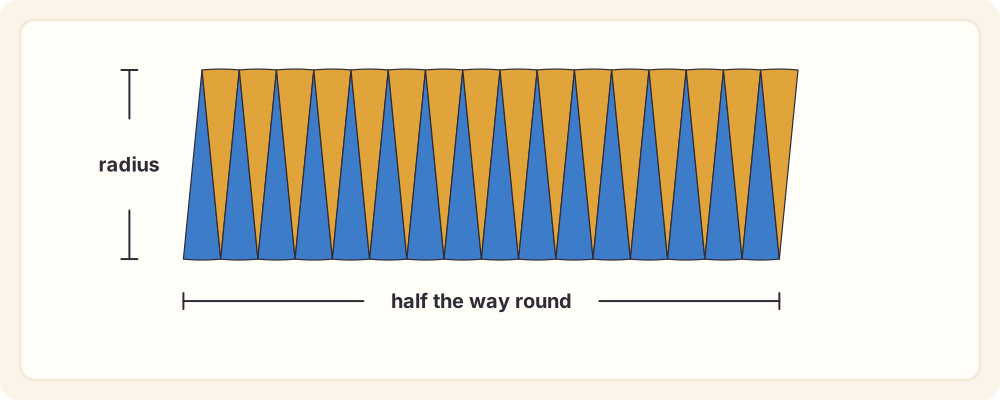
The area of a rectangle is length × width, as in The Area of a Rectangle. Here that is (π × radius) × radius. So:
- area of a circle = π × radius × radius
A circle with a radius of 10 cm has an area of about 3.14 × 10 × 10 = 314 square centimetres.
Does that make sense?
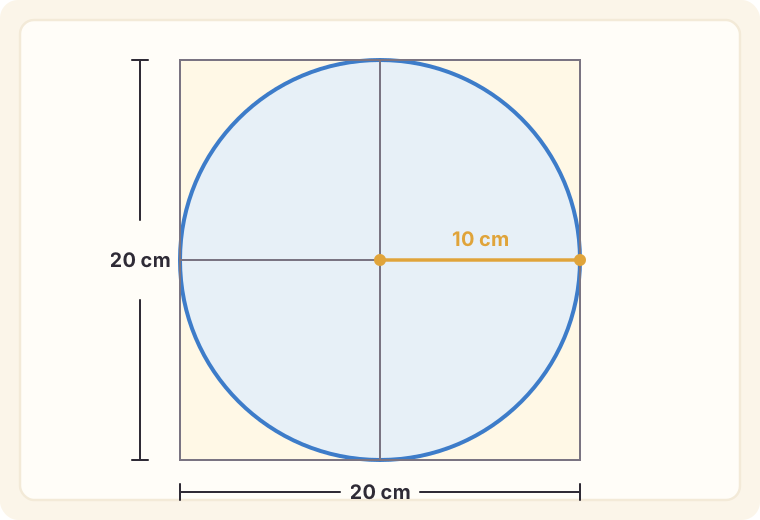
Put the circle of radius 10 cm inside a square that just fits round it. The square is 20 cm on each side, so its area is 20 × 20 = 400 cm². The circle is smaller than the square: 314 is less than 400. Now look at one small square on the radius, 10 by 10, which is 100 cm². The circle holds a bit more than 3 of those small squares, which matches "π × radius × radius": 3.14 small squares.
Leila's table is 1 metre across, so its radius is half a metre, 0.5 m. Its area is about 3.14 × 0.5 × 0.5, which is about 0.79 m². One tin is enough, with some to spare.
Try it at home
- Draw a circle on paper, cut it out, fold it in half three times and cut along the folds to get 8 slices. Lay them head to tail.
- Find the area of a round mat with a radius of 2 m.
- Double the radius of a circle from 3 cm to 6 cm. How many times bigger does its area get?
Answers: 2. About 3.14 × 2 × 2 = 12.56 m². 3. 3 × 3 = 9 and 6 × 6 = 36, so 4 times bigger.
Words to know
- area of a circle - π × radius × radius, found by cutting the circle into thin slices that make almost a rectangle
Big idea
Cutting a circle into thin slices and laying them head to tail makes almost a rectangle, one radius high and half the circumference long. So the area of a circle is π × radius × radius.