Measuring Angles in Degrees
Skateboarders talk about doing "a 180" (turning round to face the way you came) or "a 360" (spinning all the way round). Those numbers measure turning. Where do they come from, and how do you measure an angle exactly?
A turn cut into 360 steps
To measure a length, we use a small unit, like the centimetre, and count how many fit. Angles work the same way. A full turn is cut into 360 equal small turns, and each one is called a degree. We write degrees with a small circle: 360°.
- A full turn is 360°.
- A half turn is 360 ÷ 2 = 180°.
- A quarter turn, the right angle, is 360 ÷ 4 = 90°.
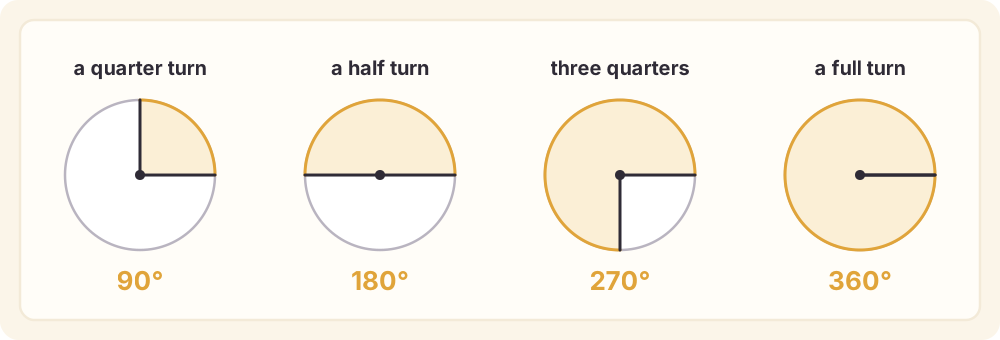
Why 360, and not 100? Nobody knows for sure. About 4,000 years ago, people in Mesopotamia (in what is now Iraq) counted in sixties, and astronomers there later split the circle of the sky into 360 parts. A year also has about 360 days. Whatever the reason, 360 was a good choice: it can be shared equally by 2, 3, 4, 5, 6, 8, 9, 10, 12 and many more numbers, so halves, thirds, quarters and sixths of a turn are all whole numbers of degrees.
Names for angles
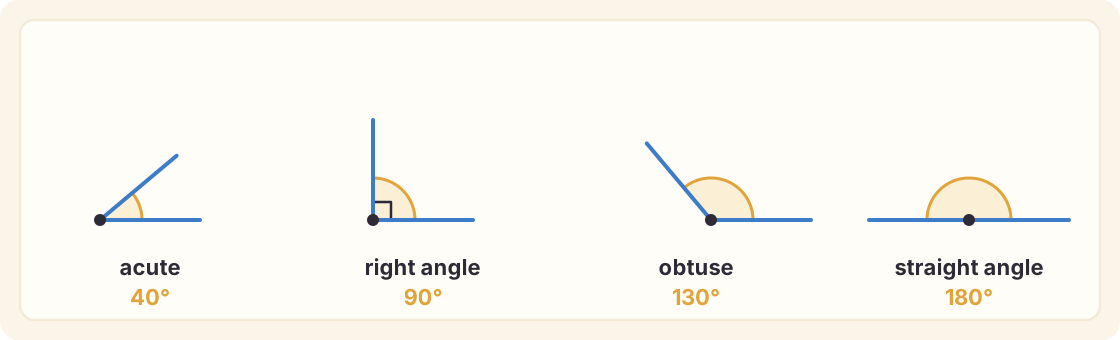
Angles get names by comparing them with the right angle:
- An acute angle is smaller than 90°, like the tip of a slice of pizza.
- A right angle is exactly 90°.
- An obtuse angle is bigger than 90° but smaller than 180°, like a half-open laptop pushed far back.
- A straight angle is exactly 180°. Its two lines make one straight line.
The protractor
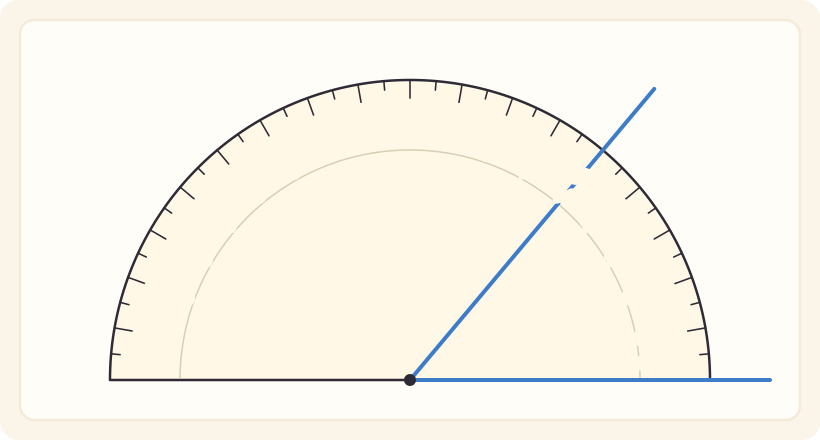
A protractor is a ruler for angles: a half circle marked from 0° to 180°. To measure an angle:
- Put the centre of the protractor exactly on the point where the two lines meet.
- Turn the protractor so its zero line lies along one of the lines.
- Follow the other line out to the scale, and read the number.
Most protractors have two rows of numbers, one counting from the right and one from the left. Read the row that starts at 0 on the line you lined up. If you read the other row, a 50° angle looks like 130°. Ask yourself first: is it smaller or bigger than a right angle?
Longer lines, same angle
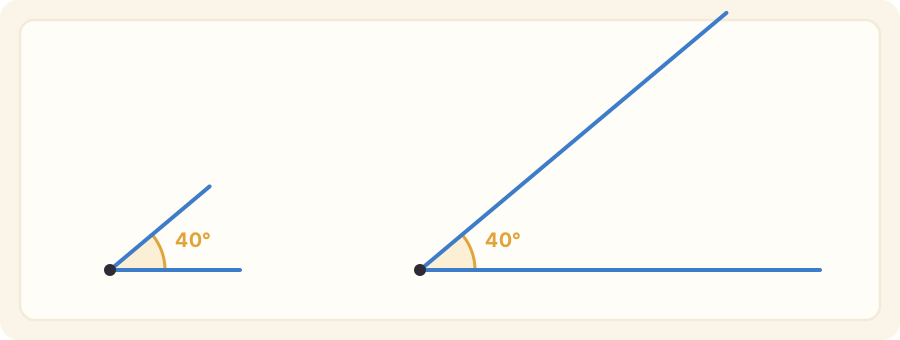
Draw an angle of 40° with short lines, and another with very long lines. Which is bigger? Neither: both are 40°. The angle measures the turn between the lines, not how far they go. The lines of an angle are rays and go on for ever anyway: we only ever draw a piece of them.
Try it at home
- Stand up and turn 90°, then 180°, then 360°. Which way are you facing each time?
- Draw an angle, guess whether it is acute or obtuse, then measure it with a protractor if you have one.
- How many degrees is a third of a full turn?
Answers: 1. To your side, behind you, and the way you started. 3. 360 ÷ 3 = 120°.
Words to know
- degree (°) - one of 360 equal parts of a full turn
- acute angle - an angle smaller than 90°
- obtuse angle - an angle bigger than 90° and smaller than 180°
- straight angle - an angle of 180°; its lines make one straight line
- protractor - a tool for measuring angles in degrees
Big idea
Angles are measured in degrees, 360 to a full turn, so a right angle is 90° and a straight angle is 180°. The size of an angle is the amount of turn, whatever the length of the lines.