Ones, Tens and Hundreds
Look at the number 333. It is written with the same numeral three times. But the three 3s don't mean the same thing. One of them means three hundred, one means thirty, and one means three. How can the same sign mean three different amounts?
Bundles of ten
Imagine you have a big pile of sticks to count. Instead of counting them one by one, you tie them into bundles of ten. When you have ten bundles, you tie them into one big bundle of a hundred.
Now you can describe the pile very quickly. Say you have 2 big bundles, 4 bundles and 3 loose sticks. That is two hundreds, four tens and three ones: 243 sticks.
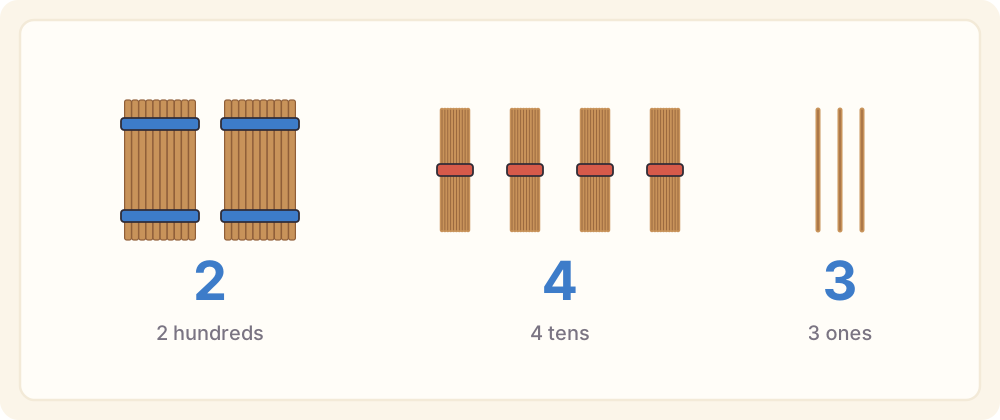
This is the same idea as the groups of five in the How Many at a Glance? lesson, but with ten. Why ten? Very likely because people learned to count on their ten fingers.
Where a numeral stands
Each numeral in a number is called a digit. In 243 there are three digits: 2, 4 and 3.
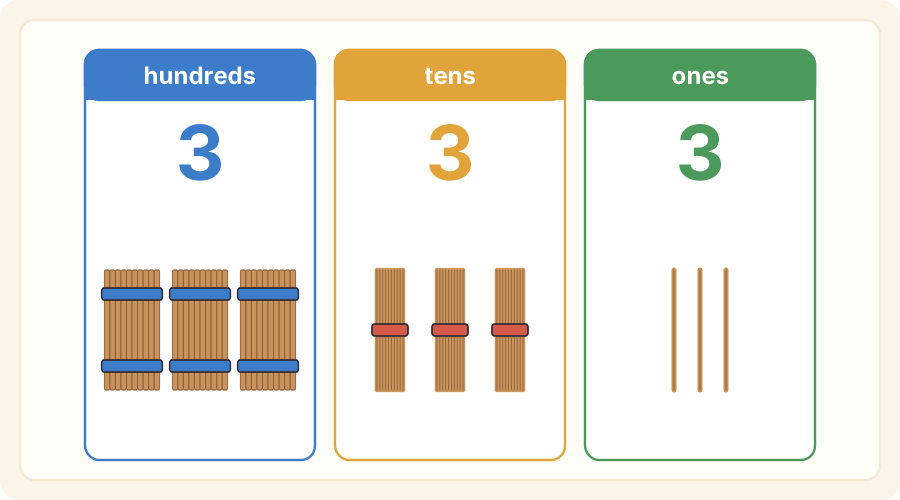
When we write a number, each digit's place tells you what it counts:
- the place on the right counts ones;
- the place next to it counts tens;
- the next place counts hundreds;
- and the next, thousands: ten hundreds.
So the 3 in 300 means three hundreds, the 3 in 330 means three tens, and the 3 in 333 means three ones. The same digit is worth more the further left it stands. This way of writing numbers is called place value: the value of a digit depends on its place.
Zero keeps the places
Now we can see zero's most important job, which we met at the end of the Zero lesson. Think of 205: two hundreds, no tens, and five ones. Without a sign for "no tens", it would look like 25, which is a very different number.
The zero is a placeholder. It says: "there is nothing in this place, but the place is still here." It keeps the other digits in the right places.
25, 205, 250 and 2,005 all use the digits 2 and 5. Only the zeros tell them apart.
Ten is the moment to move left
Count up: 7, 8, 9... and then? There is no single digit for ten. So you write a 1 in the tens place, meaning "one bundle of ten", and a 0 in the ones place, meaning "no loose ones": 10.
The same happens at 99 + 1. Ten ones make a ten, and ten tens make a hundred: 100. Every time a place fills up to ten, it becomes one in the next place to the left.
Try it at home
- Count out 35 beans or matches. Put them in cups of ten. How many full cups, and how many left over? Does it match the digits in 35?
- Write the number with five hundreds, no tens and seven ones. Then the number with seven hundreds, five tens and no ones. Answers below.
Answers: 507 and 750.
Words to know
- digit - one of the ten numerals 0 to 9, as it stands in a number
- place value - the rule that a digit's value depends on its place: ones, tens, hundreds, thousands
- placeholder - a zero that keeps a place empty, so the other digits stay in the right places
Big idea
We write numbers in groups of ten. Where a digit stands tells you whether it counts ones, tens, hundreds or thousands, and zero holds a place open when it is empty. That is how ten digits are enough for any number.