Below Zero
On a winter morning the weather forecast says it is 5 degrees below zero. In a big building, the lift has buttons for floors under the street. A friend lent you 3 coins, and until you pay them back you have less than nothing. Zero isn't always the bottom. What comes before it?
The line goes left too
In the Number Line lesson, the line started at 0 and went to the right. But nothing stops us from carrying on to the left of zero, with the same equal steps.
The numbers there are the negative numbers. We write them with a small dash in front, a minus sign: -1, -2, -3, and so on. We say "minus one" or "negative one".
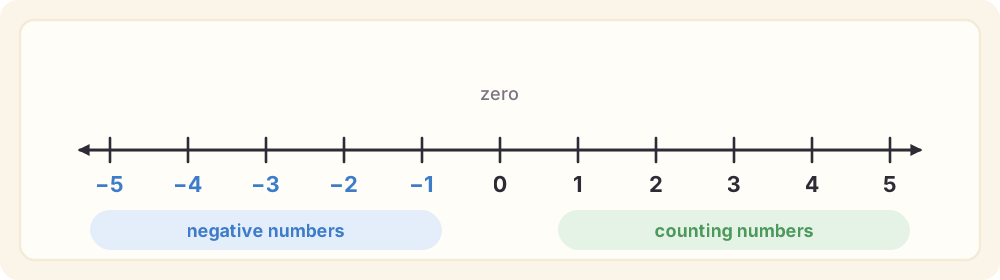
Each negative number is as far to the left of zero as its partner is to the right: -3 is three steps left of 0, just as 3 is three steps right.
Where we meet them
Negative numbers measure things that can go below a starting point:
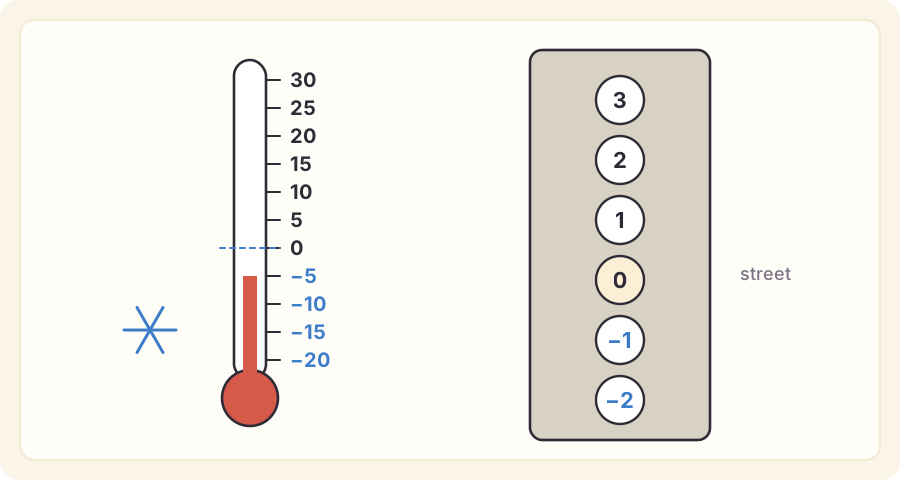
- Temperature. On a thermometer, 0 degrees is where water freezes (on the scale used in most of the world). Colder than that is below zero: -5 degrees.
- Floors. In many buildings, the street is floor 0. The car park under it is floor -1, and the one under that is -2.
- Money. If you have nothing and owe 3 coins, you have -3 coins: you need 3 coins just to get back to zero.
Which is bigger?
The rule from the Bigger and Smaller lesson still works: further right is bigger. That gives an answer that surprises many people:
- -2 is to the right of -5, so -2 is bigger than -5:
-2 > -5.
Think of the thermometer. -2 degrees is a cold morning; -5 degrees is colder. The bigger the number after the minus sign, the smaller the number really is, because it is further below zero. And every negative number is less than zero, and less than every counting number.
A new family of numbers
The counting numbers, zero, and the negative numbers together make a family that mathematicians call the integers: ..., -3, -2, -1, 0, 1, 2, 3, ... In everyday words, they are the whole numbers with their negatives - no halves or quarters.
People in China were using negative numbers about 2,000 years ago, with red counting rods for numbers above zero and black rods for numbers below it. In India, Brahmagupta, whom we met in the Zero lesson, wrote rules for them as "fortunes" and "debts".
Try it at home
- Draw a number line from -10 to 10. Mark today's temperature where you live, and the coldest temperature you can remember.
- Which is colder in each pair: -3 or 1? -8 or -4? Answers below.
Answers: -3; -8.
Words to know
- negative number - a number less than zero, written with a minus sign, like -4
- minus sign - the small dash in front of a negative number
- integers - the whole numbers together with their negatives: ..., -2, -1, 0, 1, 2, ...
Big idea
The number line goes left of zero too. Negative numbers measure things below a starting point - a cold day, a floor under the street, money owed. Further right is still bigger, so -2 is bigger than -5.