Bigger and Smaller
Two friends compare their scores in a game. One has 352 points, the other 325. Same three digits, in a different order. Who won? You can't line up 352 points next to 325 points and look. So how do we compare numbers?
Further right is bigger
In the Number Line lesson we saw that bigger numbers sit further to the right. So to compare two numbers, find them both on the line:
- the one further right is bigger, or greater;
- the one further left is smaller, or less.
7 is to the right of 4, so 7 is greater than 4. And 4 is less than 7. These two sentences say the same thing, from opposite ends.
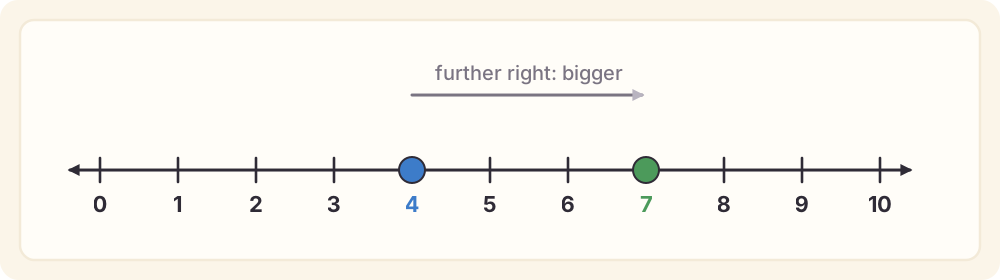
When two numbers are in the same place, they are equal: 5 is equal to 5,
written 5 = 5.
Two small signs
Mathematicians use two signs for "greater than" and "less than":
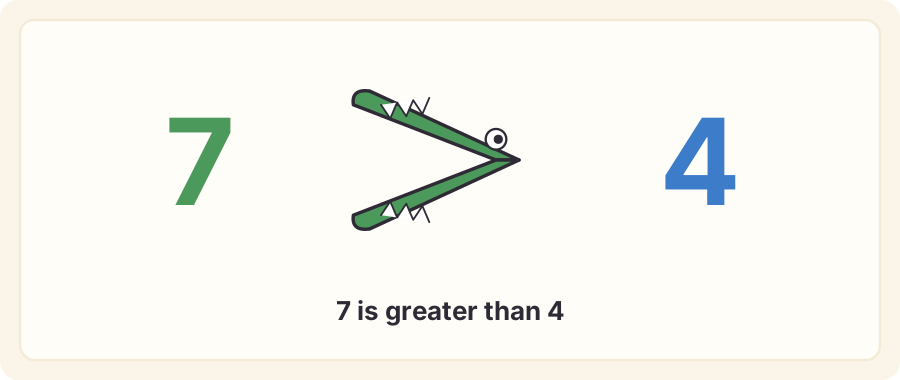
7 > 4means 7 is greater than 4;4 < 7means 4 is less than 7.
How do you remember which is which? The sign is wide open on one side and pointed on the other. The wide side always faces the bigger number. Some children learn it as a hungry crocodile's mouth, which always opens towards the bigger meal.
Comparing big numbers
For big numbers, drawing a number line is too slow. Place value, from the Ones, Tens and Hundreds lesson, does it instead.
First, count the digits. A number with more digits is bigger: 1,000 has four digits, 999 has three, so 1,000 is bigger. Every four-digit number is at least a thousand.
If they have the same number of digits, compare from the left, one place at a time, and stop at the first place where they differ:
- 352 and 325: the hundreds are the same (3 and 3);
- the tens are different: 5 tens against 2 tens;
- 5 tens is more, so 352 is bigger. You don't need to look at the ones at all.
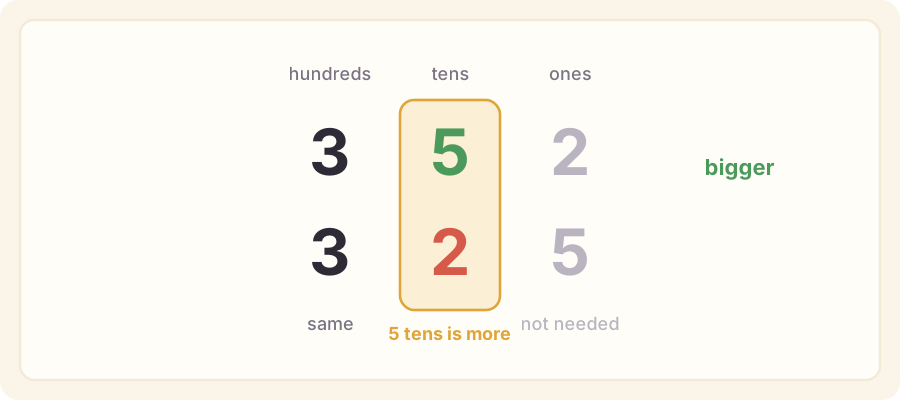
Why from the left? Because the left digits are worth the most. Five tens is more than any number of ones can make up.
Try it at home
- Write
>or<between each pair: 8 and 3; 19 and 91; 400 and 399. - Ask someone in your home their age and the age of a friend. Write the comparison with the right sign.
Answers: 8 > 3; 19 < 91; 400 > 399.
Words to know
- greater than (
>) - further to the right on the number line; bigger - less than (
<) - further to the left on the number line; smaller - equal (
=) - the same amount, in the same place on the number line
Big idea
Of two numbers, the one further right on the number line is greater. We write
7 > 4and4 < 7, with the wide side of the sign towards the bigger number. For big numbers, more digits means bigger, and with the same number of digits you compare from the left.