From Tally Marks to Numerals
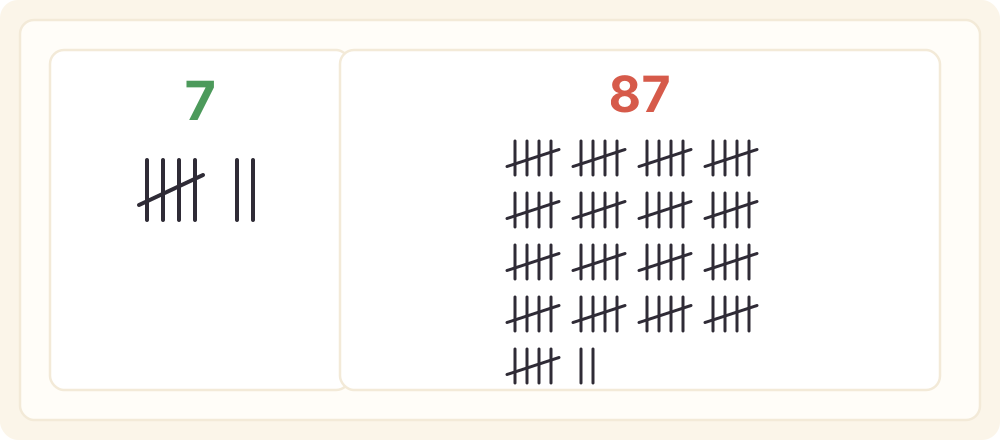
A teacher keeps score in a class game with a line on the board for every point. After the game, one team has 7 lines. Easy to read. But what if a team had 87 points? Eighty-seven little lines would fill the board, and nobody could read the score at a glance. How do we write big numbers so they stay short?
One line for each thing
The oldest way to write a number down is a tally: one mark for each thing. It is the shepherd's pebbles from the Why We Count lesson, drawn instead of carried. People have scratched tally marks on bones and walls for many thousands of years.
As we saw in the How Many at a Glance? lesson, a tally is easier to read when the marks are in groups of five. But even in groups, big numbers stay long. 87 is seventeen bundles and two lines.
Signs for groups
So people invented signs that stand for a whole group. The Romans, about 2,000 years ago, used letters:
- I for one, V for five, X for ten,
- L for fifty, C for a hundred, M for a thousand.
To write a number, they put signs side by side and added them up. XVII is ten, five, one and one: 17. Eighty-seven is LXXXVII: fifty, three tens, five and two ones. Shorter than 87 lines, but still long, and doing sums with these letters is very hard.
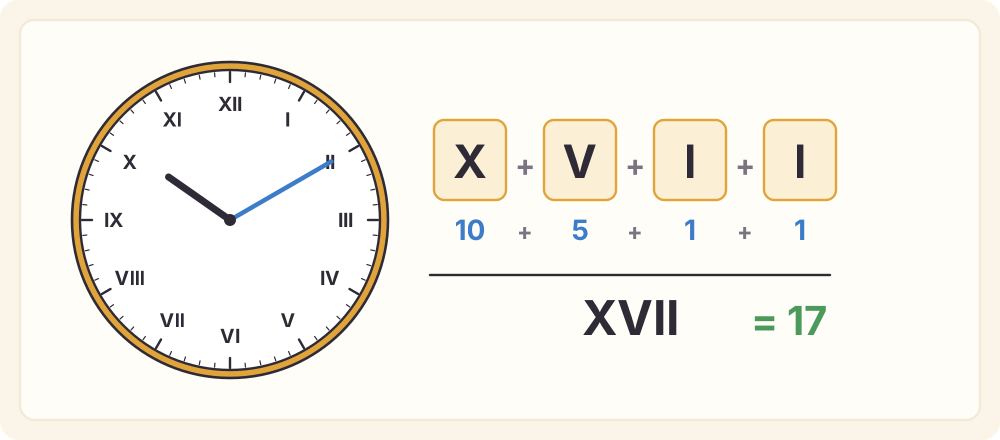
You can still see Roman numerals on some clocks, on buildings, and after the names of kings and queens, like Elizabeth II.
Ten signs from India
The way most of the world writes numbers today came from India, more than 1,400 years ago. It uses only ten signs, one for each number from zero to nine. Signs like these, for writing numbers, are called numerals.
The idea travelled west. In Baghdad, about 1,200 years ago, the Persian scholar al-Khwarizmi wrote a book explaining the Indian way of writing numbers. His book, and others like it, carried the idea to the Arabic-speaking world and then, hundreds of years later, to Europe. That is why the numerals are often called Hindu-Arabic numerals.
The signs changed shape on the way. In Iran and much of the Arab world, people write them one way; in Europe, another. But they are the same ten numerals, used in the same way:
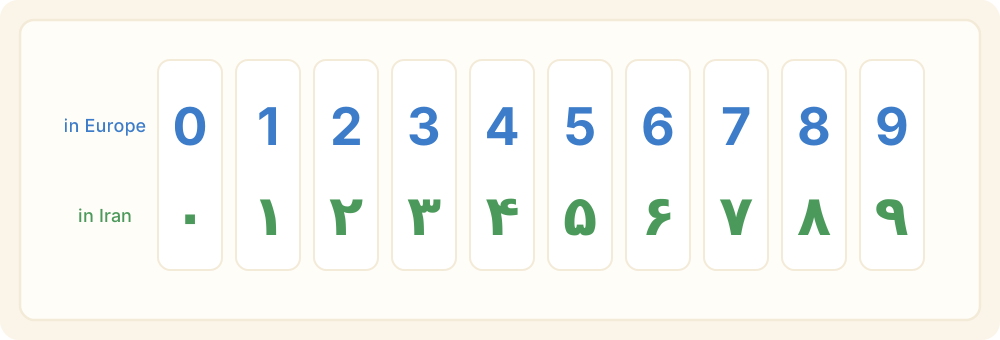
With just ten signs you can write any number at all, however big, in a few signs: 87 needs only two. How can ten signs be enough? That is the trick of the next two lessons: a sign for nothing, and where each sign stands.
Try it at home
- Write your age, and the year you were born, in tally marks, then in Roman numerals. Which is shorter?
- Look for Roman numerals around you: on a clock, a watch, a film's ending, a book's chapters.
Words to know
- tally - writing a number with one mark for each thing
- numeral - a sign used to write a number, like 7 or ۷ or VII
- Hindu-Arabic numerals - the ten numerals from zero to nine, invented in India and used across most of the world today
Big idea
A tally needs one mark for each thing, so big numbers get very long. Signs for whole groups make them shorter, and the ten numerals invented in India let us write any number with just a few signs.