How Many at a Glance?
Roll a dice. The top shows five dots. Did you count them, "one, two, three, four, five"? Probably not. You just saw five. But throw seven beans on a table and you will have to count them. Why can we see some numbers at once, and not others?
Up to about four, we just see
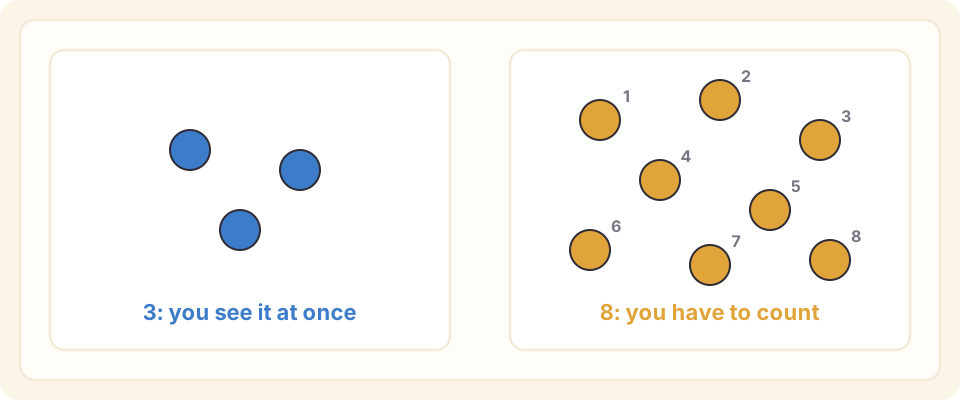
Look at a few things quickly - one cup, two cups, three cups - and you know how many without counting. Scientists who study the mind have found that people can do this for up to about four things. This quick seeing has a name: subitizing (say "SOO-bi-tie-zing"), from a Latin word for "suddenly".
Babies can do a little of it, and so can some animals. It is older than counting words.
Above four or five, it stops working. With seven scattered beans, you have to count, as in the Why We Count lesson: point at each one and say the next word.
Patterns help
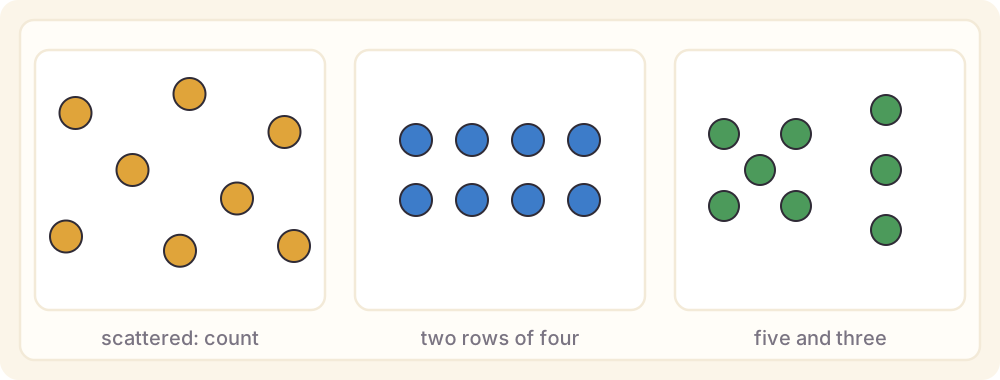
Why, then, can you see five dots on a dice at once? Because they are in a pattern. You have seen that pattern so many times that it is like a picture of the number. Six on a dice is two rows of three, and three you can see at once.
Patterns turn big numbers into small ones you can see:
- An egg box is two rows of six. You see two rows, and you know six.
- Dominoes, playing cards and dice all use patterns of dots for the same reason.
Groups of five
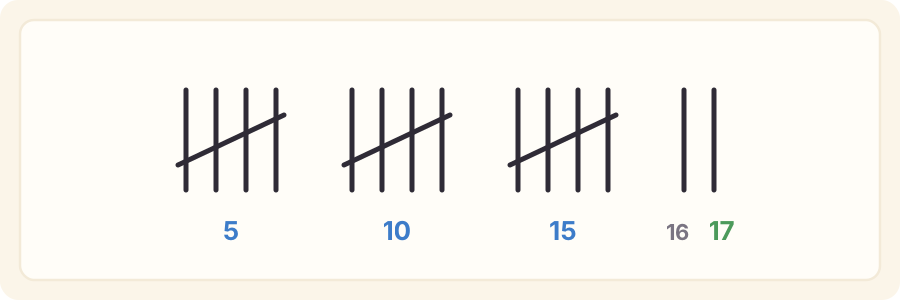
When people keep score, they often draw a small line for each point. After four lines, the fifth line goes across them. Then every bundle is five, and you can count the bundles: five, ten, fifteen, then the few lines left over.
Different places draw the bundle differently. In China and Japan, people often keep score by writing the character 正, which has exactly five strokes, one stroke per point.
Grouping is one of the most important ideas in all of maths. In the next module we will see how our way of writing numbers is built on groups of ten.
Try it at home
- Ask someone to drop a few coins on a table and cover them after one second. How many could you say without counting? Try with 3, 5 and 8 coins.
- Put 12 buttons in a pattern - rows, or groups - so that someone else can see how many there are without counting them one by one.
Words to know
- subitizing - seeing how many things there are at a glance, without counting; it works up to about four
- pattern - things placed in a regular way, like the dots on a dice, so you can see how many there are at once
Big idea
We can see up to about four things at once. For more, we count, or we put things into patterns and groups we can see quickly - the same idea that our way of writing numbers is built on.