Same Amount, Different Names
Ana cuts her chocolate bar into 2 equal pieces and eats one. Ben cuts the same kind of bar into 4 equal pieces and eats two. Ben says, "I ate more: I had 2 pieces, you only had 1." Is Ben right?
Two names for one amount
Put the two bars side by side. Ana ate 1/2 of her bar. Ben ate 2/4 of his. The part that is gone is exactly the same size: Ben's pieces are smaller, but he ate two of them.
- 1/2 = 2/4.
Cut the bar into 8 pieces instead, and half the bar is 4 of them: 4/8. So 1/2, 2/4 and 4/8 are three names for the same amount. Fractions like these, which are the same amount, are called equivalent fractions.
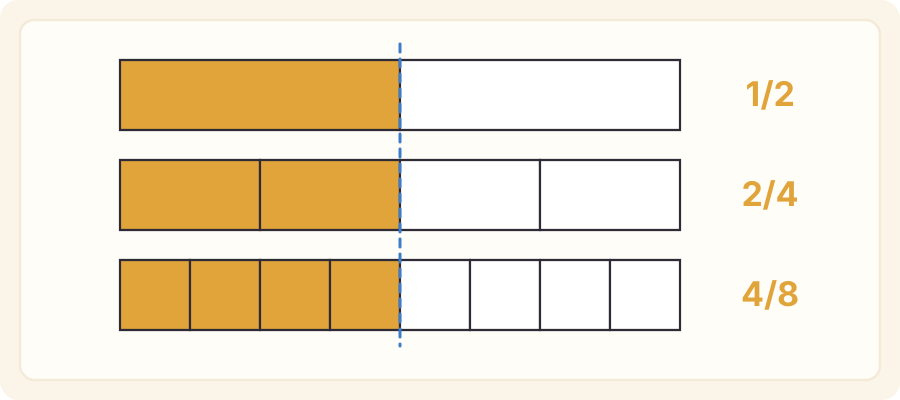
So Ben is wrong. Counting pieces only works when the pieces are the same size.
Making equivalent fractions
Look at what happened to the numbers when each piece was cut in two:
- the number of parts doubled: 2 became 4;
- the number of parts you have doubled too: 1 became 2.
Cutting every piece into 2 doubles both numbers, and cutting into 3 multiplies both by 3. The amount doesn't change. So to find an equivalent fraction, multiply the top and the bottom by the same number:
- 1/3 = 2/6 = 3/9, multiplying by 2 and then by 3.
It works backwards too. 6/8 shares 2 into both numbers: 6/8 = 3/4.
Which is bigger?
With the same bottom number, the pieces are the same size, so just count them: 5/8 is more than 3/8.
With the same top number, look at the size of the pieces. Is 1/3 of a pizza more or less than 1/2? Cutting into 3 makes smaller pieces than cutting into 2. So 1/3 is less than 1/2, even though 3 is bigger than 2. The more parts a whole is cut into, the smaller each part.
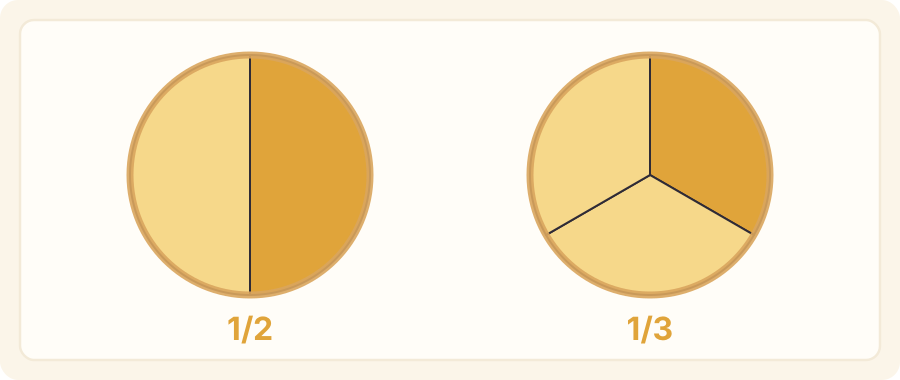
Would you rather have 1/4 of a cake or 1/10 of it? The quarter: it is a much bigger slice.
Try it at home
- Fold one sheet of paper in half, and another in half and then in half again. Colour half of each. Do the coloured parts match?
- Write two more fractions equivalent to 1/2.
- Which is more: 2/5 or 4/5? 1/5 or 1/6? Answers below.
Answers: 2. any of 3/6, 5/10, 10/20... 3. 4/5; 1/5.
Words to know
- equivalent fractions - fractions that are the same amount, like 1/2 and 2/4
Big idea
Different fractions can be the same amount: 1/2 = 2/4 = 4/8. Multiplying the top and bottom by the same number gives an equivalent fraction. With the same top number, a bigger bottom number means smaller pieces, so 1/3 is less than 1/2.