One More, Forever
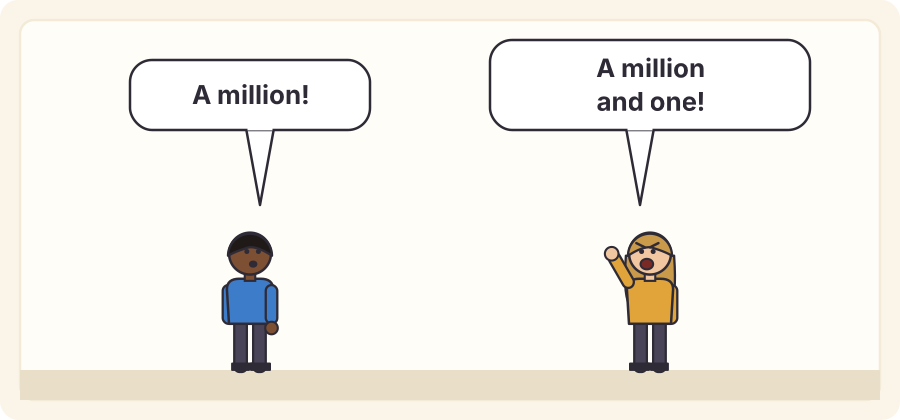
Sooner or later, every child asks: "What is the biggest number?" Someone says "a hundred". Someone else says "a hundred and one!" Then "a million!", "a million and one!" The game never ends. Why not?
The counting numbers
In the Why We Count lesson we saw that counting means matching things with the words one, two, three, and so on, in a fixed order. These numbers have a name: they are the counting numbers. Mathematicians also call them the natural numbers:
1, 2, 3, 4, 5, 6, 7, 8, 9, 10, 11, 12, ...
The three dots at the end mean "and so on, in the same way".
Each counting number comes from the one before it by adding one more. Three is two and one more. Ten is nine and one more. That is all you need to make every counting number: start at one, and keep adding one.
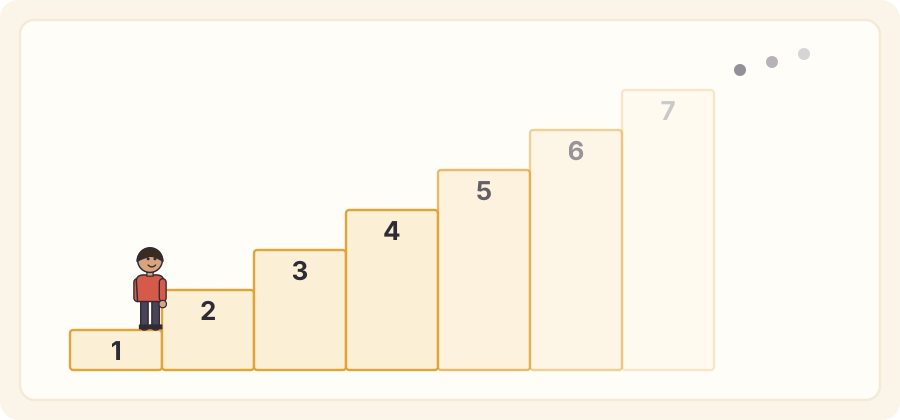
There is always one more
Now the question from the start. Is there a biggest counting number?
Suppose someone says they have found it. Call their number "the biggest". Add one to it. The new number is a counting number too, and it is one bigger than "the biggest". So "the biggest" was not the biggest after all.
This works for any number anyone names, however big. So there is no biggest counting number. The counting numbers never run out.
Never ending is not a number
People sometimes say the counting numbers "go on to infinity". Infinity is not the last counting number, waiting at the end of the line. It is a way of saying that there is no end. You can never reach it by counting, however long you count.
Even counting to a million is hard. If you said one number every second, day and night, without sleeping, it would take you more than eleven days. To count to a billion would take more than thirty years. And a billion is nowhere near the end - there is no end.
A list with no gaps
The counting numbers go up in steps of exactly one. Between 3 and 4 there is no other counting number. In a later lesson we will meet numbers that sit between them, like "three and a half", but those are not counting numbers: you can't count three and a half sheep.
Try it at home
- Play the "one more" game with someone: each of you names a bigger number than the last one said. Can either of you ever win? Why not?
- Count out loud for one minute with a timer. How far did you get? About how many minutes would it take to count to a thousand?
Words to know
- counting numbers (or natural numbers) - the numbers 1, 2, 3, 4, ... that we count with
- infinity - the idea of going on with no end; not a number you can reach by counting
Big idea
Every counting number is the one before it plus one more. Because you can always add one more, there is no biggest counting number: they never run out.