Between the Whole Numbers
In The Number Line lesson, we saw that there is room between the marks: between 0 and 1, between 1 and 2. At the time, we had no numbers to put there. Now we have fractions. Where do they go?
Cutting the step from 0 to 1
The step from 0 to 1 is one whole. Cut it into 4 equal parts, and each part is 1/4. Count the quarters along the line: 1/4, 2/4, 3/4, and then 4/4, which is the mark for 1.
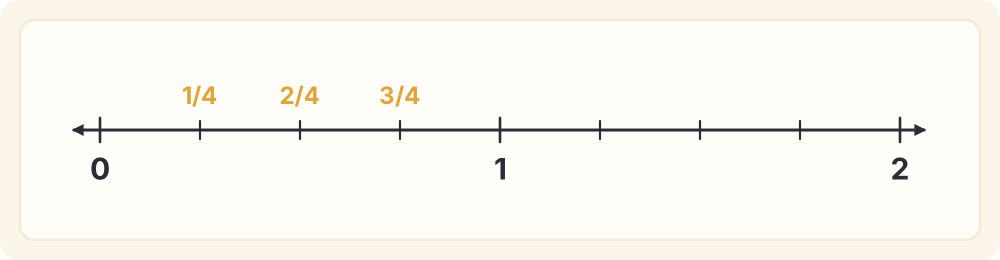
So a fraction is a number with its own place on the line, just like 3 or -2. And equivalent fractions, from the Same Amount, Different Names lesson, sit on the same mark: 1/2 and 2/4 are both exactly halfway between 0 and 1.
More than one whole
Keep counting quarters past 1: 5/4, 6/4, 7/4, 8/4. Five quarters is one whole and one quarter more. We can write that as 1 and 1/4, a whole number and a fraction together.
- 5/4 = 1 and 1/4;
- 8/4 = 2, because 8 quarters make 2 wholes.
A fraction with a top number bigger than the bottom one, like 5/4, is more than one whole. Think of quarters of pizza: 5 quarters is a whole pizza and one slice from another pizza.
Sharing gives fractions
In the Sharing Fairly lesson we asked about 3 ÷ 12 and had no answer yet. Fractions give one. Take a smaller case: share 3 pizzas between 4 friends.
Cut every pizza into quarters. That makes 12 quarters, so each friend gets 3 quarters: 3/4 of a pizza.
- 3 ÷ 4 = 3/4.
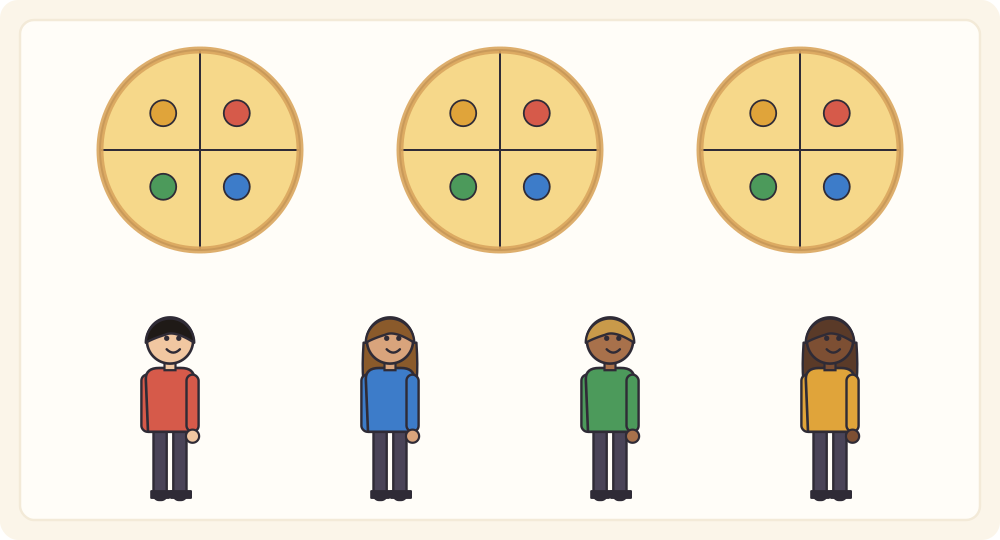
That is true of every fraction: a fraction is a division. 3/4 means 3 divided by 4. The slash is a way of writing "divided by". So every division, like 3 ÷ 12 = 3/12 = 1/4, now has an answer, as long as we don't divide by zero.
Try it at home
- Draw a line, mark 0 and 1 a hand's width apart, and cut the step into 2, then 4 equal parts. Label every mark.
- Where would 3/2 go on your line? (Hint: how many halves make 1?)
- Share 2 sandwiches between 3 people. How much does each get? Answers below.
Answers: 2. halfway between 1 and 2, because 3/2 = 1 and 1/2. 3. 2/3 of a sandwich.
Words to know
- 1 and 1/4 - one whole and one quarter more, the same as 5/4
Big idea
Fractions have their own places on the number line, between the whole numbers. Equivalent fractions sit on the same mark, and a fraction can be more than one. A fraction is a division: 3/4 is 3 ÷ 4.