When It Doesn't Share Evenly
Fourteen children are going on a school trip by car. Each car can take 4 children. How many cars are needed? 14 ÷ 4 doesn't come out evenly: there is no number that makes 4 × ? = 14. Does that mean the question has no answer?
Something left over
Let's do it as in the Sharing Fairly lesson: fill one car with 4 children, then another, then another.
- After 3 cars, 12 children are seated (3 × 4 = 12).
- 2 children are still standing on the pavement.
- They are not enough to fill another car.
So 14 ÷ 4 is 3, with 2 left over. What is left over is called the remainder. We write it:
- 14 ÷ 4 = 3 remainder 2.
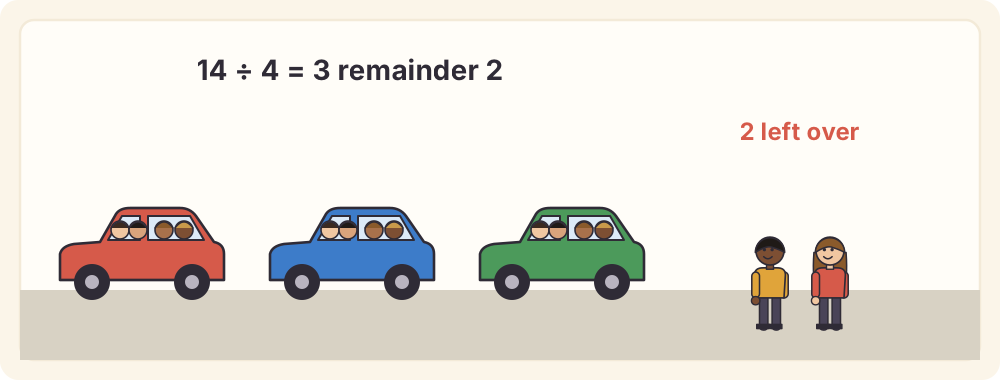
You can check it: 3 cars of 4 is 12, and 12 + 2 = 14. Every child is counted.
The remainder is always small
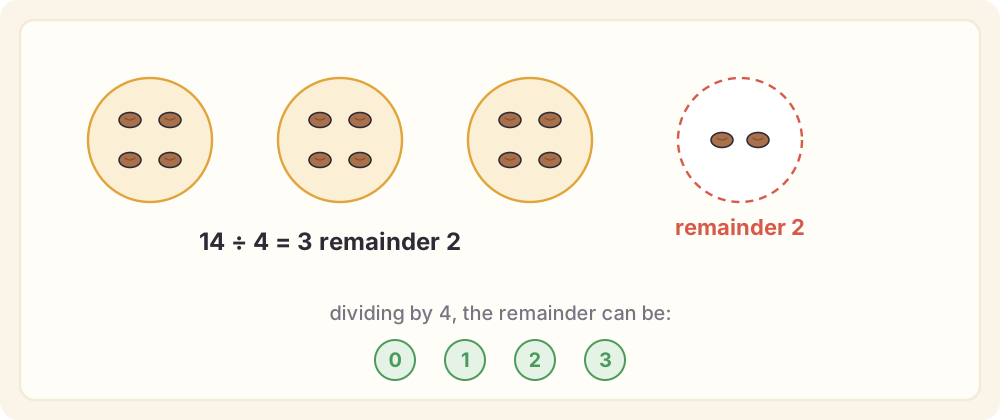
The remainder is always less than the size of the group. If 4 or more children were left over, they could fill another car, and we would not have finished. So when you divide by 4, the remainder can only be 0, 1, 2 or 3.
A remainder of 0 means the number shares evenly, like 12 ÷ 4 = 3.
What to do with the remainder
The sum is the same in each of these questions, 14 ÷ 4 = 3 remainder 2. But the answer to the question is not always the same:
- How many cars are needed? The 2 children left over still need a car, so the answer is 4 cars - one more than 3.
- How many full boxes of 4 eggs can you pack from 14 eggs? Only full boxes count, so the answer is 3 boxes (and 2 eggs stay out).
- Share 14 apples fairly between 4 friends. Each gets 3, and 2 are left. Or you could cut the 2 left over into pieces - but that needs numbers smaller than one, which come in the next module.
So always ask: what does the remainder mean here? That decides the answer, not the sum alone.
Try it at home
- Deal 17 coins into piles of 5. How many full piles, and how many left over?
- A bus holds 30 people. How many buses are needed for 70 people? Answers below.
Answers: 3 piles, remainder 2; 70 ÷ 30 is 2 remainder 10, so 3 buses.
Words to know
- remainder - what is left over when a number doesn't share evenly; it is always less than the size of the group
Big idea
When a number doesn't share evenly, something is left over: 14 ÷ 4 is 3 remainder 2. The remainder is always smaller than the group. What you do with it - another car, or leave it out - depends on the question.