Sharing Fairly
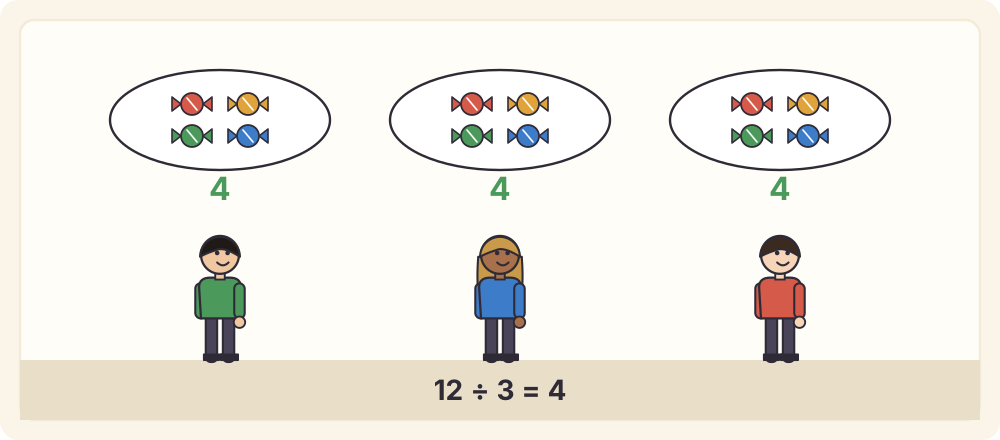
A grandmother has 12 sweets and 3 grandchildren. She wants to be fair: every child must get the same number of sweets, and none may be left over. How many does each child get?
Dealing them out
The simplest way is to deal them out, like cards: one sweet to each child, then another to each child, round and round, until the sweets run out.
Count what one child has: 4. Every child has 4. So 12 sweets shared between 3 children is 4 each.
This is dividing. We write it with a division sign:
- 12 ÷ 3 = 4, said "twelve divided by three equals four".
Two questions, one answer
Dividing answers two different questions:
- How many each? 12 sweets shared between 3 children: 4 each.
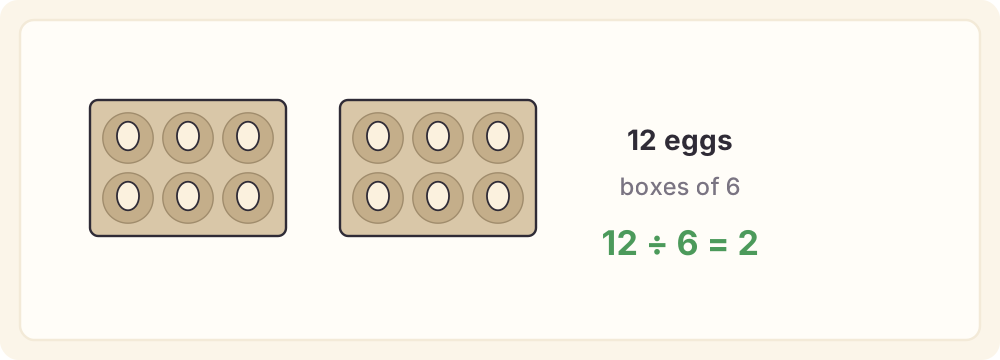
- How many groups? 12 eggs, packed into boxes of 6: how many boxes? You take 6 eggs away, then another 6, and the eggs are gone. That is 2 boxes. So 12 ÷ 6 = 2.
Both are dividing: cutting a number into equal parts.
Dividing undoes multiplying
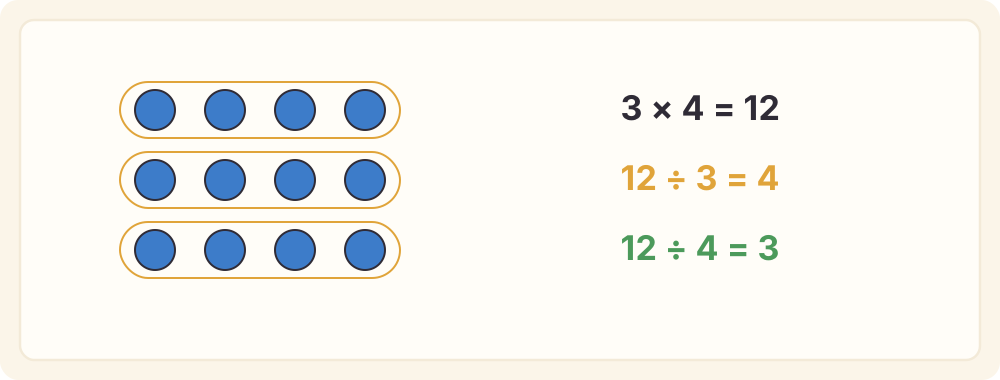
In the Rows and Groups lesson we saw that an array of chairs can be read in more than one way. Take 12 chairs in 3 rows of 4: 3 × 4 = 12. Now read the same array as sharing. Shared between 3 rows, the 12 chairs make 4 in each row. Shared into rows of 4, they make 3 rows.
- 3 × 4 = 12, so 12 ÷ 3 = 4 and 12 ÷ 4 = 3.
Just as subtracting undoes adding, dividing undoes multiplying. So when you need 20 ÷ 4, ask yourself: "4 times what is 20?" The answer is 5, because 4 × 5 = 20. So 20 ÷ 4 = 5.
The order matters, and zero is special
Like subtracting, dividing cares about order: 12 ÷ 3 is 4, but 3 ÷ 12 means sharing 3 sweets among 12 children - not even one sweet each. We will come back to that kind of answer in the module on parts of a whole.
And you can never divide by zero. Sharing 12 sweets among no children makes no sense: there is no one to give them to. "12 ÷ 0" has no answer at all.
Try it at home
- Deal 18 buttons into 3 piles, one at a time. How many in each pile? Now check with multiplying.
- You have 20 coins. How many piles of 5 can you make? Answers below.
Answers: 6 in each pile, because 3 × 6 = 18; 4 piles, because 4 × 5 = 20.
Words to know
- dividing - sharing a number out into equal parts, or finding how many equal groups fit in it
- division sign (÷) - the sign for dividing
Big idea
Dividing shares fairly: 12 ÷ 3 = 4 means 12 shared between 3 is 4 each, or 4 groups of 3 fit in 12. It undoes multiplying, so 3 × 4 = 12 tells you 12 ÷ 3 = 4. You can never divide by zero.