The Number Family
This course started with a shepherd counting sheep: 1, 2, 3. It has met many kinds of numbers since then: zero, numbers below zero, fractions, decimals. Are these all different things? Or do they belong together?
Each kind answers a new question
Look back at how each kind of number came in:
- Counting numbers, 1, 2, 3, ... answer "how many?" (the Why We Count lesson).
- Zero answers "how many, when there are none?" and fills the empty place in 205 (the Zero lesson). With zero, we have the whole numbers: 0, 1, 2, 3, ...
- Negative numbers answer "what is 3 - 7?", where the whole numbers had no answer (the Below Zero lesson). Together with the whole numbers, they are the integers: ..., -2, -1, 0, 1, 2, ...
- Fractions answer "what is 3 ÷ 4?", where the integers had no answer (the Between the Whole Numbers lesson).
Each time, a sum with no answer made people find a new kind of number.
One family, one inside the other
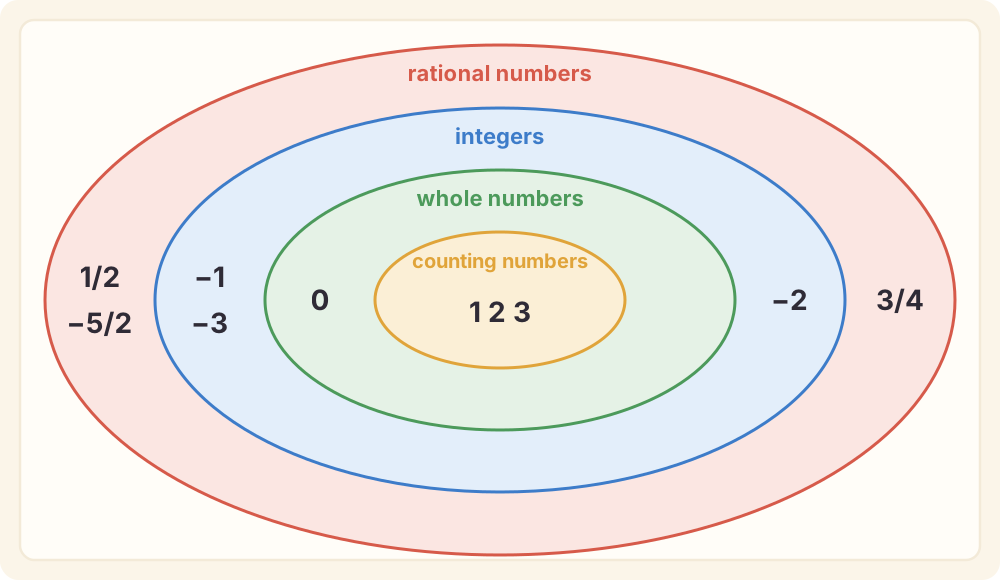
The new numbers didn't push the old ones out. Every counting number is still a whole number: 3 is a whole number. Every whole number is still an integer. And every integer is a fraction too: 3 is 3/1, three wholes.
So the kinds of number sit one inside the other, like boxes in boxes. Mathematicians call the biggest box here, all the numbers that can be written as a fraction, the rational numbers. ("Rational" comes from ratio, another word for one number divided by another.)
All on one line
All of them live on the number line: negative numbers to the left of zero, fractions and decimals in the gaps between the whole numbers. A decimal is a fraction too: 0.75 is 75/100, and 2.5 is 25/10.
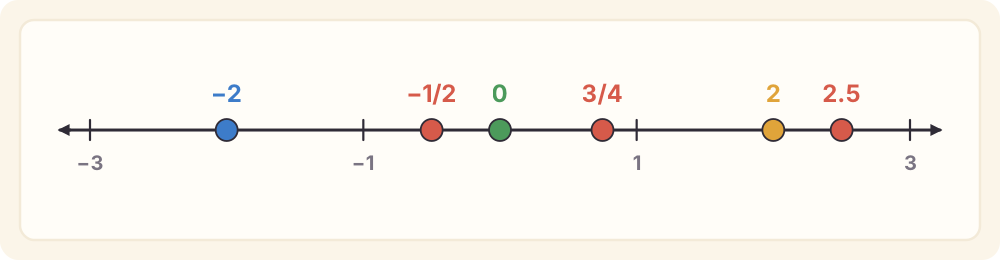
Is every point on the line a fraction? It seems it must be: the fractions are everywhere, and between any two of them there is always another. But the surprising answer is no. About 2,500 years ago, Greek mathematicians found lengths that no fraction can measure exactly, such as the diagonal of a square whose sides are 1. Those numbers are for Numbers Level 2.
Try it at home
- Write the numbers -3, 1/2, 7, 0 and 2.5 on slips of paper. Sort them: which are counting numbers? Whole numbers? Integers? Which can be written as a fraction?
- Find a number in your home that isn't a counting number: a temperature, a price, a measurement.
Answers to 1: counting numbers: 7. Whole numbers: 7, 0. Integers: -3, 7, 0. Fractions: all five (2.5 = 5/2, 7 = 7/1).
Words to know
- whole numbers - 0, 1, 2, 3, and so on
- integers - the whole numbers and the negative numbers: ..., -2, -1, 0, 1, 2, ...
- rational numbers - all the numbers that can be written as a fraction
Big idea
Each new kind of number answered a question the old ones couldn't: zero, negatives, fractions. They fit one inside the other, and all of them can be written as fractions: the rational numbers. But not every point on the number line is one.