Why We Count
Imagine a shepherd, thousands of years ago, in the hills. Every morning she takes her sheep out to eat grass. Every evening she brings them back. She has no numbers: no words like "twenty-three", and no way to write them. How can she know that every sheep came home?
One pebble for each sheep
Here is one way she could do it. In the morning, as each sheep walks out of the pen, she drops one pebble into a bag. One sheep, one pebble. Another sheep, another pebble.
In the evening, as each sheep walks back in, she takes one pebble out of the bag.
- If the bag is empty when the last sheep is in, every sheep came home.
- If a pebble is left over, a sheep is missing. She should go and look for it.
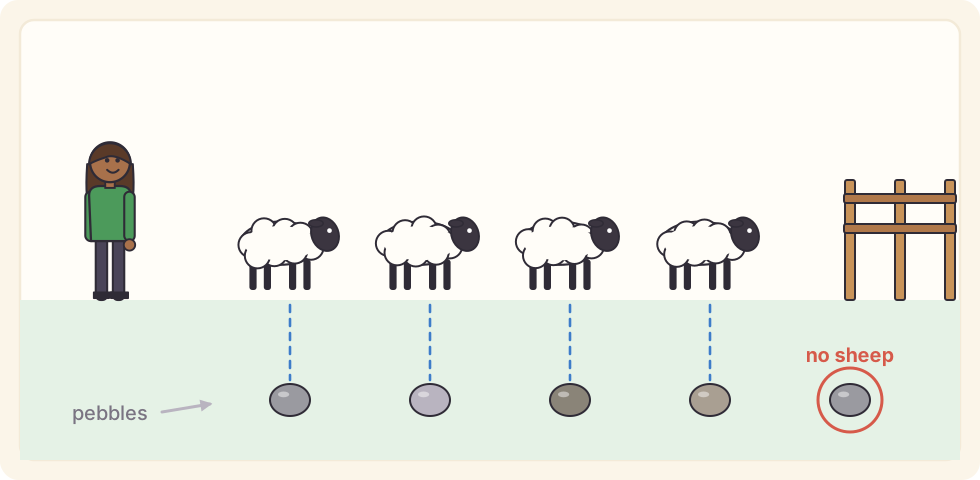
She never needed to know how many sheep she had. She only needed to match one to one: each sheep with one pebble, and no pebble used twice. The pebbles and the sheep are the same "how many", even though they look nothing alike.
This idea is very old. The word "calculate" comes from the Latin word calculus, which means a small pebble.
Counting is matching with words
Pebbles are heavy to carry. So people did something clever: they matched things with words instead. The words are always in the same order - one, two, three, four - and everyone learns that order as a child, so you always carry them with you.
When you count apples, you point at each apple and say the next word:
- point at the first apple, say "one";
- point at the next apple, say "two";
- and so on, never pointing at the same apple twice, never skipping one.
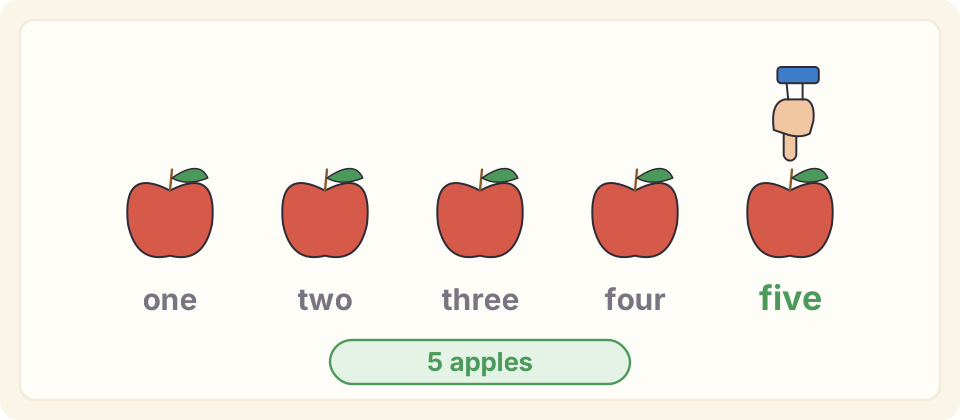
This is exactly what the shepherd did with pebbles. The counting words are pebbles you keep in your head.
The last word tells you how many
When you say "five" at the last apple, something new happens. "Five" is not the name of that apple. It tells you how many apples there are, all together. Children learn this step a little after they learn to say the words in order: at first a child may count "one, two, three" and then, asked how many, count again.
It also doesn't matter where you start. Count the apples from left to right or from right to left: you always end on "five". The order you count in can change, but the answer can't.
Try it at home
- Take a handful of buttons or dried beans and some coins. Put one coin next to each button, one to one. Are there more buttons, more coins, or the same? You didn't need to count to find out.
- Now count the buttons from left to right, then from right to left. Do you end on the same word?
Words to know
- matching one to one - pairing each thing in one group with exactly one thing in another, with nothing used twice
- counting - matching things, one to one, with the counting words in their fixed order; the last word says how many there are
Big idea
Counting is matching. A shepherd could match sheep with pebbles; we match things with the words one, two, three. The last word tells us how many there are, whichever order we count them in.