Counting in Other Groups
A football match has been going for 59 minutes. One minute later, the clock doesn't say 60 minutes: it says 1 hour. Something fills up and a new place begins - just like 9 turning into 10. Is counting in tens the only way?
Ten is a choice
In the Ones, Tens and Hundreds lesson we saw that our numbers are built on bundles of ten: ten ones make a ten, ten tens make a hundred. Ten is very likely there because of our ten fingers.
But nothing in maths says the bundle has to be ten. You could bundle sticks in fives, or twelves, or sixties. The idea of places works the same way for any size: when a place fills up, it becomes one in the next place to the left.
The size of the bundle is called the base. Our everyday numbers are base ten.
Sixty: the clock
About 4,000 years ago, people in Babylon counted in sixties. We still use their way every day, on clocks:
- 60 seconds make a minute;
- 60 minutes make an hour.
So a clock's minutes work like a place that fills up at 60, not at 10. After 59 minutes comes 1 hour and 0 minutes, like 9 turning into 10.
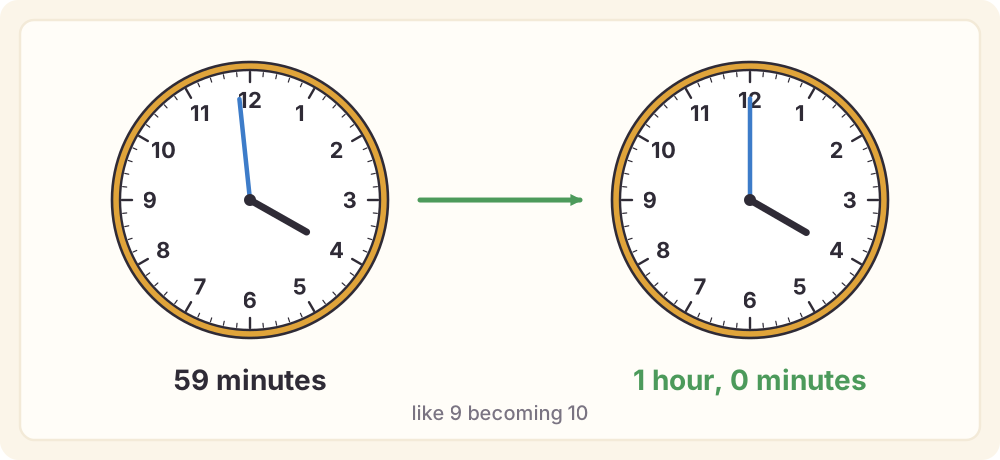
Sixty is a handy size because it can be shared in many ways: in halves, thirds, quarters, fifths, sixths and tenths. That is why an hour splits so neatly into 30, 20, 15, 12 or 10 minutes.
Two: the computer
A computer works with tiny switches, each one either off or on. Two states, so computers count in base two, with only two digits: 0 and 1.
In base two, a place fills up at two. So counting goes:
- 0, then 1 (one);
- then the ones place is full, so: 10 (one two, no ones) - this is two;
- 11 - two and one, which is three;
- 100 - this is four, because two twos fill the next place.
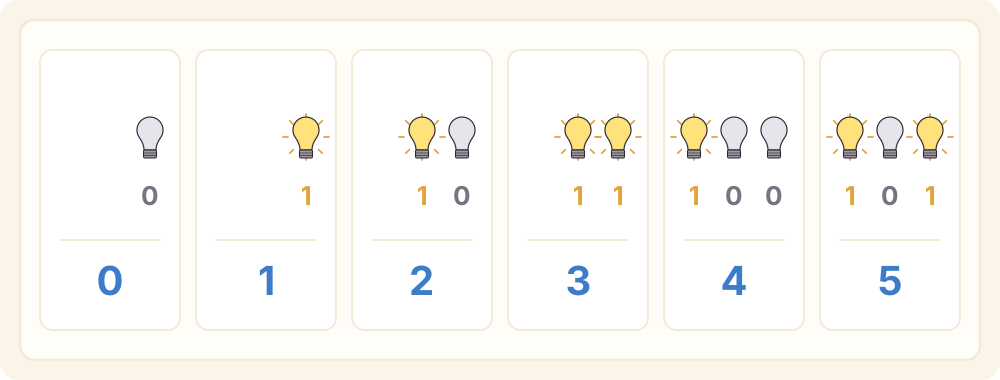
So in base two, "10" means two, not ten. Every photo, song and message on your phone is stored as long rows of 0s and 1s like these.
Same numbers, different ways to write
Whatever the base, the amounts are the same: seven sheep are seven sheep. Only the way of writing them changes. Base two writes seven as 111 (one four, one two and one one). Base ten writes it as 7.
Try it at home
- Look at a clock or watch. What comes after 4:59? What comes after 9:59? Which place "fills up"?
- Count your fingers in base two: hold a finger down for 0 and up for 1. With only two fingers, how far can you count? Answer below.
Answer: to three (00, 01, 10, 11).
Words to know
- base - the size of the bundle that fills a place; our everyday numbers are base ten
- base two - counting with bundles of two and only the digits 0 and 1, as computers do
Big idea
Our numbers group in tens, but any group size works the same way: when a place fills up, it becomes one in the next place. Clocks still use the Babylonians' sixties, and computers count in twos.