Even and Odd
A dance teacher asks the class to find a partner. If there are 8 children, everyone has someone to dance with. If there are 9, one child is left standing alone, however they pair up. Some numbers split into pairs neatly, and some never do. Which ones?
Pairs and one left over
Put things into pairs, two by two:
- If nothing is left over, the number is even. 8 is even: 4 pairs.
- If one is left over, the number is odd. 9 is odd: 4 pairs and 1 alone.
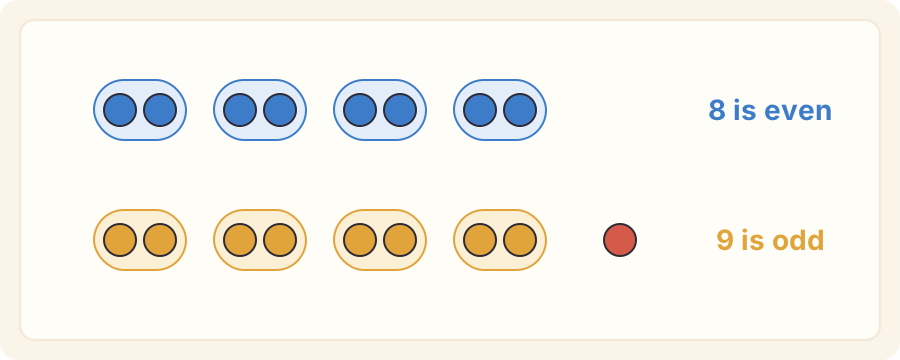
There is never more than one left over. If two were left, they would make another pair. In words from the When It Doesn't Share Evenly lesson: dividing by 2 leaves a remainder of 0 for an even number and 1 for an odd number.
Taking turns
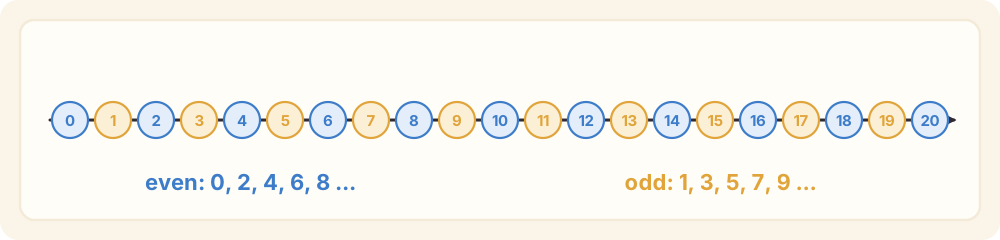
Counting up from zero, the numbers take turns: even, odd, even, odd...
- Even: 0, 2, 4, 6, 8, 10, 12, ...
- Odd: 1, 3, 5, 7, 9, 11, 13, ...
Yes, zero is even. Zero things split into pairs with nothing left over: zero pairs.
The last digit tells you
Is 3,458 even or odd? You don't need to make 3,458 pairs. Just look at the last digit, the ones:
- if it is 0, 2, 4, 6 or 8, the number is even;
- if it is 1, 3, 5, 7 or 9, the number is odd.
3,458 ends in 8, so it is even.
Why does only the last digit matter? Because every ten is even: a ten makes 5 pairs. So the tens, hundreds and thousands always split into pairs, and only the ones are left to decide.
Adding evens and odds
Pairs also explain what happens when you add:
- even + even is even: pairs plus pairs are still pairs.
- odd + odd is even: the two odd ones out pair up with each other.
- even + odd is odd: the odd one out is still alone.
So 7 + 5 must be even before you even work it out. (It is 12.)
Try it at home
- Count the socks in a drawer. Can they all be put into pairs? Is the number even or odd?
- Is your house number even or odd? On many streets, the even numbers are on one side and the odd numbers on the other. Is that true on yours?
- Even or odd: 47, 120, 999, 1,000? Answers below.
Answers: odd, even, odd, even.
Words to know
- even number - a number that splits into pairs with nothing left over; it ends in 0, 2, 4, 6 or 8
- odd number - a number that leaves one over when put into pairs; it ends in 1, 3, 5, 7 or 9
Big idea
An even number splits into pairs with none left over; an odd number always leaves one. The last digit tells you which, because tens always pair up. Odd plus odd is even, because the odd ones out pair up together.