Zero, the Number for Nothing
There are 3 biscuits in a jar. You eat one, then another, then the last one. How many biscuits are in the jar now? "None", you might say. "Nothing". But is "nothing" a number? For most of history, people did not think so.
A number for an empty box
In the Why We Count lesson, the last counting word told us how many things there are. But what is the answer when there is nothing to count? We need a number for that too: zero, written 0.
Zero is the number of biscuits in an empty jar, of birds on an empty branch, of goals in a game nobody scored in.
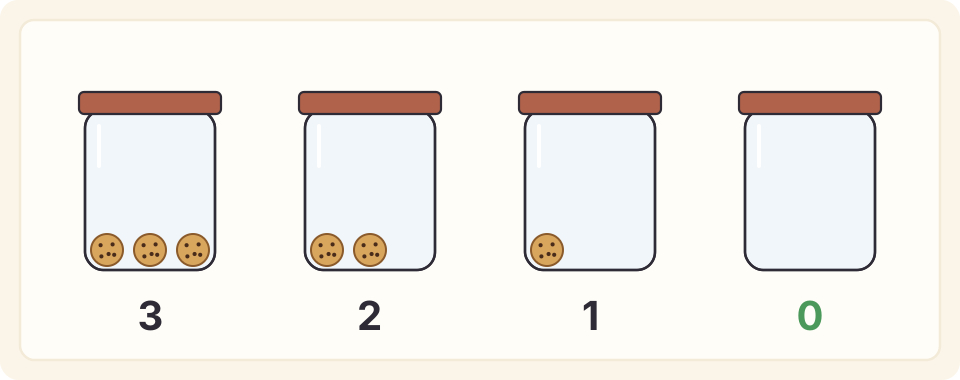
Notice that zero is not a counting number. You can't point at a thing and say "zero". It comes before one: zero, one, two, three...
Nothing became a number
For thousands of years, people counted and did sums without a sign for zero. Roman numerals, from the last lesson, have no zero: there is no Roman way to write "nothing".
The people of Babylon (in what is now Iraq) began, over 2,000 years ago, to leave a special mark where a number had an empty place. It was a gap-filler, not yet a number.
Then, in India, about 1,400 years ago, the mathematician Brahmagupta wrote down rules for using zero as a number, like any other. In the year 628 he wrote what happens when you add zero to a number, or take it away.
The rules of zero
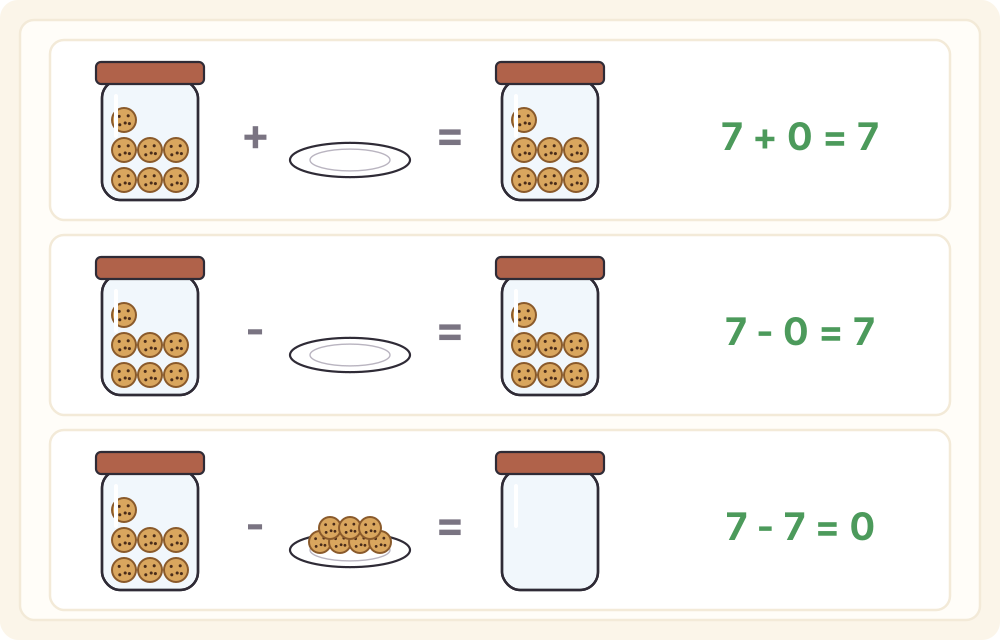
Here are zero's rules for adding and taking away, the ones Brahmagupta wrote down:
- Add zero to a number, and the number doesn't change: 7 + 0 = 7. Adding no biscuits to a jar leaves the same biscuits.
- Take zero away, and the number doesn't change: 7 - 0 = 7.
- Take a number away from itself, and you get zero: 7 - 7 = 0. Eat all the biscuits and the jar is empty.
Zero all around us
Once you look, zero is everywhere:
- In many countries, the ground floor button in a lift says 0. One floor up is 1.
- A football score of 2 - 0 means one team scored no goals.
- A ruler starts at 0, not at 1: that is where the length begins.
- A stopwatch starts at 0.
Zero has one more job, maybe its most important. It lets us tell 25 from 205 and from 250. That is the next lesson.
Try it at home
- Look at a ruler and a lift (or a picture of one). Where does each one put the zero?
- Work these out with buttons or coins: 5 + 0, 5 - 0, 5 - 5. Answers below.
Answers: 5, 5, 0.
Words to know
- zero (0) - the number of things when there is nothing there; it comes before one
Big idea
Zero is the number for nothing: how many biscuits are in an empty jar. Adding or taking away zero changes nothing. Treating nothing as a number took people thousands of years, and it was first done in India.