Parallel and Perpendicular Lines
Look at a page of lined paper. The lines never touch. Now look at the corner of the page: two edges meet in a square corner. These two kinds of lines have special names.
Perpendicular lines meet at a square corner
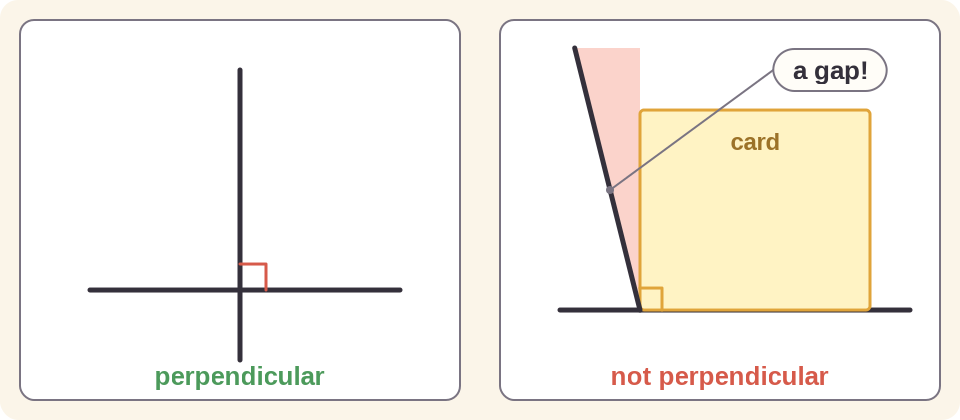
Two lines are perpendicular when they cross or meet at a right angle.
A little square in the corner shows the right angle.
To check, put the square corner of a card in the corner. Both edges must lie along the lines.
If there is a gap along one edge, the angle is not a right angle, and the lines are not perpendicular.
Parallel lines never meet
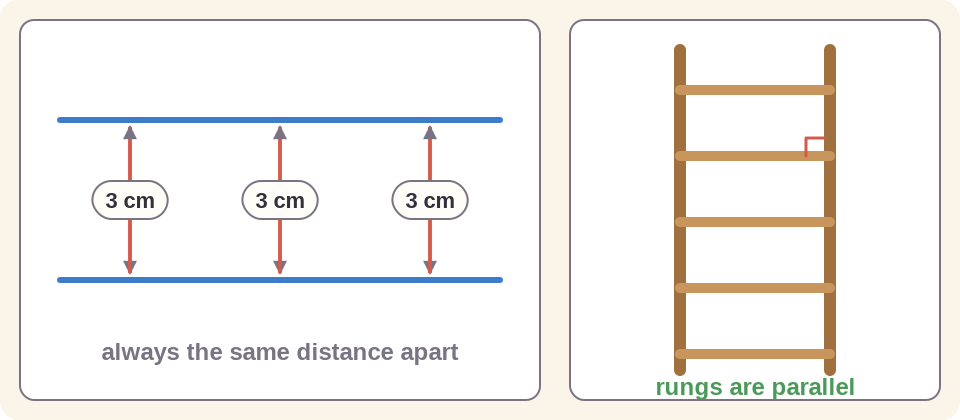
Two lines are parallel when they always stay the same distance apart. They never meet.
Measure straight across them in three places: you get the same length every time.
Train rails look like they meet far away, but that is only how our eyes see them.
The rungs of a ladder are all perpendicular to its sides, so the rungs are parallel to each other.
Try it at home
- Find three pairs of parallel lines and three pairs of perpendicular lines in your room.
- Check the perpendicular ones with the corner of a card.
- Measure the gap between two parallel lines in two places.
Words in this lesson
- parallel - always the same distance apart, never meeting.
- perpendicular - meeting at a right angle, a square corner.
Big idea
Perpendicular lines meet at a right angle; parallel lines stay the same distance apart and never meet.