Two-Digit by Two-Digit
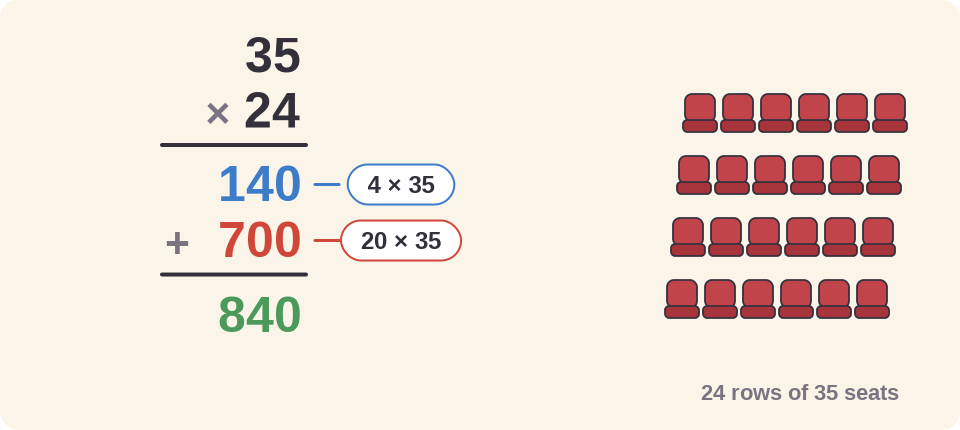
A theater has 24 rows with 35 seats in each row. How many seats is that? Here is the short way grown-ups use.
Two rows instead of four
Multiply 35 by the ones digit of 24: 35 × 4 = 140. That is the first row.
Multiply 35 by the tens: 35 × 20 = 700. That is the second row. It always ends in 0.
Add the two rows: 140 + 700 = 840.
So the theater has 840 seats.
Check with an estimate
Round 24 to 20 and 35 to 40. 20 × 40 = 800.
840 is close to 800, so the answer makes sense.
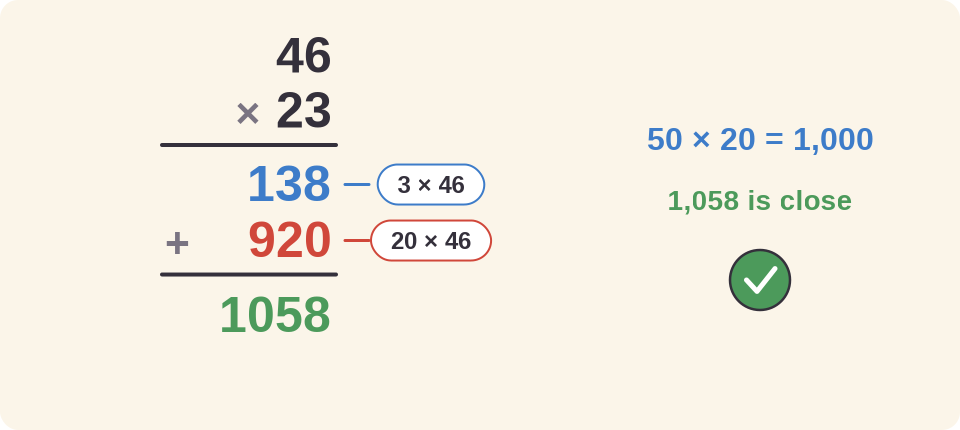
Try 46 × 23: the first row is 46 × 3 = 138. The second is 46 × 20 = 920. Together: 1,058.
Try it at home
- Count the rows and the chairs in a row of a room or a picture.
- Multiply them with two rows.
- Check with an estimate.
Words in this lesson
- estimate - a close answer from rounded numbers.
Big idea
Multiply by the ones, then by the tens (a row ending in 0), and add the rows.