Factor Pairs
You have 12 chairs to set out in equal rows, with none left over. How many different ways can you do it?
Rectangles of chairs
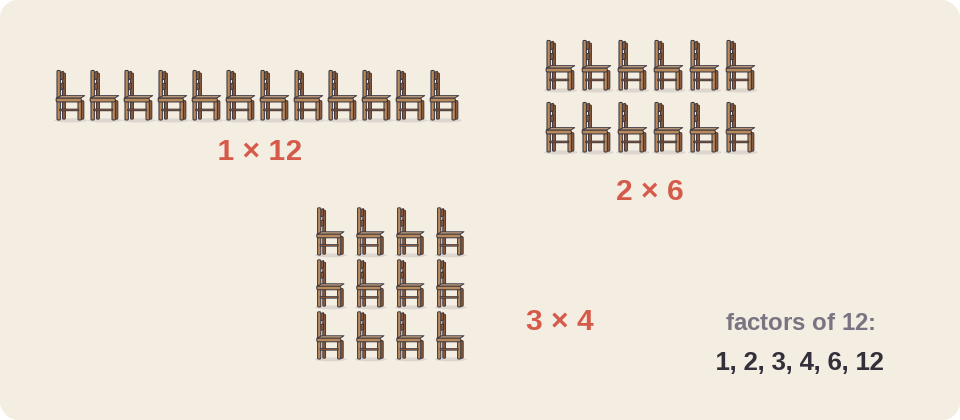
1 row of 12 chairs works. So do 2 rows of 6, and 3 rows of 4.
4 rows of 3 and 6 rows of 2 are the same shapes, turned around.
5 rows won't work: 5 rows of 2 is 10, and 2 chairs are left.
Each way makes a multiplication: 1 × 12, 2 × 6, 3 × 4.
The numbers that multiply to make 12 are its factors: 1, 2, 3, 4, 6 and 12.
Find them in pairs
Factors come in factor pairs. Start at 1 and go up.
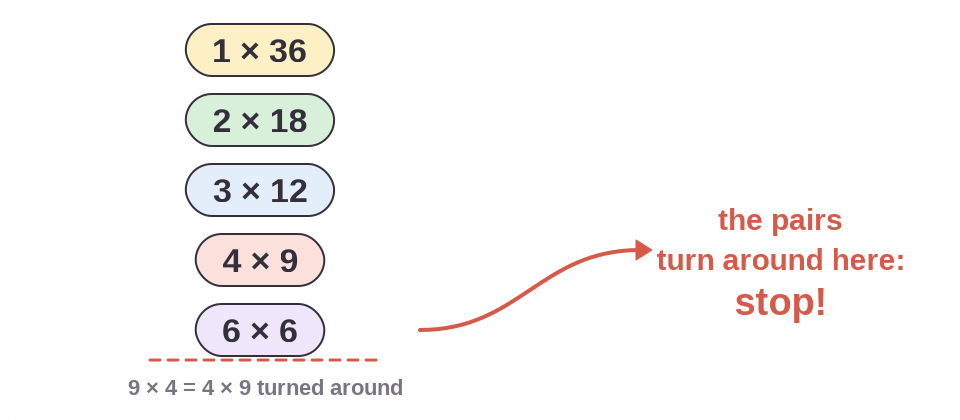
For 36: 1 × 36, 2 × 18, 3 × 12, 4 × 9, 6 × 6.
5 is not a factor, because 36 ÷ 5 leaves 1.
After 6 × 6, the next pair would be 9 × 4, which we already have, turned around. So stop!
Every number has 1 and itself as factors.
Try it at home
- Take 18 counters or coins.
- Make every rectangle you can with them.
- Write the factor pairs of 18. Did you find 1 × 18, 2 × 9 and 3 × 6?
Words in this lesson
- factor - a number that multiplies with another to make a number.
- factor pair - two factors that multiply to make the number.
Big idea
The factors of a number are the sides of its rectangles; find them in pairs and stop when they turn around.