Multi-Step Word Problems
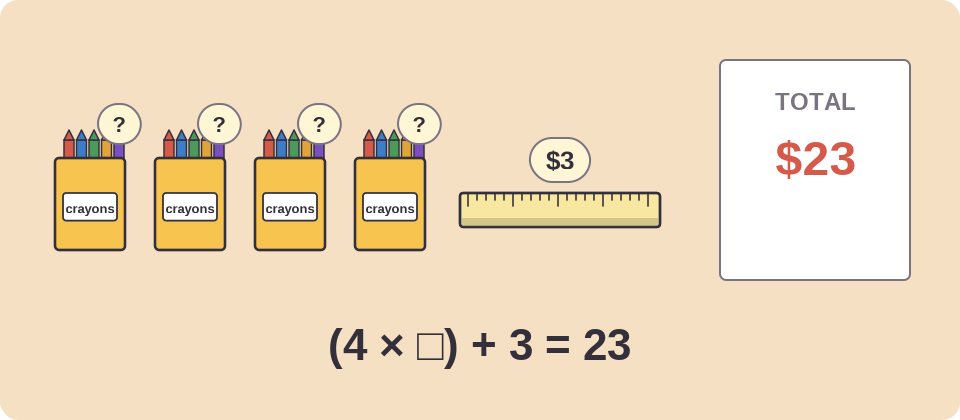
Four boxes of crayons and a $3 ruler cost $23 in all. How much is one box of crayons? You can't answer it in one step.
Write a number sentence with a box
Put a box where the unknown price goes.
Four boxes cost 4 × □. Add the ruler: (4 × □) + 3 = 23.
Take the ruler away first: 23 - 3 = 20. So 4 × □ = 20.
Then 20 ÷ 4 = 5. One box costs $5.
Check: 4 × 5 + 3 = 23. It works!
Split it into smaller problems
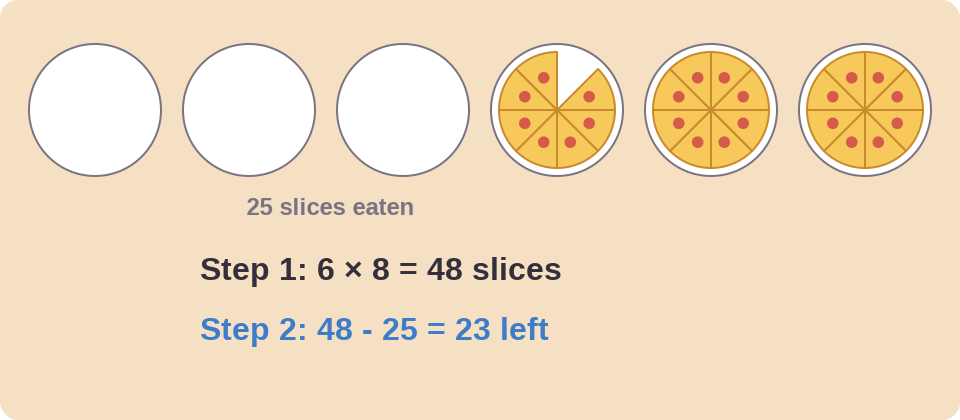
A class orders 6 pizzas cut into 8 slices. 25 children eat 1 slice each. How many slices are left?
Step 1: how many slices? 6 × 8 = 48.
Step 2: how many are left? 48 - 25 = 23.
Write each step on its own line. Then the big problem becomes two small ones.
Make the numbers simpler
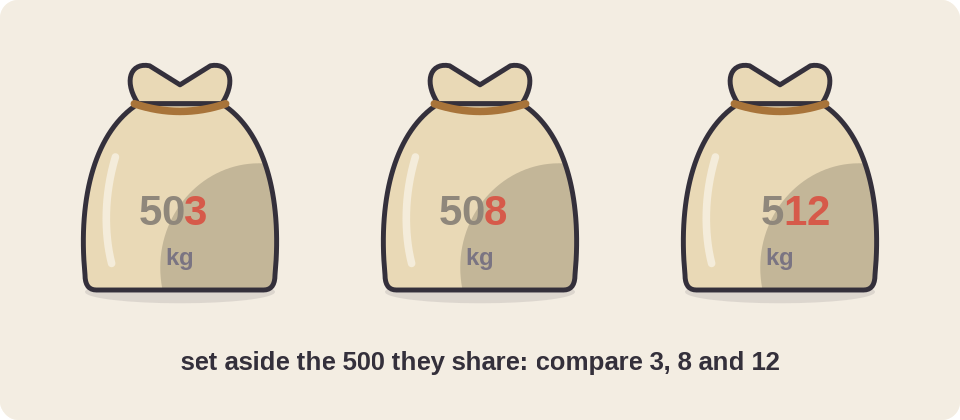
Three bags of flour weigh 503, 508 and 512 kilograms. Which is heaviest, and by how much?
They all have 500. Set it aside and compare 3, 8 and 12. Much easier!
Try it at home
- Make up a problem: 3 bags of 6 apples, and you eat 4. How many are left?
- Solve it in two steps.
- Write it as one number sentence: (3 × 6) - 4 = 14.
Words in this lesson
- number sentence - a problem written with numbers and signs, like (4 × □) + 3 = 23.
Big idea
Break a big problem into steps, use a box for the unknown, and make numbers simpler when you can.