Multiplying by 10, 100 and 1,000
A box holds 56 pencils. How many pencils are in 10 boxes? In 1,000 boxes? There is a fast way.
Every digit moves left
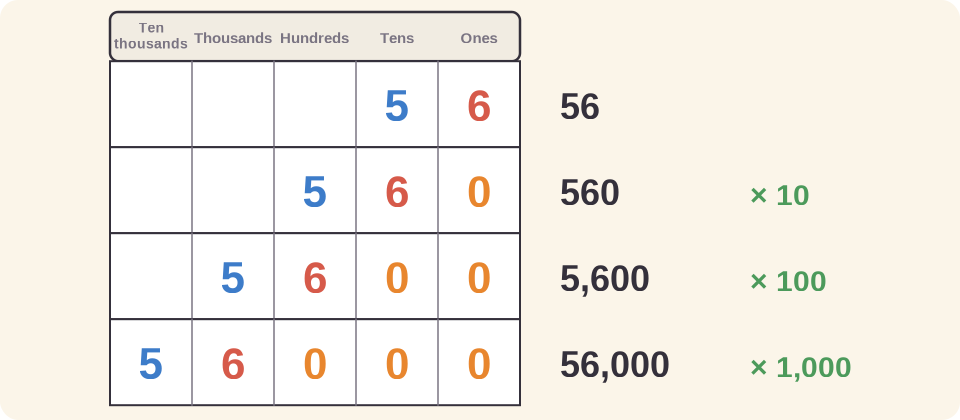
56 × 10 = 560. Each digit moves one place to the left, and a 0 fills the ones.
56 × 100 = 5,600: two places left, two zeros.
56 × 1,000 = 56,000: three places left, three zeros.
So 1,000 boxes hold 56,000 pencils.
Round numbers times round numbers
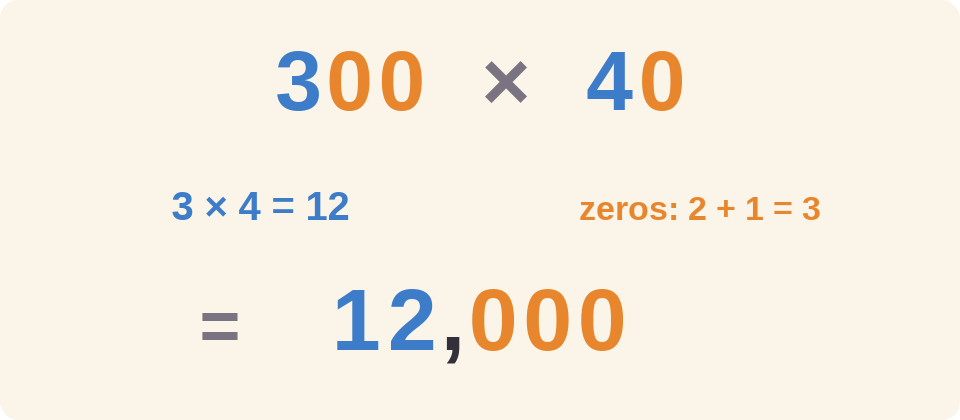
300 × 40 looks big. Multiply the front digits first: 3 × 4 = 12.
Then count the zeros in both numbers: two in 300 and one in 40. That is three zeros.
Put them on the end: 12,000.
Careful with 50 × 80: 5 × 8 = 40, which already has a zero. Add two more: 4,000.
Try it at home
- Use a calculator to work out 7 × 10, 7 × 100 and 7 × 1,000.
- What do you notice about the zeros?
- Now predict 60 × 300 before you check.
Words in this lesson
- multiple of ten - a number that ends in 0, like 30 or 400.
Big idea
Multiplying by 10, 100 or 1,000 moves every digit one, two or three places left.