Multiplying a Big Number by One Digit
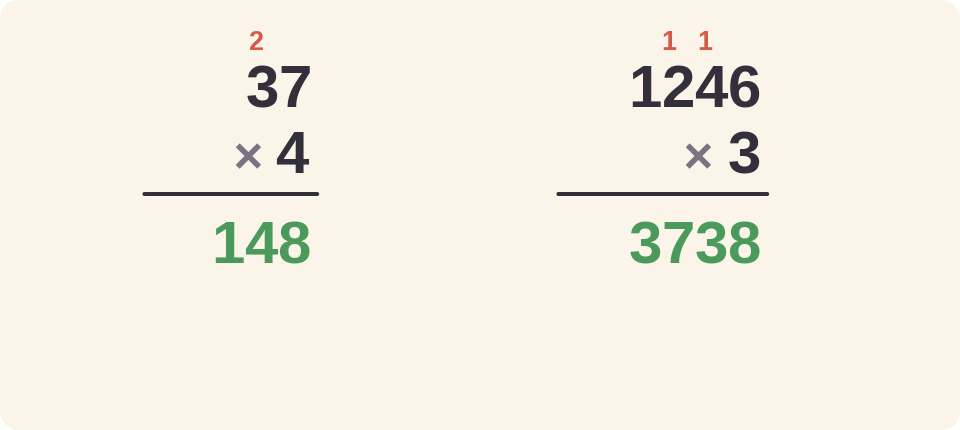
One bus seats 37 children. How many children can 4 buses take? Let's multiply in columns.
Start with the ones and carry
Write 37 with 4 under its ones.
Ones: 4 × 7 = 28. Write 8 and carry 2 tens.
Tens: 4 × 3 = 12 tens, plus the 2 carried makes 14 tens.
Write 14. So 37 × 4 = 148 children.
Bigger numbers work the same way. 1,246 × 3: ones, then tens, then hundreds, then thousands, carrying each time. It makes 3,738.
Check with an estimate
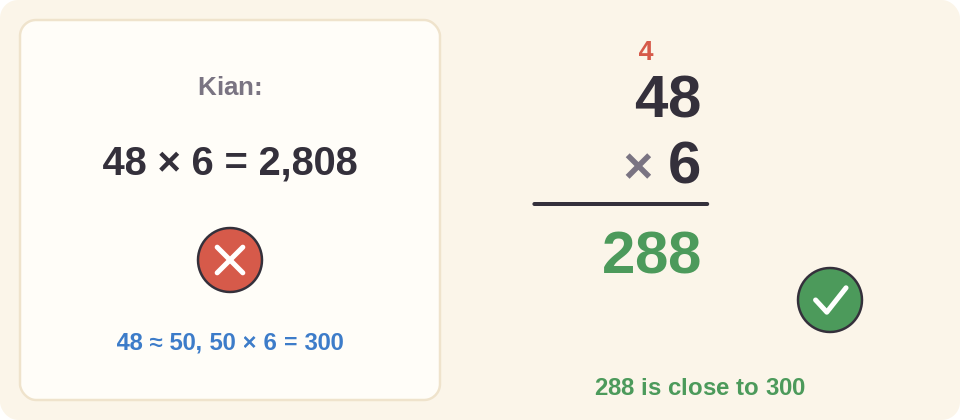
Kian worked out 48 × 6 and got 2,808. Is that right?
Round 48 to 50. 50 × 6 = 300.
2,808 is nowhere near 300, so it must be wrong. He wrote the 28 instead of carrying the 2.
The right answer is 288, close to 300.
Try it at home
- A pack has 24 crayons. How many crayons are in 6 packs?
- Multiply in columns, carrying when you need to.
- Check with an estimate: 20 × 6 or 25 × 6.
Words in this lesson
- carry - move the tens of a product to the next column on the left.
Big idea
Multiply each digit from the right, carry, and check with an estimate.