Prime and Composite Numbers
Some numbers of cookies can be laid out in a rectangle with more than one row. Others can only make one long line. What makes them different?
One line or a rectangle?
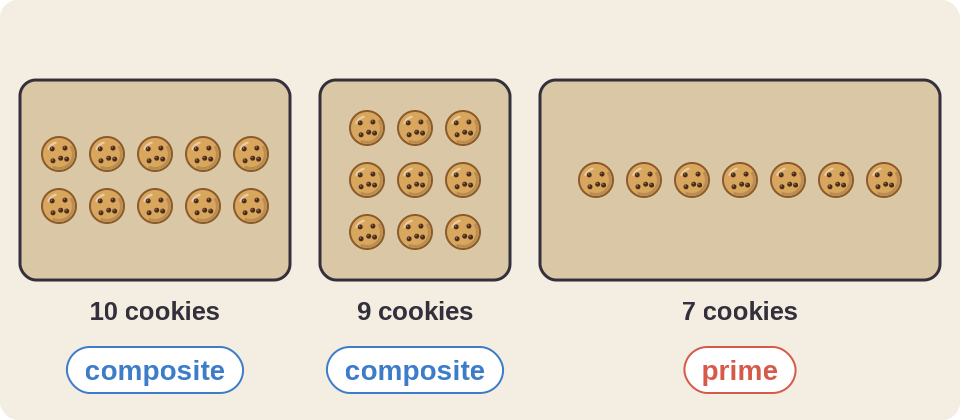
10 cookies can make 2 rows of 5. 9 cookies can make 3 rows of 3.
But 7 cookies only make one line of 7. No other rectangle works.
7 has just two factors: 1 and 7. A number like that is prime.
10 and 9 have more than two factors. They are composite.
1 is neither: it has only one factor, itself.
A sieve for primes
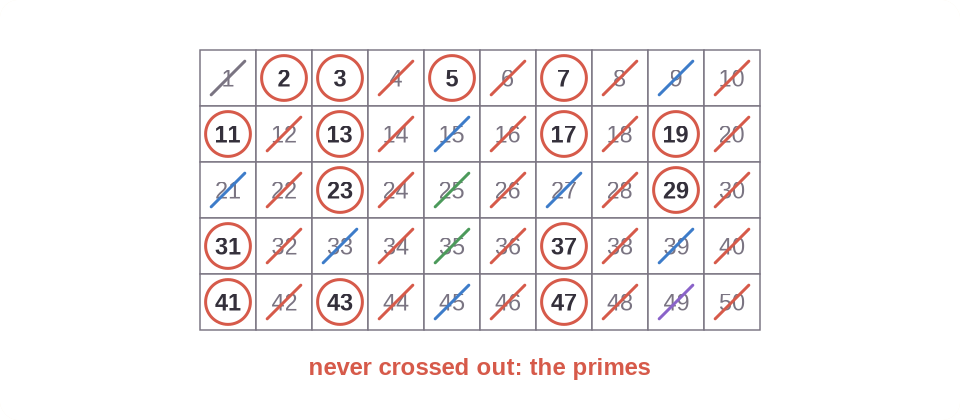
Long ago, a Greek thinker named Eratosthenes found primes with a sieve.
Write the numbers 2 to 50. Circle 2, then cross out every other multiple of 2.
Circle 3, the next number left, and cross out its multiples. Then do 5, then 7.
The numbers that are never crossed out are the primes: 2, 3, 5, 7, 11, 13...
For numbers up to 100, you can stop after 7. The next prime is 11, and 11 × 11 = 121 is already past 100.
Try it at home
- Take 11 buttons. Can you make a rectangle with 2 or more rows?
- Try 12 buttons. How many rectangles can you make?
- Which of the two is prime?
Words in this lesson
- prime number - a number with exactly two factors, 1 and itself.
- composite number - a number with more than two factors.
Big idea
A prime number has exactly two factors; a composite number has more; 1 is neither.