Subtracting Multi-Digit Numbers
A truck brought 6,004 bricks, and the builders used 2,357. How many are left? There are lots of zeros on top. Here is what to do.
Regroup when the top digit is too small
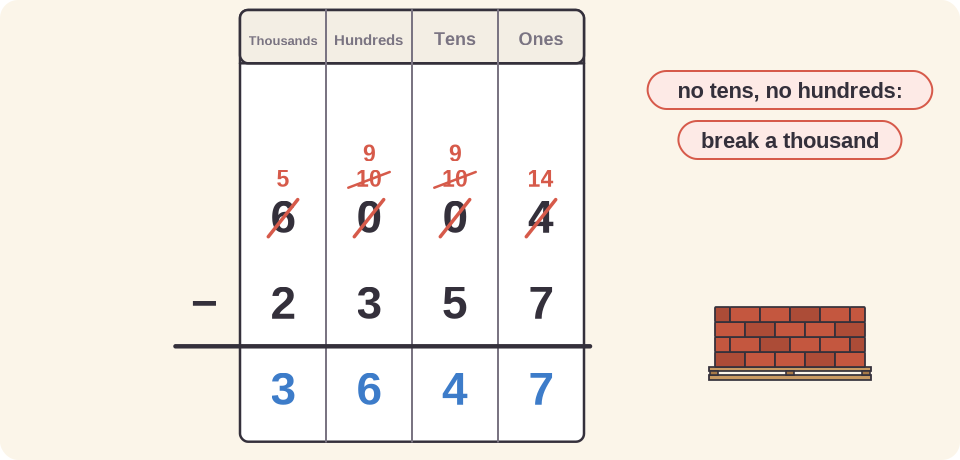
Start with the ones: 4 - 7. We can't take 7 from 4.
We need a ten, but the tens place is 0. The hundreds place is 0 too.
So go to the thousands. Break 1 thousand into 10 hundreds. Break 1 hundred into 10 tens. Break 1 ten into 10 ones.
Now the top reads 5 thousands, 9 hundreds, 9 tens and 14 ones.
14 - 7 = 7, 9 - 5 = 4, 9 - 3 = 6, 5 - 2 = 3. So 6,004 - 2,357 = 3,647.
Check by adding
Subtraction and addition undo each other.
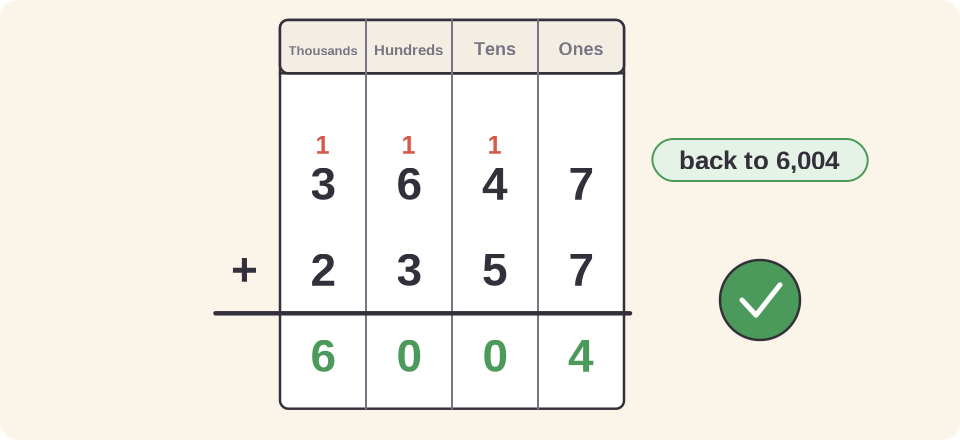
Add the answer to the number you took away: 3,647 + 2,357.
If you get back the top number, 6,004, your answer is right.
Round thousands can be done in your head too: 6,000 - 800 = 5,200.
Try it at home
- Write 5,000 - 1,350 on paper.
- Subtract, regrouping across the zeros.
- Check by adding your answer to 1,350.
Words in this lesson
- regroup - break one of a bigger place into ten of the next smaller place.
Big idea
Regroup from the next place when a digit is too small, and check by adding.