Comparing with the Same Bottom
Which is bigger, or ? Both are more than half. To be sure, give them the same bottom number.
Make the bottoms the same
With the same bottom number, the pieces are the same size. Then just compare the tops.
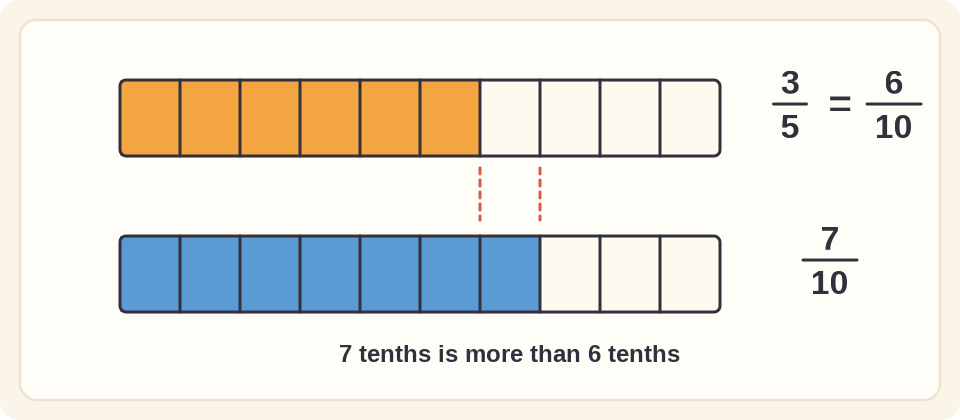
Fifths can become tenths: multiply the top and the bottom of by 2. You get .
Now compare and . 7 tenths is more than 6 tenths.
So < .
The same bottom helps with adding too
and have different bottoms. But thirds can become sixths: = .
Now both are sixths. Later you will add them: and make .
The trick works when one bottom number fits into the other: 5 into 10, 3 into 6, 4 into 12.
Try it at home
- Fold one paper strip into 5 equal parts and another into 10.
- Color 3 fifths and 7 tenths. Put the strips side by side.
- Which colored part is longer?
Words in this lesson
- common denominator - the same bottom number, given to two fractions so we can compare or add them.
Big idea
Give two fractions the same bottom number; then the bigger top means the bigger fraction.