Dividing Four-Digit Numbers
A factory makes 4,236 cookies and packs them in boxes of 6. How many boxes is that? The four steps still work, even with a big number.
When the first digit is too small
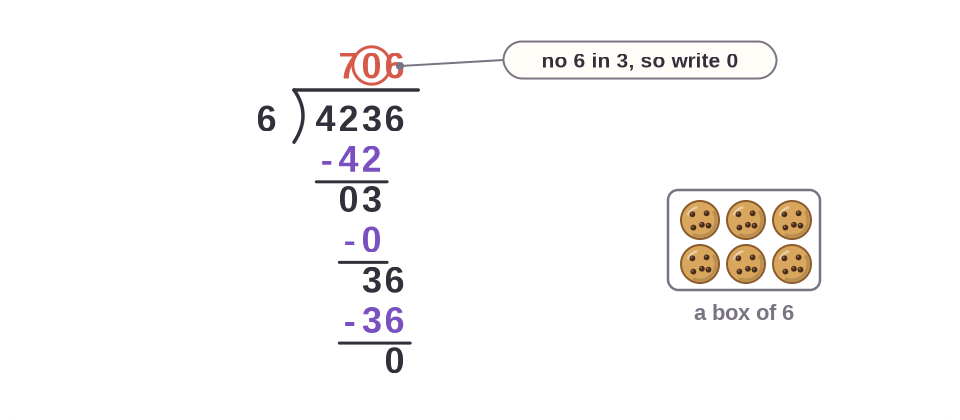
Start with 4 thousands. Can you make a group of 6 from 4? No.
So look at 42 hundreds instead. 42 ÷ 6 = 7. Write 7 over the 2.
Multiply: 7 × 6 = 42. Subtract: 0. Bring down the 3.
How many 6s in 3? None! Write 0 on top. Never skip a place.
Bring down the 6. Now we have 36. 36 ÷ 6 = 6.
So 4,236 ÷ 6 = 706 boxes.
Check by multiplying
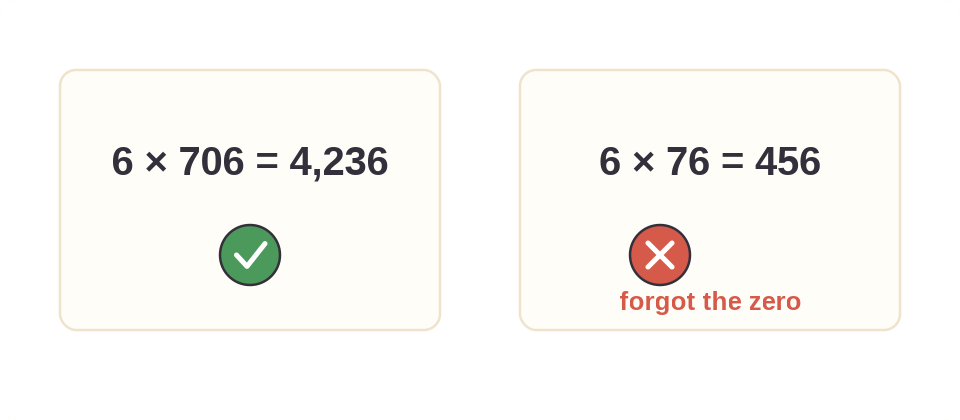
Is 706 right? Multiply it back: 6 × 706 = 4,236. Yes!
If you forget the 0, you get 76. But 6 × 76 is only 456. Far too small.
Here is another one: 625 kilograms of flour shared by 5 bakeries.
625 ÷ 5 = 125 kilograms each, and 5 × 125 = 625.
Try it at home
- Divide 3,248 by 4 with the four steps.
- Watch for a place where you must write 0.
- Check it by multiplying your answer by 4.
Words in this lesson
- check - to multiply back and see if you get the dividend.
Big idea
Long division works for big numbers too: write a 0 when a place has no group, then check by multiplying.