Multiples
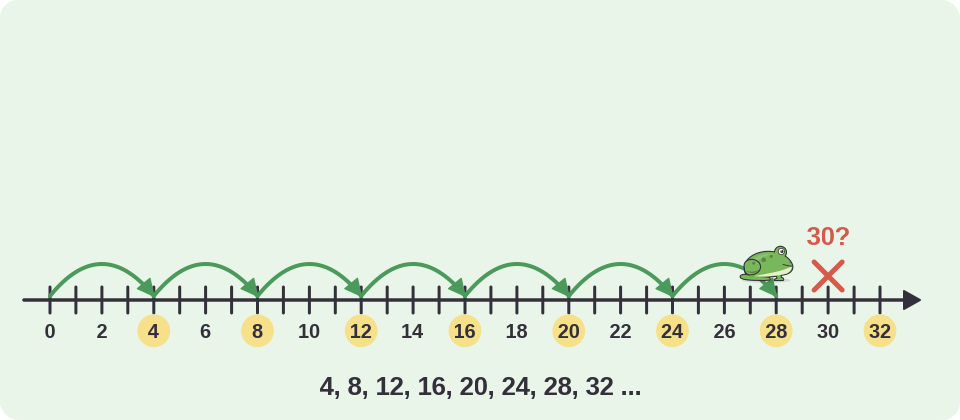
A frog starts at 0 and jumps 4 at a time: 4, 8, 12, 16... Will it ever land on 30?
Counting in jumps
The numbers the frog lands on are the multiples of 4.
They are 4 × 1, 4 × 2, 4 × 3, and so on: 4, 8, 12, 16, 20, 24, 28, 32...
30 is not on the list. 30 ÷ 4 leaves a remainder, so the frog jumps over it.
Is 28 a multiple of 4? Yes: 28 ÷ 4 = 7 with no remainder.
Multiples never end
You can always make one more jump, so there is no biggest multiple.
And 0 is a multiple of every number, because 4 × 0 = 0. The frog starts there.
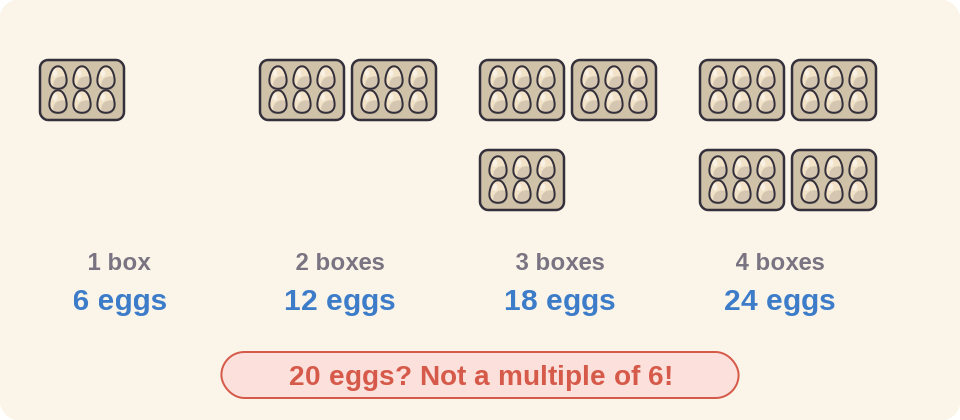
Eggs come in boxes of 6. You can buy 6, 12, 18, 24 or 30 eggs.
You can't buy exactly 20, because 20 is not a multiple of 6.
Try it at home
- Count by 7s out loud as far as you can.
- Write the first ten multiples of 7.
- Is 50 a multiple of 7? Check by dividing.
Words in this lesson
- multiple - a number you land on when you count in jumps of a number.
Big idea
The multiples of a number are what you get by multiplying it by 0, 1, 2, 3, and they never end.