The Area Model
A garden is 14 tiles long and 12 tiles wide. How many tiles cover it? Counting all of them would take a long time.
Cut the rectangle into easy parts
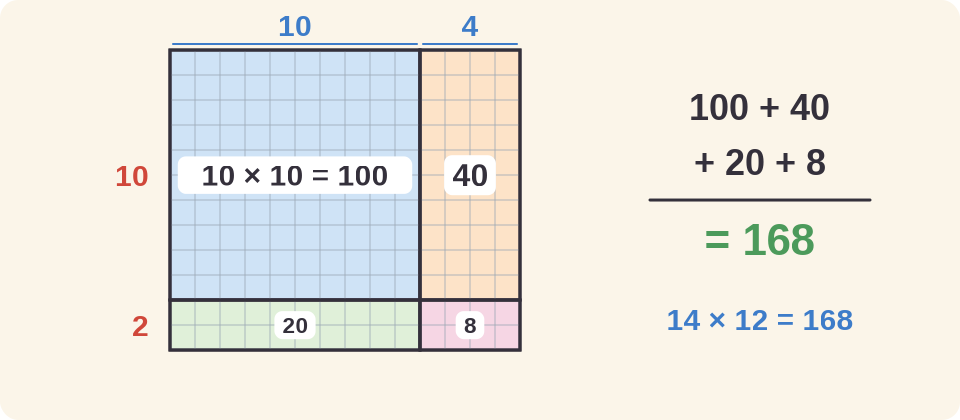
Draw a rectangle 14 long and 12 wide.
Cut 14 into 10 and 4. Cut 12 into 10 and 2.
Now the rectangle is four smaller rectangles.
10 × 10 = 100, 10 × 4 = 40, 2 × 10 = 20 and 2 × 4 = 8.
Add the four parts
100 + 40 + 20 + 8 = 168. So 14 × 12 = 168 tiles.
This drawing is called the area model. You don't need to draw every square.
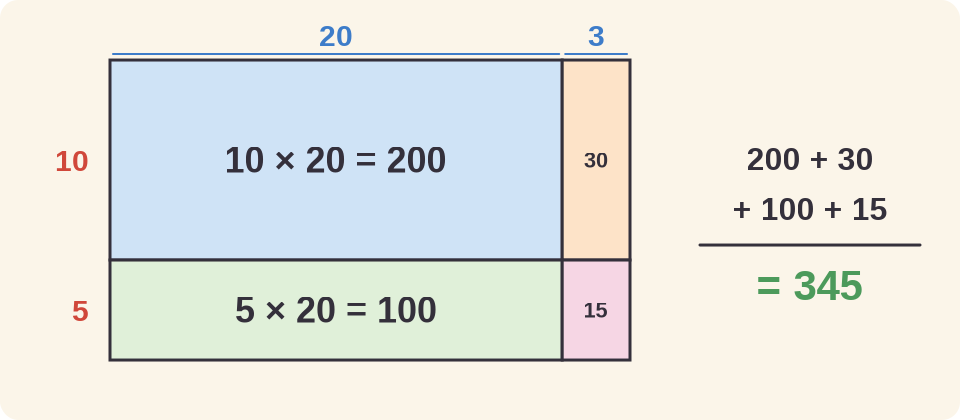
A plain rectangle with its four parts is enough: 23 × 15 is 200 + 30 + 100 + 15 = 345.
Try it at home
- Draw a rectangle for 13 × 11 on squared paper.
- Cut it into tens and ones, and find each part.
- Add the parts, then count the squares to check.
Words in this lesson
- area model - a rectangle cut into parts to show a multiplication.
Big idea
Cut both numbers into tens and ones, multiply the four parts, and add.