Partial Products
The area model has four parts. Can we write those parts in columns, without a drawing?
Four small products
Take 23 × 15. Multiply each part of one number by each part of the other.
5 × 3 = 15. 5 × 20 = 100. 10 × 3 = 30. 10 × 20 = 200.
These are partial products: parts of the whole product.
Write them in a column and add: 15 + 100 + 30 + 200 = 345.
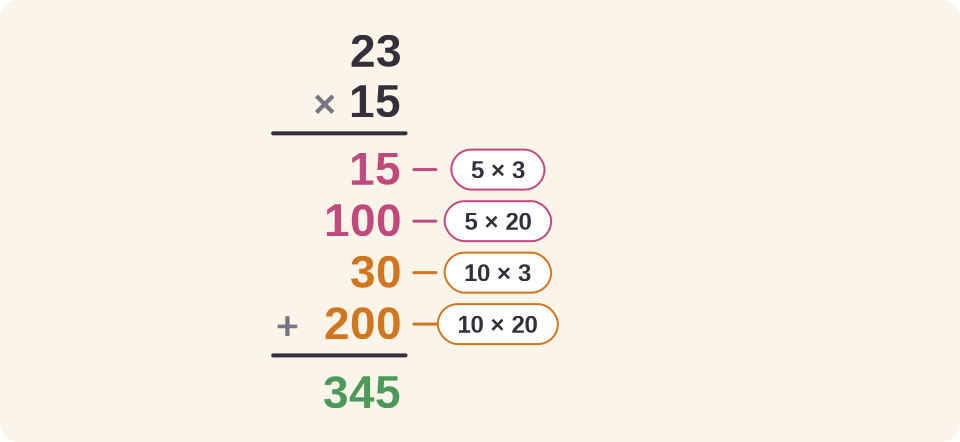
Each row matches a part of the rectangle
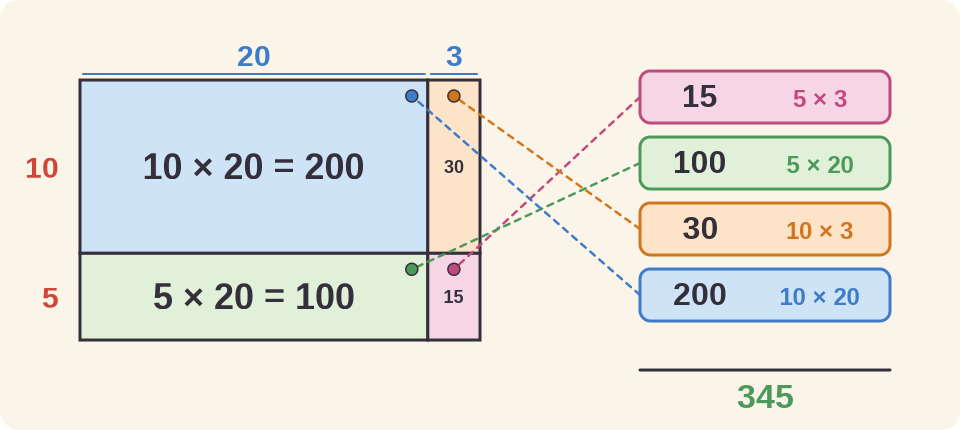
Put the column next to the area model.
Each row of the column is one part of the rectangle.
If you miss a part, the answer is too small. Count four rows for two two-digit numbers.
Try it at home
- Write 32 × 14 as four partial products.
- Add them up.
- Draw the area model to check you used all four parts.
Words in this lesson
- partial product - one part of a product, found by multiplying a part of each number.
Big idea
Two two-digit numbers make four partial products; add them for the answer.