Kilograms and Grams
A paper clip is very light. A bag of rice is heavy. Why do we use grams for one and kilograms for the other?
Weighing on a balance
Mass is how much stuff is in a thing.
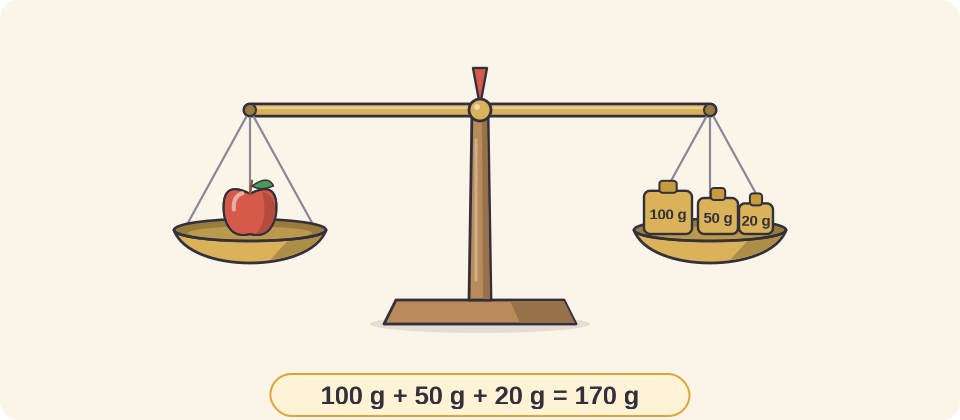
A balance shows it. When the bar is level, both pans hold the same mass.
This apple balances weights of 100 g, 50 g and 20 g.
So the apple's mass is 100 + 50 + 20 = 170 grams.
Grams, kilograms and tons
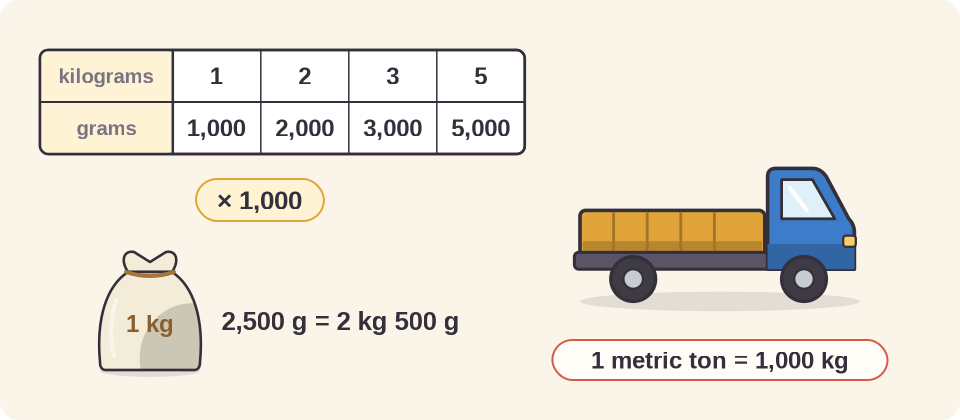
1,000 grams make 1 kilogram. A liter of water is about 1 kilogram.
To change kilograms to grams, multiply by 1,000. So 3 kg = 3,000 g.
2,500 g is 2,000 g and 500 g, so it is 2 kg 500 g.
Very heavy loads use the metric ton: 1,000 kilograms.
Try it at home
- Find packets in the kitchen that show their mass.
- Sort them: grams or kilograms?
- Change one in kilograms into grams.
Words in this lesson
- gram - a small unit of mass, written g.
- kilogram - 1,000 grams, written kg.
Big idea
1 kg = 1,000 g: multiply by 1,000 to change kilograms to grams.