Adding Multi-Digit Numbers
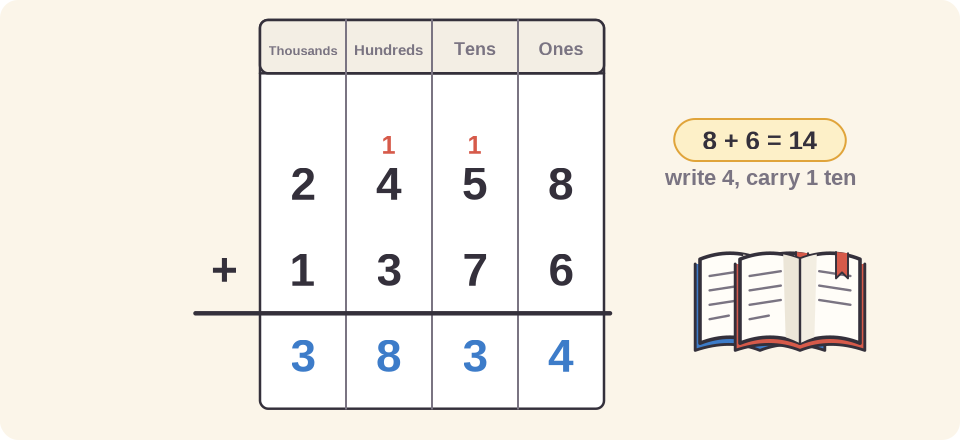
A school has 2,458 books and gets 1,376 more. How many books does it have now? Let's add them in columns.
Line up the places and start with the ones
Write the numbers one above the other, ones under ones.
Ones: 8 + 6 = 14. Write 4 and carry 1 ten to the tens column.
Tens: 1 + 5 + 7 = 13. Write 3 and carry 1 hundred.
Hundreds: 1 + 4 + 3 = 8. Thousands: 2 + 1 = 3.
So 2,458 + 1,376 = 3,834.
Bigger numbers, same steps
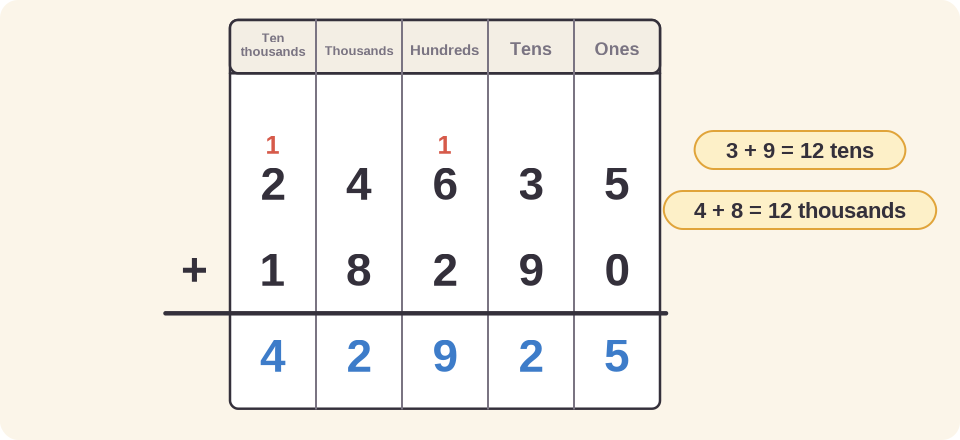
Five or six digits work the same way: one column at a time, from right to left.
Round thousands can be done in your head. 3,800 + 200 = 4,000, because 8 hundreds and 2 hundreds make 10 hundreds.
Check your answer with an estimate: 2,458 is about 2,500, and 1,376 is about 1,400. 2,500 + 1,400 = 3,900, close to 3,834.
Try it at home
- Find two prices or two distances with four digits.
- Add them in columns on paper, carrying when you need to.
- Check with an estimate.
Words in this lesson
- carry - move a ten to the next place on the left when a column adds up to 10 or more.
Big idea
Add column by column from the right, carrying when a column makes 10 or more.