Wandering Stars
Look at the same patch of sky every clear night for a month. The stars of a constellation stay in their places: Orion always has the same shape, year after year. But now and then you will find a bright "star" that is not in the same place each night. It slowly drifts across the constellations.
People noticed this thousands of years ago. The ancient Greeks called these moving lights planets, from their word for "wanderers".
Stars that move
With your eyes alone you can see five of them: Mercury, Venus, Mars, Jupiter and Saturn. They look like bright stars, but they don't stay inside one constellation. Night after night, each one moves a little against the stars behind it.
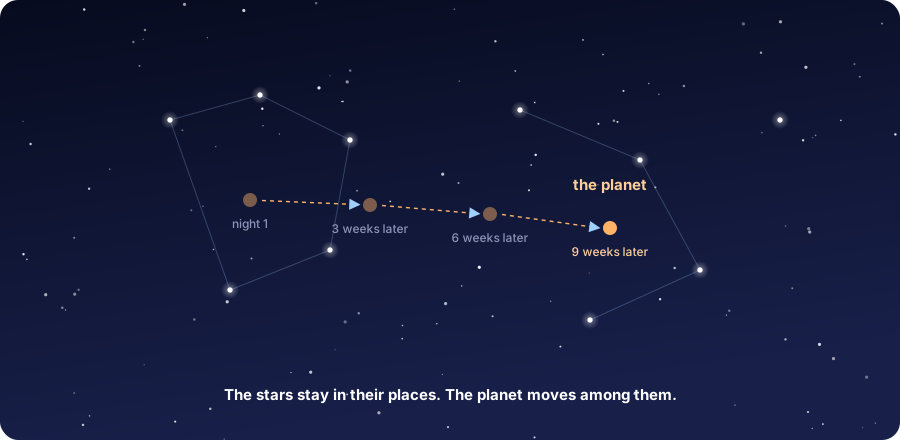
In the Constellations lesson we saw that the stars are very, very far away. They are so far that, seen from the Earth, they keep the same places in their constellations for our whole lives. So anything that moves among them must be much closer to us.
Worlds like the Earth
The planets are not stars. They are worlds that go around the Sun, just as the Earth does. Each one has its own orbit (its path around the Sun).
They wander because they are moving along their orbits, and we watch them from the Earth, which is moving along its own orbit too. So night after night we see each planet against a slightly different part of the sky.
The Earth is a planet too. It is the one we live on.
Planets shine with sunlight
The stars are suns: they make their own light. The planets don't. A planet is lit by the Sun, like the Moon is, and we see the sunlight it bounces back to us. They look bright because they are much closer to us than any star.
There is a simple way to tell a planet from a star. Stars twinkle: their tiny points of light flicker as the air above us moves. Planets usually shine with a steadier light.
The Sun's family
There are eight planets. In order, going out from the Sun, they are: Mercury, Venus, Earth, Mars, Jupiter, Saturn, Uranus and Neptune. Uranus and Neptune are too faint to see with your eyes. They were found with telescopes (tools that make faraway things look bigger and brighter), Uranus in 1781 and Neptune in 1846.
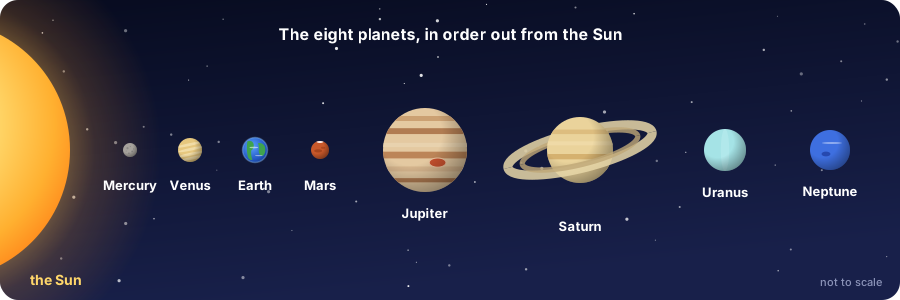
The Sun and everything that goes around it is called the solar system ("solar" means "of the Sun"): the planets, their moons, and many smaller worlds we will meet soon.
The closer a planet is to the Sun, the faster it goes around. In the Year lesson we saw that the Earth takes a year. Mercury, the closest, takes only 88 days. Neptune, the farthest, takes about 165 years.
Try it tonight
Venus is often the brightest point in the sky after the Moon. Look for it in the west just after sunset, or in the east before sunrise. Many free phone apps and websites show which planets are up tonight and where to look. Find one, and look at it on a few nights in a row against the stars around it.
Words to know
- planet - a big, round world that goes around the Sun and shines by the Sun's light, like the Earth
- solar system - the Sun and everything that goes around it
Big idea
The planets are worlds that go around the Sun, like the Earth. They shine by sunlight and slowly wander across the stars. There are eight of them, and the Earth is the third from the Sun.