Seasons
In Canada, a summer evening is still bright at nine o'clock, and children play outside after dinner. In December you walk home from school at half past four and the street lights are already on. Summer is hot, winter is freezing - and the Sun itself seems different: high and up for long hours in summer, low and gone early in winter.
Why does the same Sun give us such different halves of the year?
The obvious answer is wrong
Almost everyone's first guess is: in summer the Earth is closer to the Sun, and in winter it is farther away.
Two facts show that can't be right:
- When it is summer in Canada, it is winter in Australia - at the same time, on the same Earth. Australians have Christmas at the beach. If being closer made summer, the whole Earth would have summer together.
- The Earth is actually closest to the Sun in early January - in the middle of Canada's winter.
In the last lesson we saw that the Earth's orbit is almost a circle. Its distance from the Sun changes by only about 3 parts in 100 over the year - far too little to make summer and winter.
The tilted Earth
In the Day and Night lesson the Earth spun like a top. The imaginary line it spins around, running from the North Pole to the South Pole through the middle of the Earth, is called its axis. Halfway between the poles, a line around the Earth's middle called the equator splits it into a northern half and a southern half.
Here is the surprise: the axis doesn't stand straight up. It is tilted - it leans over a little (about 23 degrees), like a top that leans as it spins.
And as the Earth travels around the Sun, the axis keeps leaning the same way all year. (It points almost exactly at one star, the North Star - more about stars in the next lesson.)
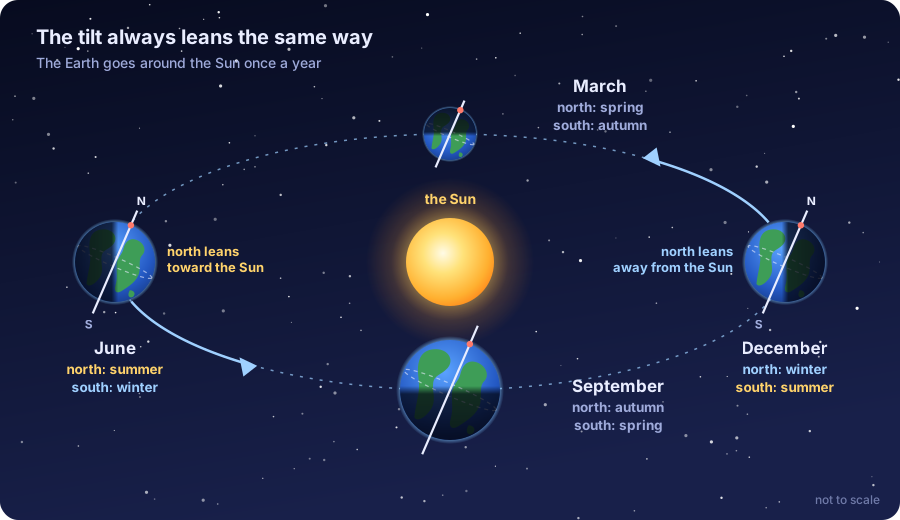
Follow the Earth around its orbit:
- In June the northern half leans toward the Sun. It is summer in Canada, Europe and China, and winter in Australia, Argentina and South Africa.
- In December the Earth is on the other side of the Sun. It still leans the same way - so now the northern half leans away from the Sun. Winter in the north, summer in the south.
- In March and September neither half leans toward the Sun: spring and autumn.
That's why the north and the south always have opposite seasons.
Why leaning toward the Sun makes summer
Leaning toward the Sun does two things for your half of the Earth.
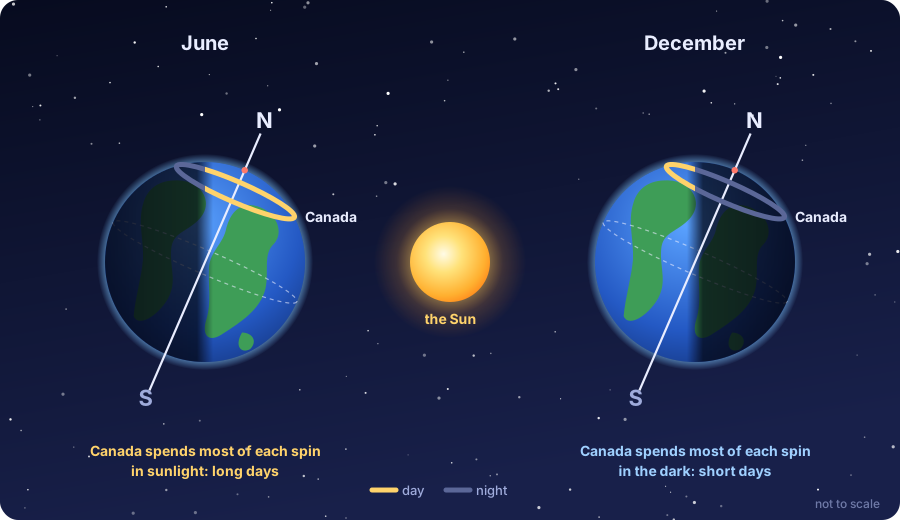
Longer days. As the Earth spins, you are carried through the sunlit half and then the dark half. When your half leans toward the Sun, your circle spends more of each spin in the light. In southern Canada a day in late June has about 15 and a half hours of daylight, and a day in late December only about 9.
A higher Sun. At noon in summer the Sun climbs high in the sky. Its light comes almost straight down, so it falls on a small patch of ground and heats it strongly. The low winter Sun's light comes in at a slant and spreads over a much bigger patch, so each bit of ground gets less of it.
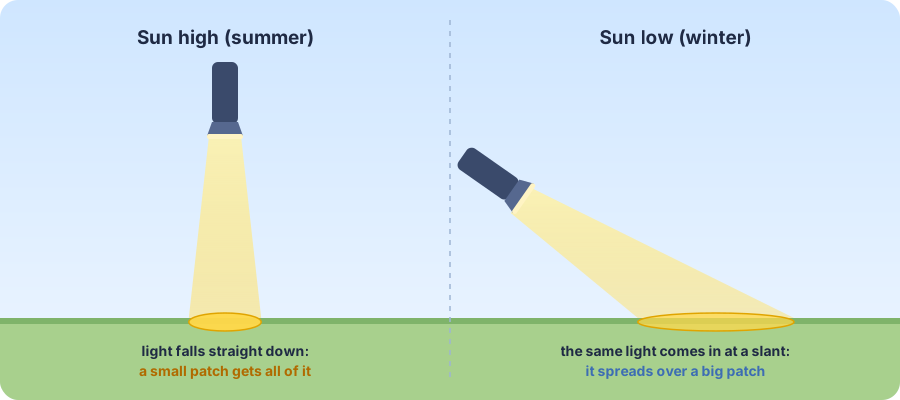
More hours of sunshine, and stronger sunshine: that is summer. Fewer hours, and weaker sunshine: winter.
Careful
The seasons don't come from the Earth getting closer to the Sun and farther away. They come from the tilt.
Try it at home
Push a pencil through your orange from top to bottom: that's the axis, with the North Pole at the top. Tilt the pencil a little toward one wall of the room - say the window. Now walk slowly around the lamp, keeping the pencil leaning toward the window the whole way.
- On one side of the lamp, the top half of the orange leans toward the light: summer in the north.
- Halfway round, the top half leans away: winter in the north, and now the bottom half gets the light.
Then, in a dark room, shine a torch straight down onto a sheet of paper, and slowly tilt it. Watch the same light spread into a bigger, dimmer patch.
Words to know
- axis - the imaginary line from the North Pole to the South Pole that the Earth spins around
- equator - the line around the middle of the Earth, halfway between the poles
- tilt - the Earth's axis leaning over, about 23 degrees
- seasons - spring, summer, autumn and winter, which come round once a year
Big idea
The Earth's axis is tilted and always leans the same way. As the Earth goes around the Sun, first the northern half and then the southern half leans toward the Sun, getting longer days and a higher Sun: its summer.