Day and Night, Revisited
On 21 June, three people in three cities watch the evening sky:
- In Singapore, near the equator, the Sun goes down a little after seven o'clock in the evening, as it does on every day of the year.
- In Madrid, in Spain, it is still light at nine o'clock. The Sun goes down at almost ten.
- In Tromsø, in the far north of Norway, the Sun doesn't go down at all. People walk outside at midnight in sunshine.
The Earth takes 24 hours to spin once for all three of them. So why are their days so different?
Why a day isn't always 12 hours
In the Day and Night lesson we learned two things:
- Half of the Earth is always lit by the Sun, and the other half is dark.
- The Earth spins once about every 24 hours. The spin carries each place through the lit half, and then through the dark half.
As the Earth spins, a city like Madrid goes once all the way around the Earth's axis and comes back to where it started. Its path is a circle.
If the axis stood straight up, the line between day and night would cut Madrid's circle into two equal halves. Madrid would spend half of the 24 hours in the light and half in the dark: 12 hours of day and 12 hours of night, every day of the year.
But in the Seasons lesson we found that the axis is tilted. Because of the tilt, the line between day and night cuts Madrid's circle into two unequal parts. Sometimes the bigger part is in the light, and sometimes it is in the dark. Madrid's day lasts as long as it takes to cross the part in the light.
June: the north leans toward the Sun
Imagine you are standing in Madrid. In the two pictures below, the dot marked you is you, in Madrid.
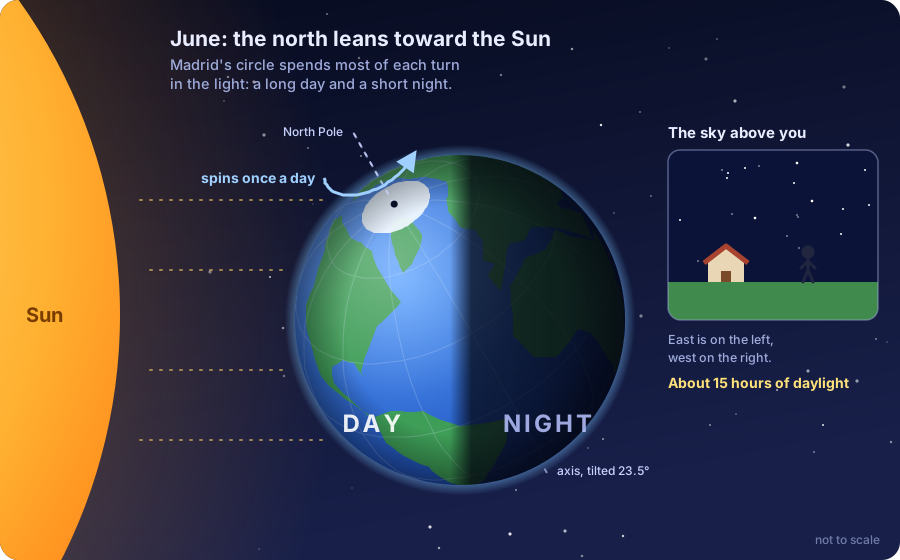
Follow the dot as the Earth turns. In June the north end of the axis leans toward the Sun, so the bigger part of Madrid's circle is in the light: about 15 hours of day and 9 hours of night. The small box shows the sky above you in Madrid.
December: the north leans away
Six months later the Earth is on the other side of the Sun. The axis still leans the same way, so now the north end leans away from the Sun.
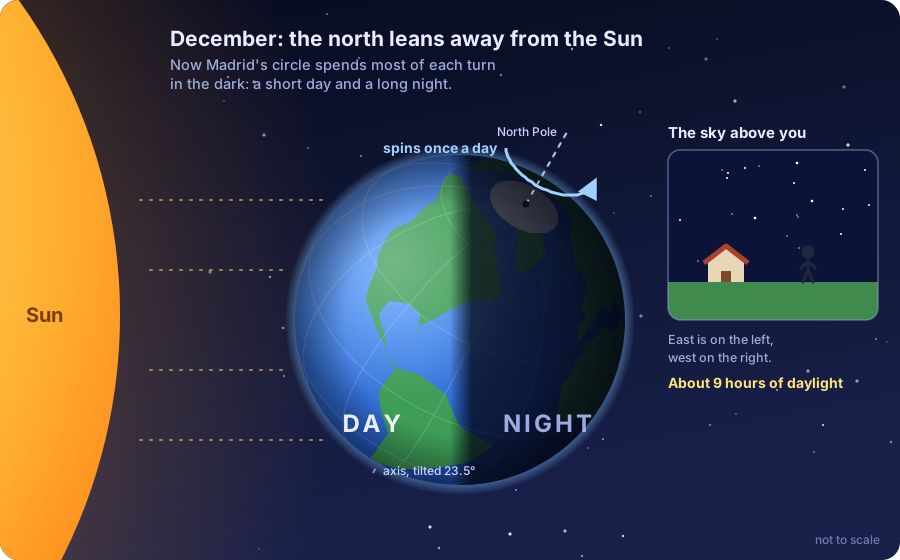
Now the bigger part of Madrid's circle is in the dark: about 9 hours of day and 15 hours of night.
In the southern half of the Earth it is the other way round. In December the south leans toward the Sun, so places there, like Melbourne in Australia, have long days.
Near the equator, and near the poles
The equator is the circle around the middle of the Earth. The line between day and night always goes through the middle of the Earth too, so, however the Earth leans, it cuts the equator into two equal halves. That is why Singapore, near the equator, has about 12 hours of day and 12 hours of night all year.
The farther a place is from the equator, the bigger the difference between its summer days and its winter days:
| Place | Longest day | Shortest day |
|---|---|---|
| Singapore, near the equator | about 12 hours | about 12 hours |
| Madrid, Spain | about 15 hours | about 9 hours |
| Oslo, Norway | almost 19 hours | about 6 hours |
| Tromsø, far north in Norway | the Sun doesn't set | the Sun doesn't rise |
Close to the North Pole the circles are small. Look at the top of the Earth in the June picture: the small circles there stay in the light for the whole turn, so the Sun is in the sky all day and all night. This is the midnight sun. In December the same circles stay in the dark for the whole turn, and the Sun doesn't come up at all: the polar night.
Try it at home
You need the lamp, the orange and the pencil axis from the Seasons lesson.
- Draw a line around the middle of the orange: the equator. Put a pen dot on it (Singapore), and another halfway between it and the top (Madrid).
- Tilt the top of the pencil toward the lamp and turn the orange slowly. The Madrid dot is in the light for more than half of the turn; the Singapore dot for half.
- Tilt the top away from the lamp and turn again. Now the Madrid dot is in the dark for more than half of the turn. The Singapore dot still has half and half.
Words to know
- midnight sun - when the Sun stays in the sky all day and all night, near the poles in summer
- polar night - when the Sun doesn't come up all day, near the poles in winter
Big idea
Half of the Earth is always lit. Because the axis is tilted, the line between day and night cuts most places' daily circle into two unequal parts. When the northern half leans toward the Sun, places there have long days and short nights; when it leans away, short days and long nights. Near the equator, day and night stay about 12 hours each all year.