Small Worlds
You are out on a dark night, and suddenly a streak of light flashes across the sky and is gone in a second. People call it a shooting star. But it isn't a star at all. It is a tiny piece of one of the solar system's smallest members.
The Sun's family is not only the Sun and eight planets. Millions of smaller worlds go around the Sun too.
Asteroids
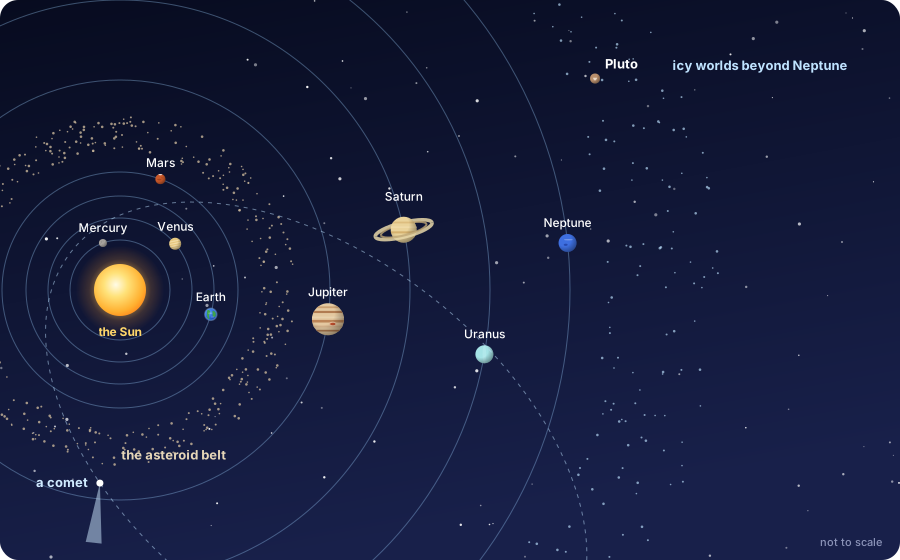
Asteroids are lumps of rock and metal, far too small to be planets. Most are no bigger than a town, and many are the size of a house or smaller. Most of them go around the Sun between Mars and Jupiter, in a wide ring called the asteroid belt.
In films, spaceships dodge between asteroids packed close together. The real belt is mostly empty space: spacecraft have flown through it many times without coming near a single asteroid.
Pluto and the dwarf planets
When Pluto was found in 1930, beyond Neptune, it was called the ninth planet. But Pluto is small, smaller than our Moon. And later, astronomers found many more icy worlds out there, some almost as big as Pluto.
So in 2006 astronomers made a new group. A dwarf planet is round and goes around the Sun like a planet, but it is too small to have cleared its path of other worlds: it shares its part of the solar system with many others. Pluto is a dwarf planet, and so is Ceres, the biggest asteroid.
In 2015 a spacecraft called New Horizons flew past Pluto. Its photos showed icy mountains, and a big, pale plain shaped like a heart.
Comets
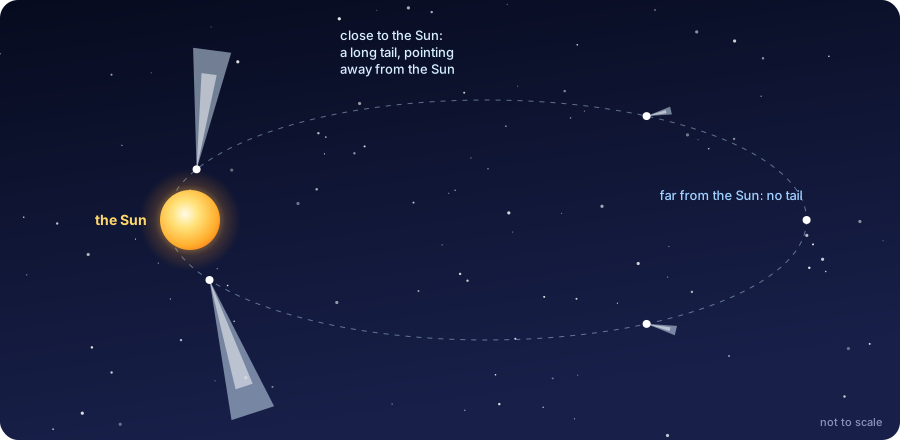
A comet is a lump of ice and dust, a few kilometres wide, like a dirty snowball. Most of the time comets are far out in the cold, beyond the planets. But some have long, stretched orbits that bring them close to the Sun.
As a comet gets near the Sun, the heat turns some of its ice into gas. The gas and dust stream out into a long, glowing tail, millions of kilometres long. The tail always points away from the Sun, blown back by the Sun's light and a wind of tiny bits coming from the Sun.
The most famous one, Halley's comet, comes back about every 76 years. It last came in 1986, and it will come again in 2061.
Shooting stars
Space is full of grains of dust and tiny pieces of rock, many left behind by comets. The Earth runs into them all the time, very fast. When one hits the Earth's air, it heats up and burns in a flash of light high in the sky. That flash is a meteor, the real name for a shooting star. Most are no bigger than a grain of sand.
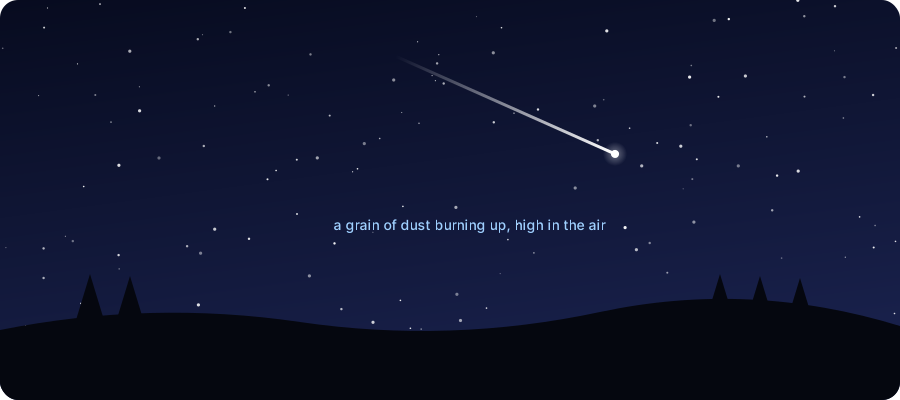
Now and then a bigger piece doesn't burn up completely, and what is left lands on the ground. A space rock that reaches the ground is a meteorite.
Try it tonight
On some nights each year the Earth passes through the dust a comet left behind, and you can see many shooting stars in an hour: a meteor shower. Two of the best are the Perseids, around 12 August, and the Geminids, around 14 December. Go somewhere dark, lie on your back, give your eyes 20 minutes to get used to the dark, and watch the whole sky. No telescope needed.
Words to know
- asteroid - a lump of rock and metal going around the Sun, much smaller than a planet
- asteroid belt - the ring between Mars and Jupiter where most asteroids are
- dwarf planet - a round world that goes around the Sun but shares its path with many other worlds, like Pluto
- comet - a lump of ice and dust that grows a long tail when it comes near the Sun
- meteor - a shooting star: a grain from space burning up in the Earth's air
- meteorite - a piece of space rock that reaches the ground
Big idea
Besides the planets, millions of small worlds go around the Sun: rocky asteroids, icy dwarf planets like Pluto, and comets that grow tails near the Sun. Shooting stars are tiny grains from space burning up in the Earth's air.