The Giant Planets
Past Mars, the solar system changes. The next four planets are not small rocky balls. They are giants: put all four rocky planets side by side, and Jupiter alone is still almost four times as wide.
Four giants
The four planets farthest from the Sun are Jupiter, Saturn, Uranus and Neptune. They are called the giant planets.
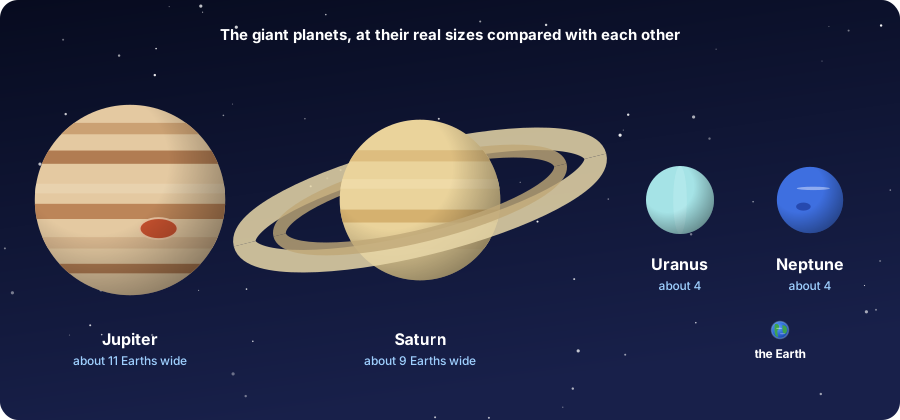
They are not made of rock like the Earth. They are made mostly of gas, deeper and thicker the farther down you go. They have no ground to stand on: a spaceship that tried to land would sink deeper and deeper into thicker and hotter gas until it was crushed. What we see from far away are the tops of their clouds.
Jupiter: the biggest
Jupiter is the biggest planet. It is about 11 times as wide as the Earth, and more than 1,000 Earths could fit inside it.
Its clouds make coloured stripes. In them is the Great Red Spot, a storm wider than the whole Earth, which has been blowing for more than 150 years.
Saturn: the rings
Saturn is about 9 times as wide as the Earth. It is famous for its bright rings. They look solid from far away, but they are made of countless pieces of ice and rock, from specks of dust to lumps as big as a house, all going around Saturn.
For its size, Saturn is very light. If you had a bath big enough to put it in, Saturn would float.
Uranus and Neptune: the cold ones
Uranus and Neptune are each about 4 times as wide as the Earth. They are so far from the Sun that they are freezing cold, and they are made of gas and slushy ice. Both look blue.
Uranus is tipped right over on its side, so it rolls around the Sun like a ball. Remember from the Seasons lesson: the Earth's tilt of about 23 degrees gives us summer and winter. Uranus is tilted so far that each of its poles has about 42 years of sunshine, then about 42 years of darkness.
Neptune, the farthest planet, has the fastest winds in the solar system, about 2,000 kilometres an hour. Its orbit is so long that, since it was found in 1846, it has gone around the Sun only once.
Rings and many moons
All four giants have rings, though only Saturn's are bright. And all four have many moons: Jupiter has nearly a hundred that we know of, and Saturn more than 250. Jupiter's biggest moon, Ganymede, is bigger than the planet Mercury.
Try it tonight
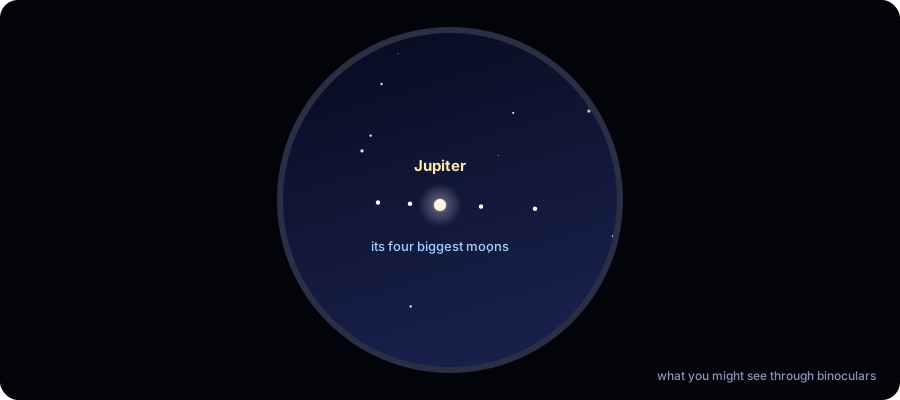
If Jupiter is in the sky (a planet app shows when), look at it through a pair of binoculars. Hold them very still: rest your elbows on a wall or a car roof. Next to the bright dot of Jupiter you may see up to four tiny dots in a line. They are Jupiter's four biggest moons, the same ones Galileo saw with his telescope in 1610. Look again the next night: they will have moved.
Words to know
- giant planets - Jupiter, Saturn, Uranus and Neptune: huge planets made mostly of gas, with no solid ground
- rings - countless pieces of ice and rock going around a planet in a thin, flat band
Big idea
The four planets farthest from the Sun - Jupiter, Saturn, Uranus and Neptune - are giants made mostly of gas, with no ground to stand on. All of them have rings and many moons.