Eclipses
On 8 April 2024, in the middle of the day, the sky over parts of Mexico, the United States and Canada went dark. Street lights came on. Birds stopped singing. Stars came out in the daytime. A few minutes later the daylight came back.
Nothing was wrong with the Sun. Something got in its way.
Every ball in space has a shadow
Hold your hand in the sunshine and it throws a shadow on the ground. The Earth and the Moon do the same. Each one is lit by the Sun on one side, and each one throws a long shadow out into space on the other side, pointing away from the Sun.
Most of the time these shadows fall on nothing at all. An eclipse happens when the Sun, the Earth and the Moon line up, and one of the shadows falls on the Earth or on the Moon.
The Moon hides the Sun
Sometimes the Moon passes exactly between the Sun and the Earth. Its shadow falls on a small part of the Earth. For people standing there, the Moon covers the Sun. That is a solar eclipse ("solar" means "of the Sun").
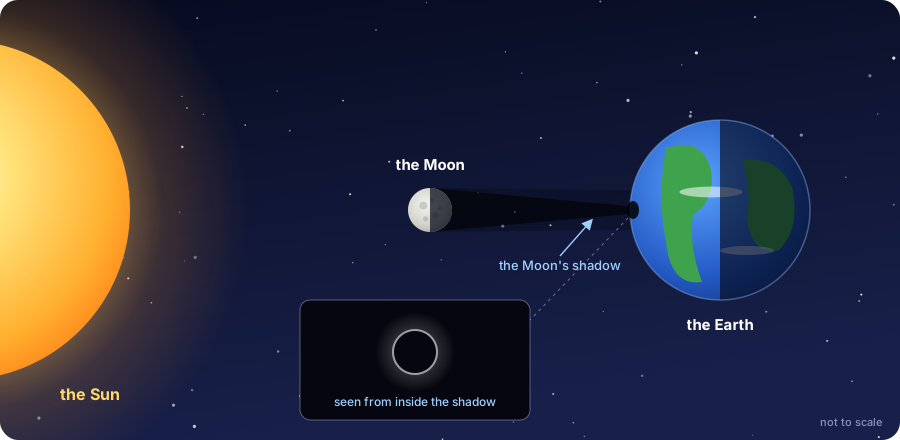
When the Moon covers the whole Sun, it is a total eclipse: the sky goes dark for a few minutes, and a faint white glow appears around the black Moon. Outside the middle of the shadow, people see the Moon cover only part of the Sun.
The Moon is between the Earth and the Sun at new moon, which we met in the Phases of the Moon lesson. So a solar eclipse can only happen at new moon.
Careful
Even when most of the Sun is covered, the small part left can hurt your eyes. Only look at an eclipse through special eclipse glasses made for it. Sunglasses are not enough.
Just the right size
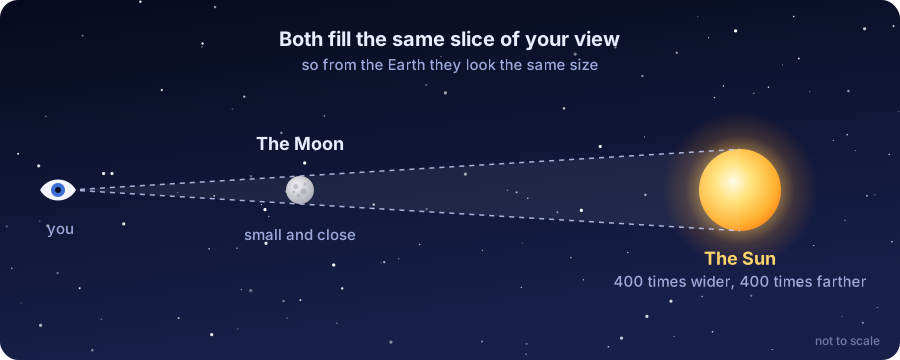
There is a lucky accident here. The Sun is about 400 times wider than the Moon, but it is also about 400 times farther away. So in the sky the two look almost exactly the same size, and the small Moon can cover the huge Sun just right.
The Earth's shadow on the Moon
Sometimes it is the other way round. The Earth passes exactly between the Sun and the Moon, and the Moon moves into the Earth's shadow. That is a lunar eclipse ("lunar" means "of the Moon").
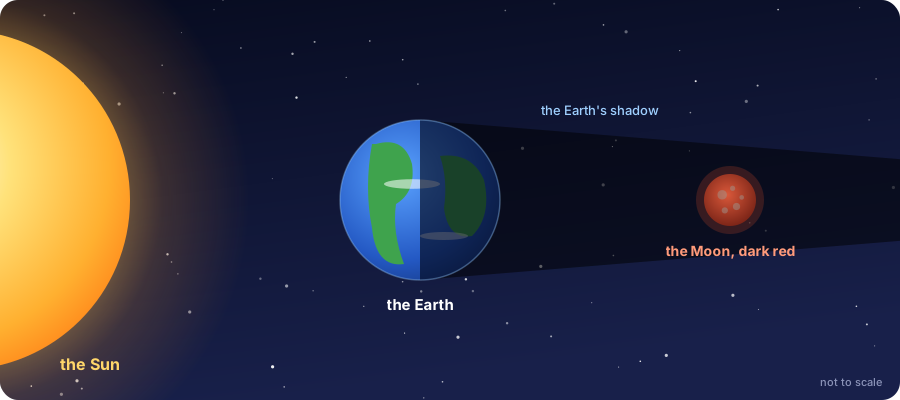
The Moon is on the far side of the Earth from the Sun at full moon. So a lunar eclipse can only happen at full moon. It lasts much longer than a solar eclipse, often more than an hour, and everyone on the night side of the Earth can see it. It is safe to watch with your eyes.
The Moon doesn't go black. It turns a dark red, like a copper coin. A little sunlight still reaches it: it passes through the Earth's air on the way, and the air lets red light through better than other colours. It is the same reason sunsets are red. During a lunar eclipse, the Moon is lit by all the sunrises and sunsets on the Earth at once.
Why not every month?
There is a new moon and a full moon every month. So why don't we get two eclipses every month?
Because the Moon's path around the Earth is tilted a little, about 5 degrees. Most months, at new moon the Moon passes a little above or below the Sun, and its shadow misses the Earth. At full moon it passes a little above or below the Earth's shadow. Only a few times a year do they line up exactly.
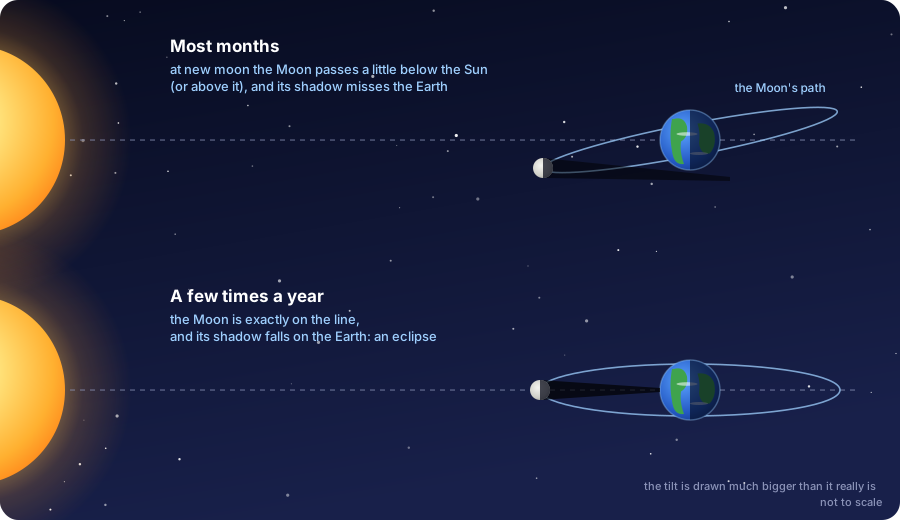
A total solar eclipse comes to some place on the Earth about every year and a half. But the Moon's shadow is small, so for any one town it is very rare: on average, about once in a few hundred years.
Try it at home
You need the lamp (the Sun), the orange (the Earth) and a grape or a small ball (the Moon).
- In a dark room, hold the orange near the lamp.
- Move the grape behind the orange, into its shadow: the grape goes dark. That's a lunar eclipse.
- Now move the grape between the lamp and the orange. Look for its small shadow on the orange: anyone standing in that shadow would see a solar eclipse.
- Move the grape a little higher or lower, and the shadows miss. That is what happens most months.
Words to know
- eclipse - when the Sun, the Earth and the Moon line up and a shadow falls on the Earth or the Moon
- solar eclipse - the Moon passes between the Sun and the Earth and hides the Sun
- lunar eclipse - the Earth passes between the Sun and the Moon, and its shadow falls on the Moon
Big idea
An eclipse is a shadow. In a solar eclipse the Moon's shadow falls on the Earth, at new moon. In a lunar eclipse the Earth's shadow falls on the Moon, at full moon. The Moon's tilted path means they only line up a few times a year.