How Big Is the Solar System?
In books and posters, the planets sit in a neat row next to the Sun, big and close together. Those pictures have to squeeze everything in to fit on one page. The real solar system looks nothing like that. It is almost all empty space.
The numbers are too big to picture: the Earth is about 150 million kilometres from the Sun. So let's shrink everything instead.
Shrink the Sun to a football
Imagine the Sun shrunk down to the size of a football, about 20 centimetres across. Shrink everything else by the same amount. How big is the Earth, and where is it?
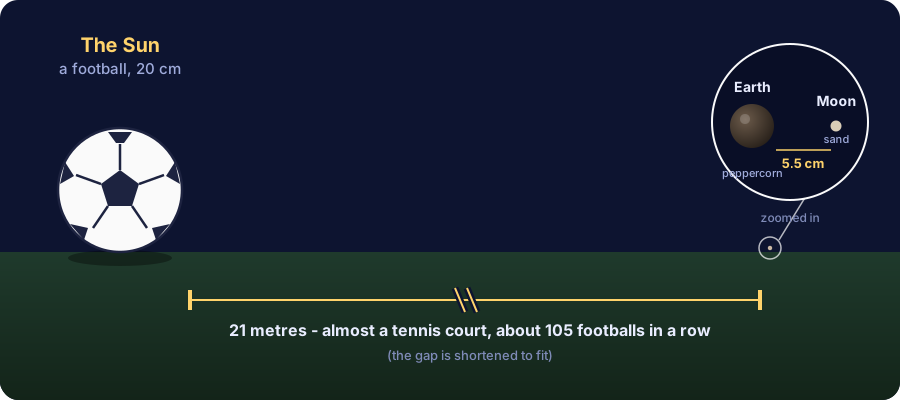
The Earth is a peppercorn, 21 metres away from the football: almost the length of a tennis court. The Moon is a grain of sand, about 5 and a half centimetres from the peppercorn.
Remember from the Earth lesson: 109 Earths side by side would stretch across the Sun. Here you can see it: a peppercorn next to a football.
Walk to the planets
Now put the football in a big park, and walk away from it in a straight line. Take steps of about a metre each.
| Planet | Its size | Steps from the football |
|---|---|---|
| Mercury | a pinhead | 8 |
| Venus | a peppercorn | 15 |
| Earth | a peppercorn | 21 |
| Mars | a pinhead | 33 |
| Jupiter | a grape | 112 |
| Saturn | a smaller grape | 206 |
| Uranus | a pea | 412 |
| Neptune | a pea | 648 |
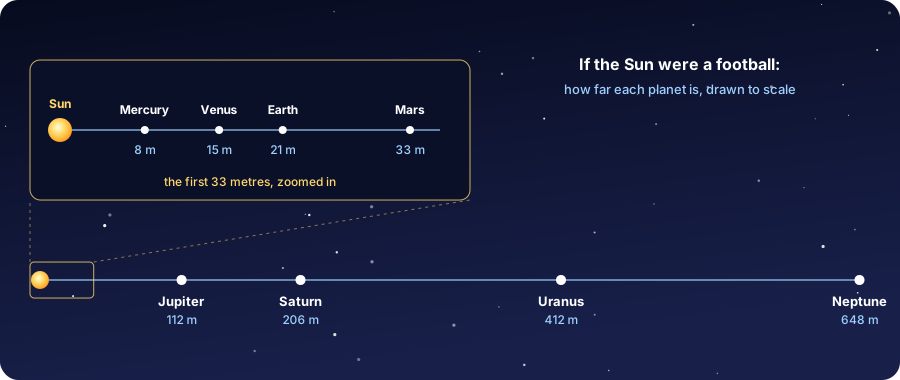
The four rocky planets are all within 33 steps of the football. Then the gaps grow huge. To reach Neptune you walk about 650 metres, and on the whole walk you pass only eight tiny things: two pinheads, two peppercorns, two grapes and two peas. Everything else is empty space.
How far is the nearest star?
The Sun is a star. How far is the next star, in our football model?
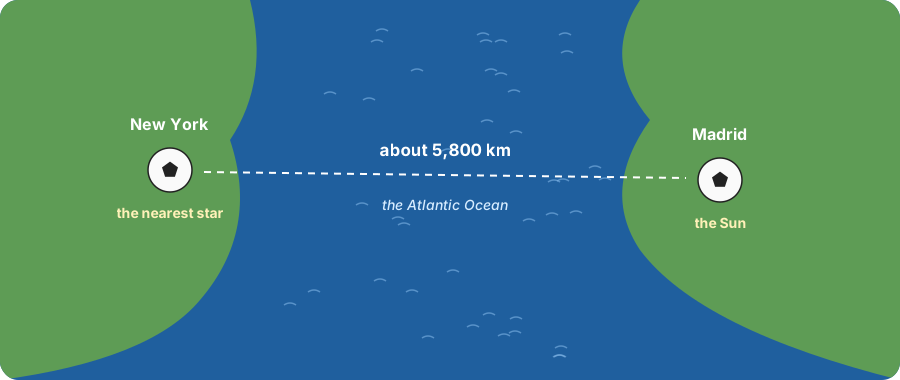
Put the football in Madrid, in Spain. The nearest star would be another football in New York, on the other side of the Atlantic Ocean, about 5,800 kilometres away. And between the two, nothing but a few peas and peppercorns near each football.
Light takes time
Light is the fastest thing there is. But even light takes time to cross the solar system. Sunlight takes about 8 minutes to reach the Earth. So when you see the Sun, you see it as it was 8 minutes ago. Light from the Sun takes about 4 hours to reach Neptune.
Try it at home
Make the model yourself, in a park or along a long, quiet street.
- Put down a football (or any ball about 20 centimetres across): the Sun.
- Walk 8 big steps and put down a pin: Mercury. Then 7 more steps for a peppercorn, Venus, and 6 more for another peppercorn, Earth.
- 12 more steps, a pin: Mars. Then keep walking: 79 more steps to a grape, Jupiter.
- Turn around and look back at the football. Then try to imagine walking on to Neptune, more than half a kilometre from the start.
Words to know
- scale model - a copy of something with every size and distance shrunk by the same amount
Big idea
The solar system is almost all empty space. If the Sun were a football, the Earth would be a peppercorn 21 metres away, Neptune a pea about 650 metres away, and the nearest star another football thousands of kilometres away.