Phases of the Moon
Look at the Moon on a few evenings in a row. One week it is a thin curve, like a fingernail. A week later it is a half circle. A week after that it is a whole bright circle. Then it gets thinner again, until for a few nights you can't see it at all.
The Moon is a ball of rock. Rock doesn't grow and shrink. So why does the Moon seem to change shape?
The shapes of the Moon
The shapes come in the same order every month:
- New moon - you can't see the Moon at all.
- Crescent - a thin curve of light.
- Half moon - half of a circle.
- Full moon - a whole bright circle.
After the full moon the shapes come back in the opposite order: half moon, crescent, and new moon again. The changing shapes of the Moon are called its phases.
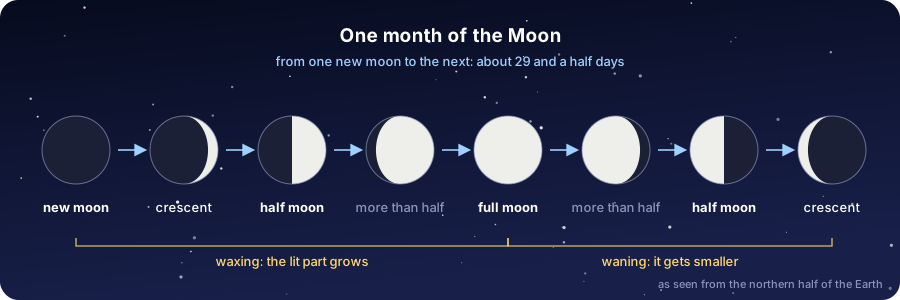
From new moon to full moon, the lit part grows. We say the Moon is waxing (growing). From full moon back to new moon, it shrinks. We say it is waning (getting smaller).
Half of the Moon is always lit
Remember from the Moon lesson: the Moon makes no light of its own. The Sun lights it, and the Sun always lights one half of the Moon, the half facing the Sun. The other half is dark.
So the Moon never really changes. What changes is how much of its lit half we can see from the Earth.
It depends where the Moon is
The Moon goes around the Earth about once a month. Follow it around, in the picture below. The Sun is far away on the left, so its light comes from the left onto the Earth and onto the Moon at every point of the trip.
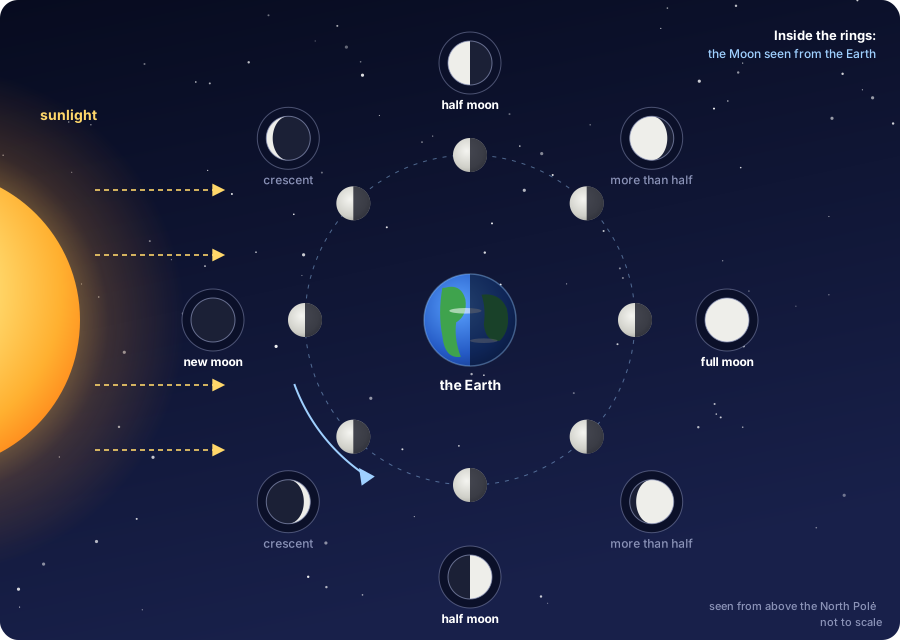
- When the Moon is between the Earth and the Sun, its lit half faces the Sun, away from us. We look at its dark half, so we see nothing: new moon.
- A week later the Moon has gone a quarter of the way around. Now we look at it from the side. We see half of its lit half: a half moon.
- Another week later the Moon is on the far side of the Earth from the Sun. Its lit half faces us, so we see all of it: full moon.
- In the last week the Moon comes back around, and we see less and less of its lit half, until it is new moon again.
That is also why a full moon rises just as the Sun sets. At full moon the Sun and the Moon are on opposite sides of the Earth. When your side of the Earth turns away from the Sun in the evening, it turns toward the Moon.
It isn't the Earth's shadow
Many people think the dark part of the Moon is the Earth's shadow falling on it. It isn't. Look at the picture again: at a half moon, the Moon is off to one side, and the Earth's shadow points away from the Sun, nowhere near the Moon. The dark part is simply the Moon's own night side, the half the Sun isn't lighting.
(Sometimes the Earth's shadow really does fall on the Moon. That is something different, and it is the next lesson.)
One month
From one full moon to the next takes about 29 and a half days. For thousands of years people used this to count time. The word month comes from the word "moon".
If you live in the southern half of the Earth, for example in Australia or Argentina, the Moon looks the other way round: a growing crescent is lit on its left side, not its right. The phases come in the same order everywhere.
Try it at home
You need the lamp (the Sun) and the orange (the Moon). This time your head is the Earth.
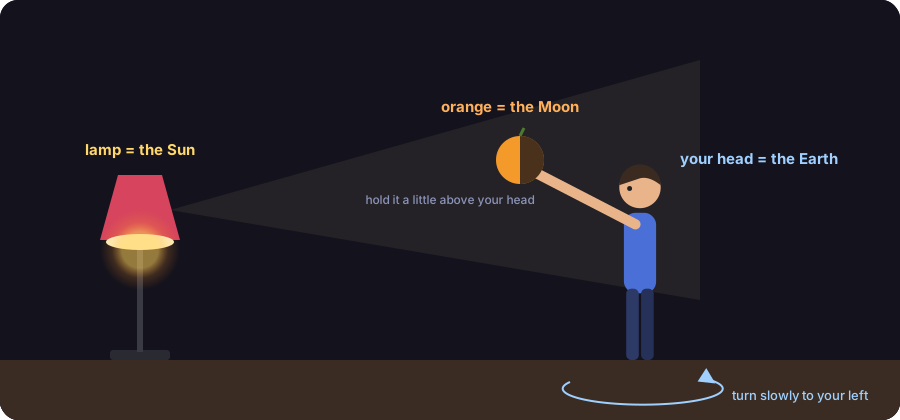
- Put the lamp on one side of a dark room. Stand a few steps away from it.
- Hold the orange at arm's length, a little above your head, so your head doesn't block the light.
- Face the lamp, with the orange in front of it: you see its dark side. That's new moon.
- Turn slowly to your left, keeping the orange in front of your face. Watch a thin crescent of light appear on it, then a half, then, with your back to the lamp, a full orange.
- Keep turning until you face the lamp again. The light shrinks back to nothing.
One full turn of your body is one month.
Words to know
- phases - the changing shapes of the Moon through the month
- new moon - when the Moon is between the Earth and the Sun, and we can't see it
- full moon - when the Moon is on the far side of the Earth from the Sun, and we see all of its lit half
- crescent - a thin curve of the Moon
- waxing / waning - the lit part of the Moon growing / getting smaller
Big idea
The Sun always lights half of the Moon. As the Moon goes around the Earth, we see more or less of that lit half, from none (new moon) to all of it (full moon) and back again, about every 29 and a half days.